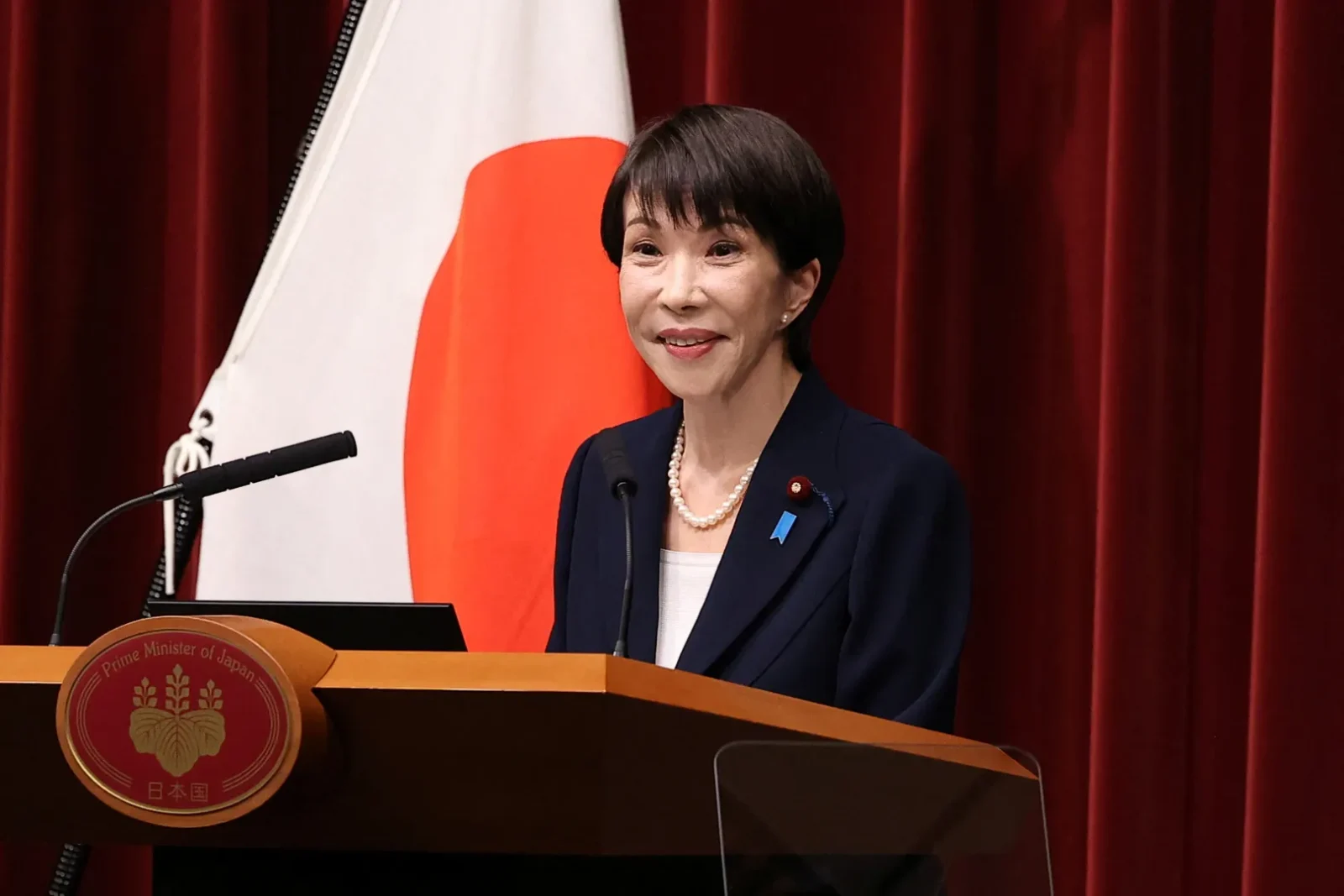
When Sanae Takaichi secured Japan’s largest Lower House election victory since World War Two on February 8, 2026, financial markets did not simply celebrate. They calculated. Within hours of her Liberal Democratic Party winning a supermajority of 316 seats, the benchmark Nikkei 225 soared past the 57,000 mark to a record high — and yet the yen wavered and Japanese government bond (JGB) yields ticked upward again, reviving the now-familiar “Takaichi trade”: equities up, bonds and yen under pressure. The pattern encapsulates the central dilemma facing Japan’s first female prime minister: how to deliver on a sweeping mandate for economic revival without alarming a bond market already on edge over the world’s highest public debt burden.
As legislative deliberations on her flagship spending and tax-cut plans kick off this week, Takaichi faces a formidable communication challenge. Her campaign slogan — “responsible, proactive fiscal policy” — was a political winner. Translating that phrase into credible economic policy, however, is proving far harder. The contradiction embedded in the slogan itself is now Japan’s most pressing policy problem.
Build the future you deserve. Get started with our top-tier Online courses: ACCA, HESI A2, ATI TEAS 7, HESI EXIT, NCLEX-RN, NCLEX-PN, and Financial Literacy. Let Serrari Ed guide your path to success. Enroll today.
A Landslide Mandate, But A Nervous Market
Takaichi’s ascent to the prime ministership in October 2025 immediately unsettled markets. Investors fretted over how a nation labouring under the developed world’s highest debt-to-GDP ratio — approaching 263% by some IMF estimates — would fund her ambitious spending and tax-cut agenda. JGB yields surged, the yen fell toward historic lows, and the phrase “bond vigilantes” re-entered mainstream financial commentary for the first time in a generation.
The situation worsened in January 2026 when Takaichi unveiled a ¥21.3 trillion stimulus package — dubbed “Sanaeconomics” — and pledged to dissolve parliament and call a snap election. On January 20, the yield on the 40-year JGB catapulted to 4.24%, breaching the 4% threshold for the first time in over three decades. The 30-year JGB yield also hit 3.92%. Masahiko Loo, senior fixed income strategist at State Street Investment Management, described it as a revival of “the classic ‘Takaichi trade’ dynamic of stronger Nikkei, weaker JGBs and yen.”
Her landslide February election win helped stabilize markets somewhat. The new bond issuance for fiscal 2026 was held below the landmark 30 trillion yen mark for the second straight year, reducing the proportion of the budget financed by fresh debt to a nearly three-decade low. Finance Minister Satsuki Katayama’s post-election comments supporting yen stability also helped, nudging the yen to briefly strengthen 0.4% to 156.55 against the dollar. But the calm is tenuous — investors remain acutely alert to any signal that Takaichi might expand fiscal outlays further.
The Food Tax Pledge: Relief Measure or Fiscal Risk?
Central to Takaichi’s economic pitch is her pledge to suspend Japan’s 8% food consumption tax for two years. Framed as essential relief for households battered by persistent inflation, the proposal proved an effective vote-winner. Persistently rising food prices put pressure on household spending throughout 2025, with average real monthly wages recording year-on-year declines. For ordinary Japanese consumers, the food tax cut offered tangible, immediate relief.
But the proposal alarmed fiscal watchdogs and market participants alike. A Reuters poll found nearly 60% of economists were highly or somewhat concerned by the proposed two-year tax suspension, while a separate Reuters survey showed two-thirds of firms were worried about Takaichi’s loose fiscal stance. The concern is not merely about the direct revenue loss from a food tax suspension — it is about what the move signals regarding the administration’s broader appetite for fiscal discipline in a country that can ill afford to lose it.
Takaichi has sought to reassure sceptics by pledging that the Finance Ministry will not issue new bonds to cover the revenue gap. Her administration has said it intends to fund the initiative through a mix of subsidies, special tax measures, and non-tax revenues. Whether that commitment holds under legislative pressure remains to be seen.
The IMF Issues a Stark Warning
The International Monetary Fund added its authoritative voice to the concerns on February 18, 2026, in its 2026 Article IV concluding statement on Japan. The fund urged Japan to avoid reducing the consumption tax, calling it “an untargeted measure that would erode fiscal space and add to fiscal risks.” The IMF’s mission chief for Japan, Rahul Anand, told reporters that Japan should not be loosening its fiscal policy when debt servicing and welfare costs are likely to keep increasing and eventually add to the nation’s already elevated debt level.
The IMF’s warning carried a quantitative dimension that underscored the urgency. Interest rate payments are projected to double from 2025 to 2031 as debt is rolled over at higher yields. A quarter of Japan’s total spending is already funded by debt, with roughly half of that held by the Bank of Japan (BoJ) after years of heavy money printing. As the BoJ now tapers its bond buying and reduces the size of its balance sheet, the government must closely monitor market liquidity and shifting demand across investor classes.
A Morningstar analysis estimated that Japan’s interest servicing could rise from 9% of total expenditure to between 20% and 25% if JGBs are refinanced at an average yield of 2.0% to 2.5% over the next nine years. That is a deeply uncomfortable trajectory for a government already running a large structural deficit and managing the world’s most indebted developed economy.
The IMF also called on Japan to develop a credible medium-term fiscal framework with a “clearly defined fiscal anchor” and to restrict the use of supplementary budgets to genuine emergency situations. It recommended that the Bank of Japan continue raising rates gradually toward a neutral level by 2027, emphasising that the central bank’s independence and credibility must be preserved — a pointed signal given Takaichi’s past public comments advocating for sustained low rates.
Weak GDP Data Fuels the Spending Argument — and the Risk
Ironically, Japan’s dismal economic performance in Q4 2025 has strengthened Takaichi’s case for fiscal stimulus, even as it adds to the complexity of her position. Japan’s real GDP grew just 0.2% on an annualized basis in the October–December quarter, a stark miss against the Reuters consensus forecast of 1.6% expansion. On a quarterly basis, output rose just 0.1%, reversing a 0.7% contraction in Q3 but falling well short of expectations.
Private consumption, which accounts for more than half of Japan’s GDP, rose a mere 0.1% — the weakest performance in a year. Business investment climbed only 0.2%, far below forecasts of 0.8%. Exports fell 0.3%, hurt in part by US tariff pressures and a diplomatic chill with China following Takaichi’s controversial remarks about Taiwan. For the full year 2025, Japan’s economy grew 1.1% — a recovery after a 0.2% contraction in 2024, but one that reveals an economy still struggling to regain durable momentum.
“PM Takaichi’s efforts to reflate the economy via looser fiscal policy look prescient,” said Marcel Thieliant, head of Asia-Pacific at Capital Economics, reflecting a view that the GDP miss makes fiscal activism more justifiable. Yet analysts cautioned that whether Japan can achieve sustainable growth depends critically on whether real wages can firmly return to positive growth — something that has not yet materialized.
One decision can change your entire career. Take that step with our Online courses in ACCA, HESI A2, ATI TEAS 7, HESI EXIT, NCLEX-RN, NCLEX-PN, and Financial Literacy. Join Serrari Ed and start building your brighter future today.
The ‘Sanae-nomics’ vs. Abenomics Comparison
Observers have drawn frequent comparisons between Takaichi’s economic platform and the legacy of her political mentor, former Prime Minister Shinzo Abe. Toru Nakazato, associate professor at Sophia University, argued that the comparison is more nuanced than it appears. Like Abe before her, Takaichi is widely perceived as an advocate of big spending — but the actual fiscal record tells a different story.
Abe was also seen by markets as an expansionary spender, yet he ultimately refrained from ramping up expenditure and actually raised the consumption tax. “It’s true Sanae-nomics carries over some aspects of Abenomics. But the fact is, Abe did not expand fiscal spending much. Takaichi’s policies aren’t fiscally expansionary either. That is where there are similarities,” Nakazato said. He added that “there is a huge gap between her actual policies, and how they are perceived by media and markets. Filling that gap may be among her biggest challenges.”
The fiscal 2026 budget, drafted during the height of the market turbulence in January, supports this interpretation. While the total budget hit a record $783 billion, much of the increase in expenditure came from local allocation tax grants and debt-servicing costs — items that rise in tandem with higher tax revenues and bond yields, not from new discretionary spending decisions. Japan’s primary deficit for 2025 was estimated to have been smaller than in 2019 before the pandemic, and among the smallest in the G7 advanced economies.
Bond Markets: Structurally Exposed, Politically Constrained
Beneath the political drama lies a structural vulnerability that no amount of rhetoric can fully paper over. Japan has benefited for decades from interest rates averaging around 0.33% between 2016 and 2025. With the 10-year JGB yield now trading above 2.2%, the refinancing dynamics of Japan’s vast debt stock have fundamentally changed. The Bank of Japan’s shift from ultra-loose policy to gradual tightening — having raised its short-term policy rate to 0.75% in December 2025 — has removed the artificial floor beneath bond prices.
The mega-banks — Mitsubishi UFJ, Sumitomo Mitsui, and Mizuho — find themselves in a double-edged scenario. Higher yields boost their net interest margins but trigger large valuation write-downs on existing bond portfolios. Japan’s life insurance sector faces greater acute distress: unrealised losses on domestic bond portfolios swelled to an estimated $60 billion in early 2026, forcing a strategic retreat from foreign holdings and a pivot toward the now-attractive domestic yields.
David Boling, principal at The Asia Group, a firm that advises companies on geopolitical risk, put the challenge plainly: “‘Responsible, proactive fiscal policy’ was a winning campaign slogan. But turning it into policy will be harder. The idea contains built-in contradictions. And boosting spending while cutting taxes risks fuelling inflation.” He argued that Takaichi “needs to focus on the ‘responsible’ part of her fiscal policy. That emphasis would reassure the JGB market.”
Takaichi’s Tightrope: Investment Without Profligacy
Takaichi has been careful to frame her agenda not as deficit spending but as investment-led growth. “The reason why Japan’s potential growth rate remains stagnant is an enormous shortage of domestic investment,” she told reporters on February 19. “It’s not as if the government will ramp up spending. Rather, it must coordinate with the private sector.”
Her government’s fiscal 2026 economic package emphasises investment incentives in semiconductors, artificial intelligence, defence, and green energy — areas where the administration argues private-public coordination can lift Japan’s long-term growth potential without excessive reliance on debt issuance. The ¥21.3 trillion stimulus package unveiled in November 2025 included energy subsidies, cash handouts, and investment incentives, alongside funds for expanded defence spending to 2% of GDP — a target driven in part by the administration’s security concerns about China’s military activities in the region.
Takaichi has also reaffirmed that Japan’s debt-to-GDP ratio needs to be stably lowered to achieve sustainable fiscal policy and market trust. Her administration points to the fact that the primary deficit is declining and that the budget’s debt-financed proportion is at a three-decade low as evidence that fiscal discipline is being maintained. “In guiding economic policy, we are mindful of the importance of fiscal sustainability and will remain so,” she reiterated upon her re-election as premier.
Still, the administration faces a structural headwind. As the BoJ continues to taper bond purchases, domestic institutional demand for JGBs — long a reliable buyer base — could shift. The IMF has warned that if heightened volatility undermines liquidity, the Bank of Japan should be prepared to make targeted emergency interventions, such as emergency bond-buying operations. That is a contingency measure, not a policy solution — and one that would risk stoking the very inflation the BoJ is now trying to contain.
The Geopolitical Dimension
Japan’s fiscal challenges are compounded by a complex geopolitical environment. US tariffs imposed on Japanese goods in September 2025 — a 15% baseline rate — contributed to the export weakness in Q3 and continued to weigh on trade in Q4. Japan and the US are reportedly accelerating talks on a $550 billion investment deal amid tariff pressure, a negotiation that carries major implications for Japan’s trade-dependent economy.
Relations with China have also deteriorated. Takaichi’s remarks on Taiwan prompted Beijing to issue travel advisories and study-abroad alerts, directly hurting inbound Chinese tourism and contributing to the export slump. Chinese tourists were once a vital driver of Japan’s hospitality and retail sectors, and their sharp decline in Q4 added to the GDP shortfall.
Defence spending is another escalating fiscal variable. Takaichi’s pledge to increase Japan’s defence budget to 2% of GDP — driven by security concerns about China and North Korea — will add significant fiscal pressure over the coming years, even if funded in part through new revenue sources such as proposed stamp duties on real estate purchases by non-Japanese citizens.
Outlook: A Narrow Path
Takaichi’s administration enters the legislative session with a strong democratic mandate, a record budget, and a clear economic vision. But the path from vision to execution runs through a bond market that has demonstrated — repeatedly — its willingness to punish fiscal missteps with swift and painful repricing.
The IMF’s projection that the BoJ’s policy rate should reach a neutral level by 2027, combined with the doubling of debt servicing costs by 2031, sets the parameters clearly. Japan’s economy is projected to remain above potential in 2026, offering Takaichi a brief window of relatively favourable growth conditions in which to push through structural reforms. But the window will not stay open indefinitely — and wasting it on poorly targeted fiscal stimulus could leave Japan exposed to exactly the kind of “range of shocks” the IMF has warned about.
Markets, for now, have given Takaichi a conditional benefit of the doubt. The Nikkei’s record highs and the modest post-election yen stabilisation suggest investors are willing to believe her “responsible” language — as long as it is backed by action. The legislative deliberations beginning this week will provide the first real test of whether the gap between Takaichi’s rhetoric and her policy record can be closed, or whether it will widen and trigger the next episode of the Takaichi trade.
Ready to take your career to the next level? Join our Online courses: ACCA, HESI A2, ATI TEAS 7 , HESI EXIT , NCLEX – RN and NCLEX – PN, Financial Literacy!🌟 Dive into a world of opportunities and empower yourself for success. Explore more at Serrari Ed and start your exciting journey today! ✨
Track GDP, Inflation and Central Bank rates for top African markets with Serrari’s comparator tool.
See today’s Treasury bonds and Money market funds movement across financial service providers in Kenya, using Serrari’s comparator tools.
photo source: Google
By: Montel Kamau
Serrari Financial Analyst
20th February, 2026