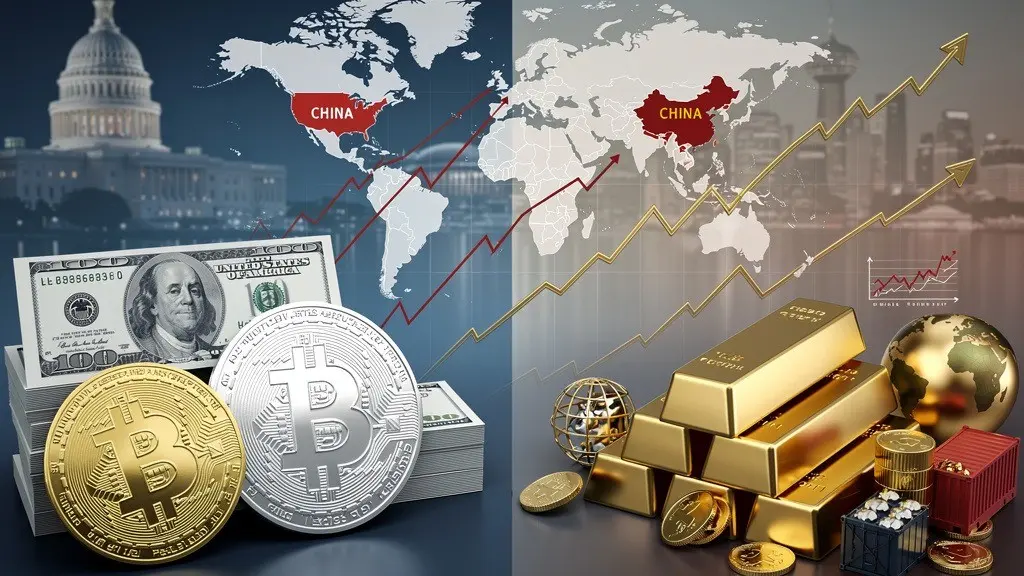
China is not staging a dramatic exit from US government debt — but it is clearly repositioning.
Over more than a decade, Beijing has steadily reduced its holdings of US Treasuries. The shift has been quiet, methodical, and incremental. Yet the cumulative effect is substantial: China’s share of foreign-held US Treasuries has fallen to 7.3%, the lowest level since 2001. In absolute terms, holdings have dropped from a peak above $1.3 trillion in 2013 to approximately $682.6 billion as of November 2025 — a reduction of roughly $627–$638 billion.
Simultaneously, China has increased its gold reserves to a record 2,308 tonnes, with purchases continuing for 15 consecutive months. Gold now accounts for roughly 5% of China’s $3.3 trillion in foreign exchange reserves, the highest share in its modern financial history.
The shift has sparked online claims that China is “dumping Treasuries” or “exiting the dollar system.” But the truth is more nuanced — and more important.
This article unpacks the strategic, economic, and geopolitical implications of China’s Treasury reduction, explores historical parallels, analyzes risks for both China and the United States, and assesses whether this signals a deeper transformation in the global financial order.
Build the future you deserve. Get started with our top-tier Online courses: ACCA, HESI A2, ATI TEAS 7, HESI EXIT, NCLEX-RN, NCLEX-PN, and Financial Literacy. Let Serrari Ed guide your path to success. Enroll today.
Understanding the Scale: What the Numbers Actually Mean
To properly assess the significance of China’s Treasury reduction, context is critical.
- China currently holds about $682.6 billion in US Treasuries.
- In 2013, that figure exceeded $1.3 trillion.
- Its share of foreign-held Treasuries has dropped from 28.8% in 2011 to 7.3% today.
- Foreign holdings overall reached a record $9.36–$9.4 trillion in November 2025.
- The total US Treasury market is worth approximately $30 trillion.
Foreign investors now own roughly 31% of all Treasuries — down from nearly 50% in 2015. However, this decline in share largely reflects the massive expansion in US government borrowing over the past decade.
In other words:
The Treasury market has grown faster than foreign holdings.
China’s reduction is real — but it is not happening in a vacuum.
How China Became America’s Largest Creditor
To understand today’s shift, we must revisit the era of rapid accumulation.
Between 2000 and 2013:
- China ran enormous trade surpluses with the United States.
- US consumers purchased large volumes of Chinese exports.
- Dollars flowed into China’s financial system.
- The People’s Bank of China (PBoC) accumulated foreign exchange reserves rapidly.
- Those reserves were primarily invested in US Treasuries.
This arrangement formed a powerful financial symbiosis:
- The US benefited from low borrowing costs.
- China maintained export competitiveness.
- Treasury purchases helped stabilize China’s currency.
- The global financial system reinforced dollar centrality.
By 2013, China’s Treasury holdings surpassed $1.3 trillion, making it the largest foreign creditor to the United States.
Why the Reduction Began (And Why It Was Inevitable)
China’s Treasury decline did not begin recently — it started gradually around 2013–2014.
Several structural forces drove the shift:
1. Slowing Reserve Accumulation
China’s current account surplus moderated as its economy rebalanced toward domestic consumption. Slower surplus growth meant fewer excess dollars to reinvest.
2. Capital Outflow Periods
Between 2015 and 2017, China experienced capital outflows amid currency depreciation concerns. The central bank used reserves to stabilize the yuan — selling Treasuries in the process.
3. Domestic Economic Strategy Shift
China began emphasizing:
- Reduced reliance on export-led growth.
- Increased internal demand.
- Technological self-sufficiency.
Treasury accumulation became less central to economic strategy.
4. Strategic Risk Awareness
As geopolitical tensions increased, concentration in US government debt became a vulnerability rather than a strength.
The Gold Accumulation Strategy: Financial Insurance in a Fragmenting World
Gold accumulation is perhaps the most symbolic and strategic element of China’s shift.
China now holds 2,308 tonnes of gold, worth approximately $370 billion. That represents about 5% of total reserves, the highest proportion on record.
Gold offers unique advantages:
- No counterparty risk.
- No default risk.
- No sanctions risk.
- No exposure to US fiscal policy.
- A hedge against currency debasement.
The 2022 freezing of approximately $300 billion in Russian reserves by Western governments after the Ukraine invasion fundamentally changed reserve management calculations.
For reserve managers globally, the message was clear:
Dollar reserves can be politically weaponized.
China appears to be responding not with panic — but with strategic hedging.
One decision can change your entire career. Take that step with our Online courses in ACCA, HESI A2, ATI TEAS 7, HESI EXIT, NCLEX-RN, NCLEX-PN, and Financial Literacy. Join Serrari Ed and start building your brighter future today.
Is This a De-Dollarization Strategy?
The term “de-dollarization” is often used loosely.
A true de-dollarization effort would require:
- Major trade settlement shifts away from dollars.
- Deep alternative capital markets.
- Global trust in another reserve currency.
- Liquid, transparent bond markets rivaling US Treasuries.
Currently, none of these conditions fully exist at scale.
Even as China reduces its Treasury holdings, it still holds nearly $683 billion — making it one of the largest foreign creditors.
Furthermore:
- The dollar remains dominant in global trade invoicing.
- The US Treasury market remains the deepest and most liquid.
- Alternatives such as the euro or yuan lack comparable structural depth.
This suggests not abandonment — but diversification.
Geopolitical Risk: The Taiwan and Sanctions Variable
Geopolitical tensions between the US and China have escalated over:
- Semiconductor export restrictions.
- Technology sanctions.
- Military presence in the Indo-Pacific.
- Taiwan sovereignty concerns.
In a worst-case geopolitical scenario, financial sanctions could be deployed.
By reducing Treasury concentration and increasing gold reserves, China lowers potential exposure.
However, aggressive Treasury liquidation would harm China itself:
- Selling large volumes would depress prices.
- Remaining holdings would lose value.
- Global financial instability would impact China’s own economy.
Thus, diversification is rational. Financial confrontation is unlikely.
Other Countries Are Also Diversifying
China is not alone in trimming Treasury exposure.
Reports indicate:
- Denmark’s AkademikerPension plans to sell approximately $100 million of Treasuries.
- A Dutch pension fund reduced holdings by about €10 billion.
- India and Brazil have adjusted allocations.
But total foreign holdings reached record highs — demonstrating that while diversification occurs, demand remains broad.
The global system is adjusting — not collapsing.
The US Perspective: Does China’s Shift Matter?
For the United States, China’s reduction raises two concerns:
1. Borrowing Costs
If major foreign buyers retreat, yields could rise — increasing fiscal pressure.
However:
- Domestic investors remain strong buyers.
- US banks, pensions, and funds hold significant volumes.
- The Federal Reserve retains powerful policy tools.
2. Fiscal Sustainability
The US deficit trajectory has accelerated Treasury issuance dramatically. Foreign share has declined partly because supply has expanded.
In effect, the US must ensure:
- Credible fiscal policy.
- Stable inflation.
- Sustained investor confidence.
China’s diversification adds pressure — but not a crisis.
Risk Scenarios
Scenario 1: Gradual Diversification (Base Case)
China continues slow reductions while increasing gold modestly.
The Treasury market remains stable.
The dollar retains dominance.
Scenario 2: Accelerated Geopolitical Shock
Major geopolitical escalation prompts rapid diversification.
Treasury yields spike temporarily.
Volatility increases.
Global markets react sharply.
However, such a move would be costly for China itself.
Scenario 3: Multipolar Reserve System Emerges
Over decades, gold and regional currencies gain incremental share.
The dollar remains dominant but less monopolistic.
This is the most plausible long-term structural evolution.
Historical Comparisons
Historically:
- Japan has adjusted Treasury holdings during domestic crises.
- Oil-exporting nations have shifted allocations during oil shocks.
- Emerging markets diversified post-2008 financial crisis.
None of these episodes resulted in Treasury collapse.
Reserve diversification is cyclical.
Structural displacement is rare.
Long-Term Outlook: Gradual Evolution, Not Disruption
China’s holdings at $682.6 billion represent significant exposure — but also meaningful diversification.
Gold at 5% of reserves is notable — but still modest relative to Western central bank gold shares.
The likely outcome:
- Continued incremental diversification.
- Rising gold allocations.
- Selective currency diversification.
- Continued reliance on dollar liquidity.
The global financial system may become more multipolar — but it will not become dollar-free.
Looking Ahead: Key Indicators to Monitor
- Monthly changes in China’s gold purchases.
- Treasury holdings reports from the US Treasury.
- Changes in yuan trade settlement share.
- US fiscal deficit expansion rates.
- Central bank reserve composition trends globally.
If China’s gold share rises toward 10% or higher, diversification is accelerating.
If Treasury holdings stabilize near current levels, portfolio adjustment may be largely complete.
Conclusion: Strategic Hedging in an Era of Uncertainty
China’s reduction of US Treasury holdings from over $1.3 trillion to approximately $683 billion represents a meaningful structural shift — but not a financial rupture.
Its share of foreign-held Treasuries at 7.3% is historically low.
Its gold reserves at 2,308 tonnes are historically high.
Its diversification strategy is deliberate and measured.
This is not a sudden financial divorce.
It is a long-term portfolio adjustment shaped by:
- Geopolitical tensions.
- Sanction risk awareness.
- Domestic economic rebalancing.
- Global reserve diversification trends.
The US Treasury market remains the world’s anchor.
The dollar remains dominant.
Foreign holdings remain high in nominal terms.
China is not exiting the system.
It is rebalancing within it.
And that distinction matters enormously.
Ready to take your career to the next level? Join our Online courses: ACCA, HESI A2, ATI TEAS 7 , HESI EXIT , NCLEX – RN and NCLEX – PN, Financial Literacy!🌟 Dive into a world of opportunities and empower yourself for success. Explore more at Serrari Ed and start your exciting journey today! ✨
Track GDP, Inflation and Central Bank rates for top African markets with Serrari’s comparator tool.
See today’s Treasury bonds and Money market funds movement across financial service providers in Kenya, using Serrari’s comparator tools.
photo source: Google
By: Elsie Njenga
17th February,2026