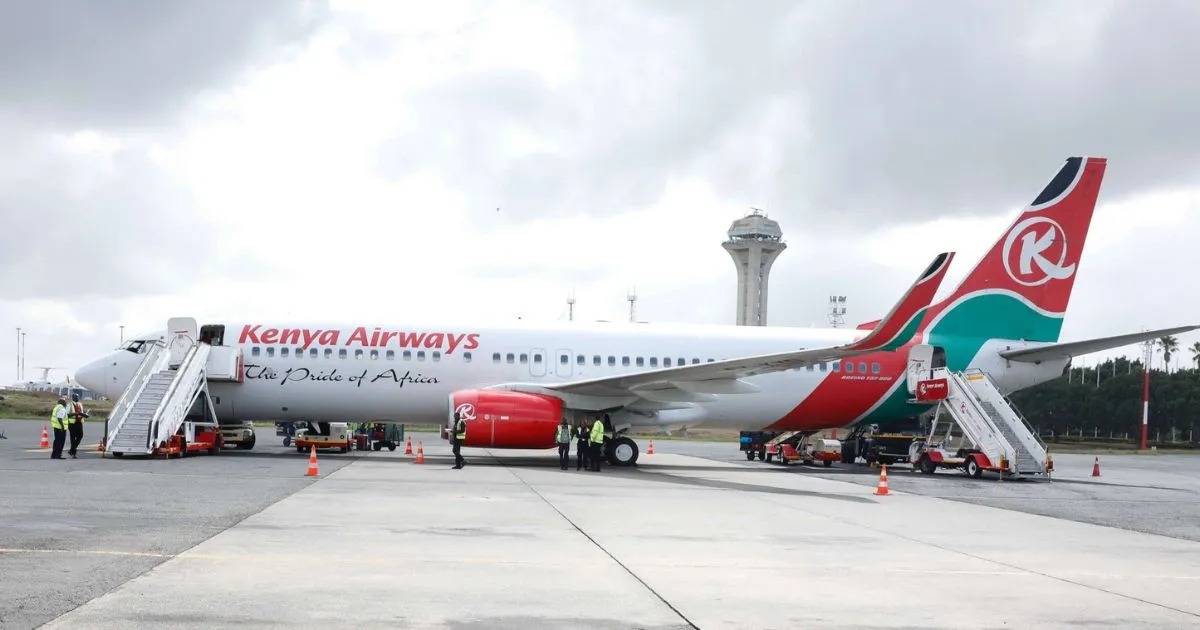
Kenya is once again attempting to reset the future of its national carrier. President William Ruto’s administration has announced plans to seek a strategic international investor for Kenya Airways (KQ) in a transaction that could inject between $1.2 billion (KSh 154.8 billion) and $2 billion (KSh 258 billion) into the airline. Treasury Cabinet Secretary John Mbadi confirmed that a global Expression of Interest (EOI) will be launched to identify a long-term strategic partner.
LIVENSE market summarySee NSE data →The announcement marks one of the most consequential privatization moves in Kenya’s recent economic history. It also reopens a long-running chapter in the story of Kenya Airways — a company that has oscillated between ambition, expansion, financial distress, restructuring, and repeated attempts at revival.
This time, however, the stakes are even higher. The proposed strategic sale is not only about saving a struggling airline. It is about fiscal sustainability, IMF commitments, aviation competitiveness, debt management, and Kenya’s positioning as East Africa’s aviation hub.
This article unpacks the financial structure behind the deal, revisits the airline’s restructuring history, analyzes why this moment is different, explores risks and opportunities, and assesses what the long-term implications could be for Kenya’s economy.
Why Kenya Airways Matters Beyond Aviation
Kenya Airways is not just another state-owned enterprise. It is a strategic asset.
As the national carrier, KQ:
- Connects Nairobi to global markets.
- Supports tourism, which remains a key foreign exchange earner.
- Facilitates cargo transport, including horticultural exports.
- Enhances Kenya’s status as a regional business and logistics hub.
Jomo Kenyatta International Airport (JKIA) serves as a gateway for East Africa. The performance of Kenya Airways influences passenger traffic, cargo capacity, and transit flows through Nairobi.
When KQ performs well, it supports:
- Tourism revenues
- Agricultural exports
- Foreign exchange inflows
- Job creation across aviation and hospitality
- Kenya’s brand as a regional economic leader
When it struggles, fiscal pressure rises and public finances absorb losses. That is why the proposed privatization is not merely corporate restructuring it is macroeconomic policy.
The Proposed Deal: Structure and Capital Expectations
According to Treasury Cabinet Secretary John Mbadi, the government expects a strategic investor to inject between $1.2 billion and $2 billion into Kenya Airways. At the upper range, that equates to approximately KSh 258 billion. The state will issue an international Expression of Interest (EOI) to attract potential investors. The government has indicated it may attach additional assets to the transaction to make it more attractive.
While full details have not been released, the structure could include:
- Equity injection into KQ
- Capital for fleet modernization
- Integration with airport infrastructure
- Strategic route expansion
- Operational restructuring commitments
The reference to “attaching more assets” suggests the possibility of bundling airport infrastructure upgrades or related aviation services into the transaction a model sometimes used in emerging market privatizations to sweeten returns.
IMF Conditions and Fiscal Reform Pressure
Privatizing Kenya Airways was reportedly one of the commitments Kenya made under its agreement with the International Monetary Fund (IMF).
Kenya has been navigating high public debt levels, fiscal deficits, and rising interest costs in recent years. IMF-backed programs typically emphasize:
- Fiscal consolidation
- Debt sustainability
- State-owned enterprise reform
- Reduced contingent liabilities
Kenya Airways has historically required government support, making it a contingent fiscal risk. Reducing that exposure aligns with IMF objectives to strengthen public finances. In that sense, the proposed sale is not only about aviation efficiency it is also about improving Kenya’s sovereign credit profile.
Historical Background: The Long Restructuring Journey of Kenya Airways
To understand why privatization is back on the table, it is essential to revisit KQ’s recent financial history.
The Debt Crisis Years
Kenya Airways experienced severe financial stress following aggressive expansion strategies and challenging macroeconomic conditions. The airline accumulated significant debt, partly linked to fleet expansion programs.
By 2017, the situation required urgent intervention.
The 2017 Debt-to-Equity Swap
In 2017, a major restructuring took place.
- Government shareholding rose from 29.8% to 48.9% through a special vehicle.
- Eleven major banks — including KCB, Equity, Co-operative Bank, and NCBA — converted portions of debt into equity.
- Banks ended up holding 38.1%.
- Air France-KLM’s stake reduced from 26.7% to 7.8%.
The debt-to-equity swap reduced immediate cash flow pressure and improved liquidity. However, while it stabilized the company temporarily, it did not fully resolve structural profitability challenges.
Why Previous Turnaround Efforts Fell Short
Several structural challenges limited previous recovery efforts:
- High operating costs relative to revenue.
- Competition from well-capitalized global carriers.
- Exposure to fuel price volatility.
- Currency risk in aircraft leasing arrangements.
- Limited domestic market size relative to fleet scale.
Additionally, aviation is a notoriously cyclical industry. Even well-run airlines can suffer during global downturns. Kenya Airways, with a constrained balance sheet, struggled to absorb shocks as effectively as larger global carriers.
The Strategic Investor Logic
The government now appears to be pursuing a fundamentally different approach: Instead of incremental restructuring, it is seeking deep strategic partnership.
A credible international aviation investor could bring:
- Capital for modernization
- Route network optimization
- Operational efficiency expertise
- Integration into global alliances
- Cost discipline and procurement advantages
- Revenue management systems
- Digital transformation capabilities
In aviation, scale and alliances matter. Carriers integrated into global networks often perform better due to coordinated scheduling, shared loyalty programs, and joint ventures.
Why Now? The Timing Question
Several factors may explain why the government is moving forward now:
- Stabilization in Kenya’s macroeconomic environment.
- Improved global aviation recovery post-pandemic.
- Pressure to meet IMF program commitments.
- Political willingness to pursue structural reform.
- Renewed investor appetite in emerging markets.
Global airlines have been rebuilding capacity and profitability. A well-positioned regional carrier could attract interest if the right commercial terms are structured.
Comparison to Similar International Privatizations
Many emerging markets have privatized or restructured national airlines over the past two decades.
Common patterns include:
LIVENSE market summarySee NSE data →- Partial privatization with strategic investors.
- Sale to foreign airline groups.
- Public-private partnerships.
- Asset carve-outs and airport bundling.
Examples globally show mixed results.
Successful cases often involve:
- Strong corporate governance.
- Clear performance targets.
- Regulatory transparency.
- Professional management autonomy.
- Political non-interference.
Failures often occur when:
- Governments retain excessive control.
- Capital injections are insufficient.
- Structural inefficiencies remain unaddressed.
Kenya’s success will depend on which model it ultimately adopts.
Financial Implications for Government
A successful deal at the upper range of KSh 258 billion would:
- Reduce fiscal pressure.
- Improve public debt dynamics.
- Potentially strengthen foreign exchange reserves.
- Signal reform credibility to markets.
- Improve Kenya’s standing with credit rating agencies.
However, the structure matters:
If proceeds are used for debt repayment, the fiscal benefit is immediate. If used for general budget support, the long-term impact depends on discipline.
Implications for Kenyan Banks
Banks hold a 38.1% stake through the earlier restructuring.
A strategic investor could:
- Dilute existing shareholders.
- Revalue bank holdings.
- Improve asset recovery prospects.
- Strengthen confidence in aviation-linked exposures.
Given that KCB, Equity, Co-op Bank, and NCBA are systemically important lenders, the outcome has broader financial sector implications.
Risks to Monitor
No privatization is risk-free.
1. Investor Appetite Risk
Will credible global investors be willing to commit up to $2 billion?
2. Valuation Risk
Is KQ’s current valuation attractive relative to required capital injection?
3. Political Risk
Aviation is politically sensitive. Will future administrations maintain reform commitments?
4. Execution Risk
Transitioning to private-led management requires clear governance frameworks.
5. Labour and Union Considerations
Airline restructurings often involve workforce rationalization, which can create political friction.
Long-Term Outlook
If executed effectively, privatization could:
- Reposition Kenya Airways as a competitive regional carrier.
- Enhance Nairobi’s role as an aviation hub.
- Increase tourism inflows.
- Improve export logistics.
- Reduce fiscal exposure.
- Strengthen sovereign credit metrics.
If poorly executed, it could:
- Lead to undercapitalization.
- Create governance disputes.
- Trigger political backlash.
- Fail to deliver operational turnaround.
Looking Ahead: What Comes Next?
Several milestones will determine the trajectory:
- Issuance of the global EOI.
- Shortlisting of strategic investors.
- Disclosure of deal structure.
- Regulatory approvals.
- Final capital injection and governance transition.
Investors will look closely at:
- Route profitability.
- Fleet condition.
- Debt residuals.
- Integration with JKIA.
- Government guarantees.
- Labour restructuring plans.
Transparency will be critical.
Conclusion: A Defining Moment for Kenya’s Aviation and Fiscal Strategy
Kenya’s decision to seek up to KSh 258 billion from a strategic investor for Kenya Airways represents more than a corporate transaction.
- It is a fiscal reform signal.
- It is an IMF compliance milestone.
- It is a test of Kenya’s privatization credibility.
- It is a strategic repositioning of national aviation policy.
After years of restructuring attempts, debt swaps, and partial state control, the government appears ready to pursue deeper structural change. Whether this becomes a turning point or another transitional phase will depend on execution, investor confidence, and long-term governance discipline. If successful, the deal could reset Kenya Airways for the next generation and reduce fiscal risk. If mishandled, it could prolong uncertainty. For now, the world’s investors are being invited to examine one of Africa’s most strategically located airlines — and decide whether Nairobi remains the gateway to East Africa’s skies.
Ready to take your career to the next level? Join our Online courses: ACCA, HESI A2, ATI TEAS 7 , HESI EXIT , NCLEX – RN and NCLEX – PN, Financial Literacy!🌟 Dive into a world of opportunities and empower yourself for success. Explore more at Serrari Ed and start your exciting journey today! ✨
Track GDP, Inflation and Central Bank rates for top African markets with Serrari’s comparator tool.
See today’s Treasury bonds and Money market funds movement across financial service providers in Kenya, using Serrari’s comparator tools.
photo source: Google
By: Elsie Njenga
17th February,2026