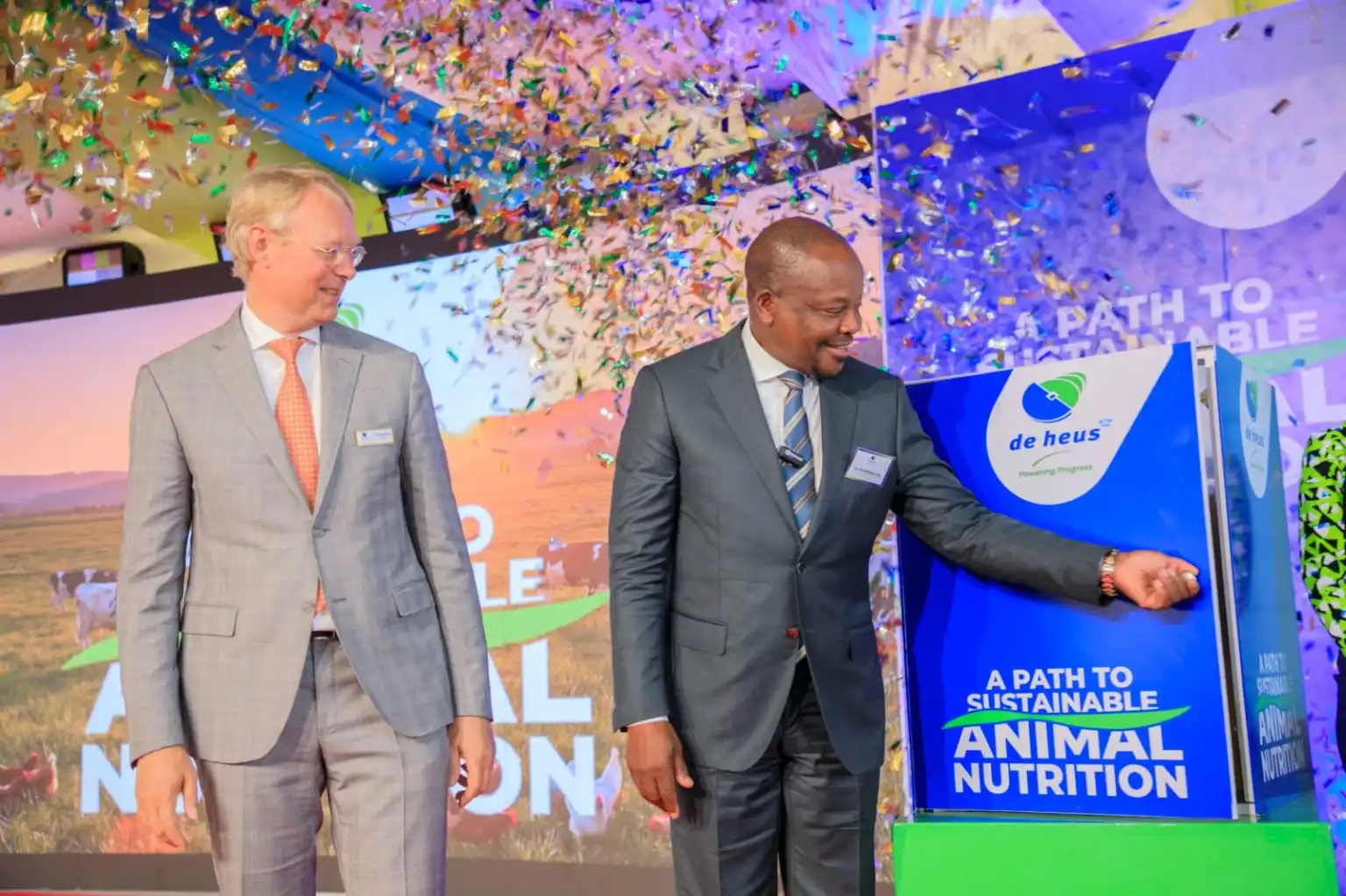
Kenya has commissioned one of the largest animal feed manufacturing facilities on the African continent, as the Dutch nutrition giant De Heus Animal Nutrition officially opened its Ksh 3 billion (USD 23 million) plant in Athi River, Machakos County on February 18, 2026 — a milestone that officials say is central to the country’s strategy to double annual milk production, slash feed import dependence, and position Kenya as a net exporter of live animals and meat.
The commissioning ceremony was presided over by Cabinet Secretary for Agriculture and Livestock Development Senator Mutahi Kagwe, who described the investment as part of sweeping structural reform in the livestock economy. “Today is not just about commissioning a factory. It is about transforming Kenya’s livestock economy,” said Kagwe. “We will not achieve this by merely increasing the number of cows — we will achieve it by increasing productivity per cow.” The event was also attended by the Ambassador of the Kingdom of the Netherlands Henk Jan Bakker, Governor of Machakos County Wavinya Ndeti, and Principal Secretary for Industry Dr. Juma Mukhwana.
Build the future you deserve. Get started with our top-tier Online courses: ACCA, HESI A2, ATI TEAS 7, HESI EXIT, NCLEX-RN, NCLEX-PN, and Financial Literacy. Let Serrari Ed guide your path to success. Enroll today.
A Decade in the Making: De Heus’s Long-Term Kenya Bet
Founded in 1911 in the Netherlands, De Heus Animal Nutrition is a family-owned company and one of the world’s leading producers of compound feeds, concentrates, and premixes for livestock and aquaculture. It operates more than 100 factories globally and produces roughly 16 million tonnes of feed annually. Its Kenyan subsidiary was established in 2023, and construction of the Athi River plant began in April 2024 — a project completed in under two years through collaboration with the local workforce, supported by technical expertise drawn from De Heus business units across Africa.
The Athi River facility is the company’s largest pellet-making feed mill in the region. It features two pellet lines producing 20 metric tonnes per hour each, a laboratory equipped for advanced mycotoxin analysis, forage testing, shelf-life determination, and real-time raw material screening using handheld Near-Infrared Reflectance (NIR) technology. The production system integrates standardised recipe formulation, automated production lines, and batch-to-batch verification to guarantee consistency — a direct response to farmer complaints about variable quality in the domestic feed market.
De Heus Chairman Co de Heus, speaking at the commissioning, emphasised the company’s investment philosophy: “Our investment is about building capabilities. We work with farmers and local partners to share technical expertise and practical solutions to improve agricultural outcomes.” He added that unlike vertically integrated agribusiness models, De Heus focuses exclusively on animal nutrition, positioning farmers as independent clients supported through knowledge transfer and technical services.
Production Capacity and Product Range
The Athi River plant has an annual production capacity of 240,000 metric tonnes, positioning it among the largest animal feed mills in East Africa. The facility produces a broad range of animal nutrition products — compound feeds, concentrates, premixes, and specialty feeds for poultry, pigs, ruminants, and aquaculture — covering the full spectrum of Kenya’s commercial livestock industry.
Managing Director of De Heus Kenya Wiehan Visagie said local manufacturing was driven by persistent gaps in feed reliability and farmer confidence, particularly among those dealing with cattle, poultry, and pigs. “For too long, feed has felt like a gamble for many farmers,” he said. “Our commitment is to deliver consistent, batch-to-batch nutrition backed by laboratory testing and strict quality controls.” By manufacturing locally, De Heus aims to shorten supply chains, improve traceability, and customise nutrition solutions to Kenyan farming systems — thereby helping farmers achieve more predictable results while reducing exposure to global supply disruptions.
De Heus already operates 35 outlets across Kenya and has plans to serve regional markets including Uganda and Tanzania, forming part of a broader strategy to position Kenya as a regional hub for livestock feed production. The company has also recently commissioned an aquafeed factory in Uganda and a second livestock feed factory in Ivory Coast — signalling the depth of its commitment to East and West African markets simultaneously.
Tackling Kenya’s 33-Million-Tonne Feed Deficit
The strategic case for the Athi River investment rests on a stark supply-demand imbalance in Kenya’s animal feed market. According to the Ministry of Agriculture, Kenya requires approximately 55 million metric tonnes of animal feed annually but produces only around 40% of that domestically, leaving a deficit of roughly 33 million metric tonnes that is partially filled through imports. The government has estimated it will need to marshal more than Ksh 460 billion over the next decade to implement its National Feed Strategy and close this gap.
Data from the Kenya National Bureau of Statistics shows the country had more than 71 million poultry birds in 2024, followed by goats, sheep, and cattle as the dominant livestock categories. The annual feed deficit of roughly 33 million tonnes means traders currently fill much of the shortfall through imports — an arrangement that exposes Kenyan farmers to exchange rate risk, supply disruptions, and inconsistent product quality. De Heus plans to replace a meaningful portion of that imported volume by supplying the domestic market from the new Athi River plant, starting with poultry — the largest livestock segment — and expanding into ruminants and aquaculture.
Feed costs are a critical structural problem for Kenyan livestock farmers. Feed accounts for up to 60–70% of total livestock production expenses, making quality and affordability decisive determinants of farm profitability. The arrival of a large-scale, locally manufactured supply of consistently formulated feed is therefore not merely an industrial milestone — it has direct implications for the unit economics of millions of smallholder and commercial livestock farmers across the country.
One decision can change your entire career. Take that step with our Online courses in ACCA, HESI A2, ATI TEAS 7, HESI EXIT, NCLEX-RN, NCLEX-PN, and Financial Literacy. Join Serrari Ed and start building your brighter future today.
Jobs, Local Sourcing, and Upstream Farmer Linkages
The Athi River plant is expected to generate approximately 280 direct jobs alongside more than 1,000 indirect employment opportunities across transport, logistics, packaging, distribution, and raw material supply chains. In Machakos County, Governor Wavinya Ndeti described the plant as a significant boost to agro-industrial development and youth employment. “Quality feed is the backbone of productive livestock,” she said. “When our poultry farmers get better feed, they get better yields. When our dairy farmers get better nutrition solutions, milk production increases.”
On the raw materials side, De Heus Kenya has committed to sourcing key inputs — including maize and soybeans — from Kenyan farmers, creating a reliable offtake market for local grain producers and boosting rural incomes. This upstream linkage is particularly significant given the government’s concurrent efforts under the Land Commercialisation Initiative, which is opening up public land for structured large-scale production of yellow maize and soybeans — key animal feed ingredients — while integrating smallholder farmers through contract farming arrangements.
The company also provides technical advisory services to farmers on feed utilisation, ration formulation, and animal nutrition management. These downstream support services are designed to ensure that the productivity gains promised by higher-quality feed actually materialise in measurable on-farm outcomes — closing the loop between manufacturing quality and farmer profitability.
Government’s Ambitious Livestock Transformation Agenda
The De Heus commissioning lands squarely within a broader and accelerating government effort to restructure Kenya’s livestock economy from the ground up. CS Kagwe has framed the overarching goal with precision: Kenya aims to double annual milk production from 5.2 billion litres to 10 billion litres and become a net exporter of live animals and meat — a transformation that requires a fundamental shift from volume-based herd expansion to productivity-per-animal improvements, underpinned by science-based nutrition, improved genetics, and stronger animal health systems.
To support this agenda, the government has announced plans to implement a feed quality index to standardise production across the industry and protect farmers from substandard formulations. “Over-diluted feed and substandard formulations designed to maximise profits at the expense of productivity will not be tolerated. Farmers must get value for their money,” Kagwe said. He emphasised that Kenya’s competitiveness in export markets for milk powder, meat, and live animals will depend heavily on feed quality and animal health standards.
Beyond feed policy, the government has also announced plans to construct 50 dams to expand irrigation and reduce reliance on rain-fed agriculture — a move intended to support the production of fodder and feed crops in arid and semi-arid regions. Separately, CS Kagwe has confirmed plans to establish national animal feed reserves to protect livestock from drought-related losses estimated at over Ksh 50 billion, having seen more than 2.5 million animals lost in the last two years due to prolonged dry spells.
Kenya is also pursuing major international livestock deals. A 25-year beef export contract with China under the Origin Prime Kenyan brand — valued at Ksh 26 billion and expected to create 135,000 jobs — signals the scale of the government’s export ambitions. In April 2025, Kenya and China also signed broader agricultural investment agreements worth USD 430 million, earmarking funds for poultry production, feed mills, and allied sectors.
The Livestock Sector’s Economic Weight — and Unrealised Potential
The urgency of the feed manufacturing investment is underscored by the sheer economic weight of Kenya’s livestock sub-sector. The sector contributes approximately 12% of Kenya’s GDP and supports millions of livelihoods — from smallholder dairy farmers in the highlands to pastoralist communities in arid and semi-arid lands that account for more than 80% of Kenya’s land area. According to KilimoSTAT and the Ministry of Agriculture, agriculture as a whole accounts for around 21% of the country’s GDP and employs approximately 40% of the total population.
Yet productivity remains significantly below potential. Kenya’s current annual milk output of 5.2 billion litres compares unfavourably with what peer nations produce from similar herd sizes — a gap attributable in large part to nutrition deficiencies that quality feed can directly address. The same logic applies to beef and pork: per-animal yields in Kenya lag behind regional benchmarks, and a large part of that gap is traceable to the inconsistency and substandard quality of available feeds.
Industry analysts note that the combined push for stricter feed standards, localised raw material sourcing, laboratory-backed production consistency, and farmer advisory support signals a structural shift in Kenya’s livestock sector — from an industry characterised by informal inputs and variable outcomes, to one capable of meeting the stringent quality standards demanded by export markets and processing industries.
A Regional Ripple Effect
The Athi River plant is not just a Kenyan story. With plans to serve regional markets including Uganda and Tanzania alongside the broader De Heus footprint across Africa — which includes facilities in Egypt, Ethiopia, South Africa, Ghana, and Ivory Coast — the factory positions Kenya as a potential export hub for compound feeds and concentrates across East Africa. At a time when several East African nations are grappling with their own feed deficits, a high-capacity, science-backed facility in Athi River — strategically located near Nairobi, the region’s largest logistics hub — carries genuine regional significance.
The Netherlands Ambassador Henk Jan Bakker captured the investment’s broader meaning at the commissioning ceremony: “This new De Heus animal feed facility reflects confidence — confidence in Kenyan farmers, confidence in the future of agriculture, and confidence in the economy of Kenya.”
For the more than two million smallholder dairy farmers, commercial poultry producers, pig farmers, and aquaculture operators across Kenya, the arrival of a reliable, locally manufactured supply of high-quality animal feed represents something more immediate: a genuine chance to improve yields, reduce costs, and build a more predictable, profitable farming business. That, in the end, is the metric against which the Ksh 3 billion investment will be judged.
Ready to take your career to the next level? Join our Online courses: ACCA, HESI A2, ATI TEAS 7 , HESI EXIT , NCLEX – RN and NCLEX – PN, Financial Literacy!🌟 Dive into a world of opportunities and empower yourself for success. Explore more at Serrari Ed and start your exciting journey today! ✨
Track GDP, Inflation and Central Bank rates for top African markets with Serrari’s comparator tool.
See today’s Treasury bonds and Money market funds movement across financial service providers in Kenya, using Serrari’s comparator tools.
photo source: Google
By: Montel Kamau
Serrari Financial Analyst
19th February, 2026