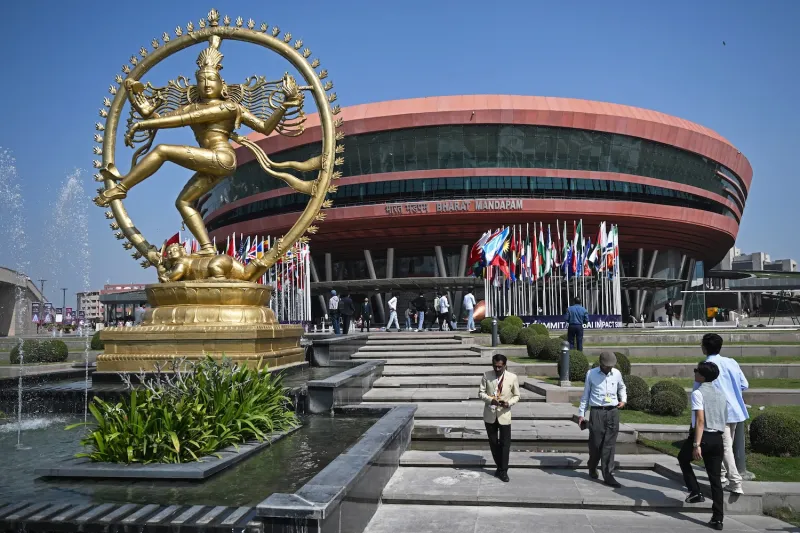
For five days this month, the Indian capital has become the undisputed centre of global artificial intelligence debate. The India AI Impact Summit 2026, running from February 16 to 20 at Bharat Mandapam, is not just another government-convened gathering of tech executives and policymakers. It is a calculated assertion by the world’s most populous democracy that the future of artificial intelligence will not be written solely in Silicon Valley or Beijing — and that emerging economies have both the talent and the vision to help shape what comes next.
The summit, billed as the first global AI convening hosted in the Global South, has drawn over 20 heads of state and government, more than 60 ministers and vice ministers, and upward of 500 senior executives, researchers, and philanthropists from across the world. For India, the gathering represents a coming-of-age moment — an opportunity to demonstrate that a nation long associated with software outsourcing and engineering talent can now anchor a global conversation about the responsible, inclusive, and economically transformative deployment of AI.
Build the future you deserve. Get started with our top-tier Online courses: ACCA, HESI A2, ATI TEAS 7, HESI EXIT, NCLEX-RN, NCLEX-PN, and Financial Literacy. Let Serrari Ed guide your path to success. Enroll today.
A Summit Built on Three Pillars and Seven Working Groups
The summit’s intellectual architecture is deliberately non-Western in its framing. Organised around three foundational pillars — People, Planet, and Progress — described in Sanskrit as “Sutras,” the event structures its deliberations through seven thematic working groups called “Chakras.” These cover areas including AI for Economic Growth and Social Good, Democratisation of AI Resources, Inclusion for Social Empowerment, Safe and Trusted AI, Human Capital, Science, and Resilience, Innovation and Efficiency. The framing is intentional: India wants the outcomes of this summit to speak to nations whose development priorities are fundamentally different from those of G7 economies.
Prime Minister Narendra Modi, who inaugurated the summit with the theme “Sarvajana Hitaya, Sarvajana Sukhaya” — welfare and happiness for all — framed the event as evidence of India’s growing strategic role in global AI discourse. His government has placed AI at the centre of its vision for Viksit Bharat 2047, the national plan for India to become a fully developed economy within the next two decades. AI, in this framework, is not simply a productivity tool; it is a lever for equitable growth.
This philosophy runs through every facet of the summit, from the way it has been designed — with separate events for researchers from Africa, Asia, and Latin America — to the nature of the deals being announced on its sidelines. The Research Symposium on AI and Its Impact, held on February 18 in partnership with IIT Hyderabad, received approximately 250 research submissions from the Global South alone, underlining that this is not merely a spectator event for developing nations — they are active contributors.
The IndiaAI Mission: $1.27 Billion to Democratise Compute
Central to India’s AI ambitions is the IndiaAI Mission, launched in March 2024 with a government outlay of Rs 10,372 crore (approximately $1.27 billion). In the roughly 20 months since its launch, the mission has moved with unusual speed. More than 38,000 high-performance GPUs have been onboarded and made available to Indian startups, researchers, and public institutions at approximately Rs 65 per hour — roughly one-third of the prevailing global average cost.
On the second day of the summit, Electronics and IT Minister Ashwini Vaishnaw announced that India would scale its compute capacity further, adding another 20,000 GPUs within weeks. That would bring India’s publicly available AI compute pool to nearly 60,000 GPUs — a scale that would make it one of the largest state-led compute democratisation programmes anywhere in the world.
Beyond raw compute, the mission has shortlisted 12 teams to develop indigenous foundational language models trained on India-specific datasets. These include multilingual models designed to serve India’s staggering linguistic diversity — the country has 22 officially recognised languages and hundreds of regional dialects. The IndiaAI FutureSkills programme is simultaneously supporting more than 13,500 scholars, including undergraduates, postgraduates, and PhD researchers, in AI-related disciplines. Twenty-seven AI and Data Labs have already been established, with hundreds more identified for rollout in Tier 2 and Tier 3 cities.
The government has also onboarded 367 datasets to AI Kosh, India’s open AI data repository, and approved 30 applications for developing India-specific AI applications. These initiatives, taken together, represent a deliberate attempt to build a full-stack domestic AI ecosystem rather than simply providing infrastructure for multinational corporations to deploy their models in the Indian market.
OpenAI, Anthropic, and Google Converge on a Market Too Large to Ignore
If the geopolitical and policy dimensions of the summit underline India’s state ambitions, the commercial landscape reveals something equally significant: India has become one of the most consequential AI markets on earth. OpenAI CEO Sam Altman, attending the summit alongside Alphabet CEO Sundar Pichai and Anthropic CEO Dario Amodei, confirmed ahead of the event that India now has 100 million weekly active ChatGPT users — making it the platform’s second-largest market globally after the United States.
Writing in the Times of India, Altman described India as a potential “full-stack AI leader” and said that Indian students account for the largest cohort of ChatGPT users in the world — a striking data point that speaks to both the youth of India’s population and the speed at which AI is permeating its education system. India also ranks fourth globally in the use of Prism, OpenAI’s free tool for scientific research and collaboration.
OpenAI opened its first Indian office in New Delhi in August 2025, and subsequently launched ChatGPT Go — a sub-$5 subscription tier that was later made free for a year for Indian users, a pricing strategy designed to accelerate adoption in a price-sensitive market. Google has pursued a parallel strategy, offering Indian students a free one-year subscription to its AI Pro plan in September 2025 and partnering with Reliance Jio to offer Gemini AI Pro free to over 500 million Jio subscribers for up to 18 months. India has also become the highest-usage market globally for Gemini in education, according to Google’s VP for education Chris Phillips.
Anthropic, too, has moved decisively. The company announced the opening of its first Indian office in Bengaluru — citing India as its second-largest market for its Claude AI model after the United States. In a further signal of deepening ties with India’s private sector, Infosys announced a strategic partnership with Anthropic to develop and deliver enterprise AI solutions across telecoms, financial services, manufacturing, and software development. Indian conglomerate Adani also entered a collaboration with Google, with plans to build a gigawatt-scale AI infrastructure campus in Visakhapatnam.
One decision can change your entire career. Take that step with our Online courses in ACCA, HESI A2, ATI TEAS 7, HESI EXIT, NCLEX-RN, NCLEX-PN, and Financial Literacy. Join Serrari Ed and start building your brighter future today.
Adani’s $100 Billion Bet and the $200 Billion Investment Pipeline
No single announcement at the summit captured headlines more dramatically than the Adani Group’s $100 billion commitment to develop renewable energy-powered, hyperscale AI-ready data centres across India by 2035. The investment, announced on the summit’s second day, is designed to build on AdaniConneX’s existing 2-gigawatt national data centre platform, with a goal of expanding to 5 gigawatts in the coming years.
Adani Chairman Gautam Adani framed the investment in explicitly sovereign terms. “The world is entering an Intelligence Revolution more profound than any previous Industrial Revolution,” he said. “Nations that master the symmetry between energy and compute will shape the next decade. India will not be a mere consumer in the AI age. We will be the creators, the builders, and the exporters of intelligence.” The group said its direct investment would catalyse an additional $150 billion in related spending across server manufacturing, sovereign cloud services, advanced electrical infrastructure, and supporting industries creating a projected $250 billion domestic AI infrastructure ecosystem over the decade.
A key enabling factor for Adani’s plan is its renewable energy portfolio. The group’s Adani Green Energy division is developing the 30-gigawatt Khavda renewable energy project in Gujarat, of which over 10 gigawatts are already operational. Vaishnaw noted at the summit that India is among the rare countries where more than 50 percent of power generation capacity comes from clean sources a significant competitive advantage as global concerns mount about the energy intensity of large-scale AI infrastructure.
The Adani announcement came as Minister Vaishnaw disclosed that AI-related investments at the summit were expected to exceed $200 billion over the next two years, including approximately $90 billion already committed. Blackstone separately acquired a majority stake in Indian AI startup Neysa as part of a $600 million equity fundraise, with the company planning to deploy more than 20,000 additional GPUs. AMD announced a partnership with Tata Consultancy Services to develop rack-scale AI infrastructure based on AMD’s “Helios” platform. And Bengaluru-based C2i, which is developing power solutions for data centres, raised $15 million in a Series A round from Peak XV.
Governance, Deepfakes, and the Responsibility Agenda
India has been careful to frame the summit not just as an investment showcase but as a serious governance forum. Minister Vaishnaw used the event to announce that India is in discussions with ministers from more than 30 countries to develop coordinated technical and legal responses to the growing threat of AI-generated deepfakes and disinformation. The government is also working on regulations that would mandate watermarking and labelling of AI-generated content.
“Innovation without trust is a liability,” Vaishnaw told delegates during a fireside conversation on creative industries and AI. He warned that deepfakes are “attacking societal trust” and called for global platforms to respect cultural context on a country-by-country basis. The government is simultaneously developing a “Create in India” mission to build a domestic talent pipeline for the creative industries in an age of generative AI, alongside a proposed new law specifically to counter the deepfake threat, according to the MeitY Secretary.
The governance agenda extends to labour markets. India’s Chief Economic Adviser V. Anantha Nageswaran delivered a keynote stressing the urgency of aligning AI adoption with mass employability — a pointed reminder that the country’s 250 million young people will need to be beneficiaries, not casualties, of AI-driven economic transformation. Investor Vinod Khosla of Khosla Ventures offered a starker warning: industries such as IT services and business process outsourcing, which have been cornerstones of India’s economic rise, could “almost completely disappear” within five years because of AI. His advice to young Indians was to build and sell AI-based products globally rather than supply labour to legacy service models.
The National Payments Corporation of India (NPCI) used the summit as a platform to announce the extension of its UPI One World wallet service to international visitors from over 40 countries a small but symbolically important demonstration of India’s digital infrastructure ambitions and its intent to globalise not just its AI capabilities but its broader fintech ecosystem.
The Geopolitical Undercurrents: US-India Tensions and the Chip Access Question
Beneath the optimism of the summit lies a more complex geopolitical reality. The Biden administration’s January 2025 decision to place India outside its Tier 1 list of countries eligible for the most advanced AI chips produced in the United States — a classification that gives preferential access to the latest Nvidia and other semiconductor technology — remains a sore point. India’s exclusion from the “Pax Silica” grouping of the most trusted AI partner nations reflects unresolved tensions over data sovereignty, export control compliance, and the terms of technology transfer.
Further complicating the picture, remarks by US Trade Adviser Peter Navarro questioning why Americans should be subsidising AI infrastructure in India have raised concerns that large US Big Tech investments of $67.5 billion — committed across Google, Microsoft, and Amazon by the end of 2025 — could become a political flashpoint in Washington. These tensions underscore the broader challenge facing India: it wants to attract Western capital and technology while simultaneously asserting digital sovereignty and developing indigenous alternatives.
The attendance of French President Emmanuel Macron, who began a three-day visit to India ahead of the summit to discuss AI cooperation, alongside Brazilian President Luiz Inácio Lula da Silva and Abu Dhabi Crown Prince Sheikh Khaled bin Mohamed bin Zayed Al Nahyan, signals that India is actively constructing a multilateral coalition that extends well beyond the US-India bilateral. The summit has drawn participation from over 100 countries, and its working groups have been structured explicitly to incorporate perspectives from economies in Africa, Asia, and Latin America.
Can India Deliver on Its Promises?
The summit has not been without its critics. Questions have been raised about India’s readiness to manage a gathering of this scale and complexity, with logistical challenges drawing comment from some delegates. More substantively, analysts have pointed out that translating user adoption into economic value remains a significant challenge India’s price-sensitive market and infrastructure constraints make monetisation at scale harder than in developed economies. Altman himself acknowledged a “capability overhang” a gap between having AI tools and knowing how to deploy them effectively for economic gain.
The global AI summit series which has progressed from the Bletchley Park AI Safety Summit in 2023 through Seoul in 2024 and Paris in 2025 to New Delhi in 2026 has, with each iteration, shifted its emphasis from safety and governance to practical impact and measurable outcomes. India has embraced this shift energetically, positioning itself as the convener that can finally anchor the discourse in the realities of developing economies rather than the preoccupations of the world’s most advanced tech ecosystems.
Whether the $200 billion investment pipeline materialises, whether the 60,000 GPUs of shared compute translate into globally competitive Indian AI products, and whether the governance frameworks negotiated at Bharat Mandapam survive contact with domestic political pressures and international trade disputes these are questions that will determine whether the India AI Impact Summit 2026 is remembered as a watershed or merely a very well-attended conference. What is beyond doubt is that India has, for this week at least, placed itself at the centre of the world’s most consequential technology conversation. The question now is whether it can stay there.
Ready to take your career to the next level? Join our Online courses: ACCA, HESI A2, ATI TEAS 7 , HESI EXIT , NCLEX – RN and NCLEX – PN, Financial Literacy!🌟 Dive into a world of opportunities and empower yourself for success. Explore more at Serrari Ed and start your exciting journey today! ✨
Track GDP, Inflation and Central Bank rates for top African markets with Serrari’s comparator tool.
See today’s Treasury bonds and Money market funds movement across financial service providers in Kenya, using Serrari’s comparator tools.
photo source: Google
By: Montel Kamau
Serrari Financial Analyst
18th February, 2026