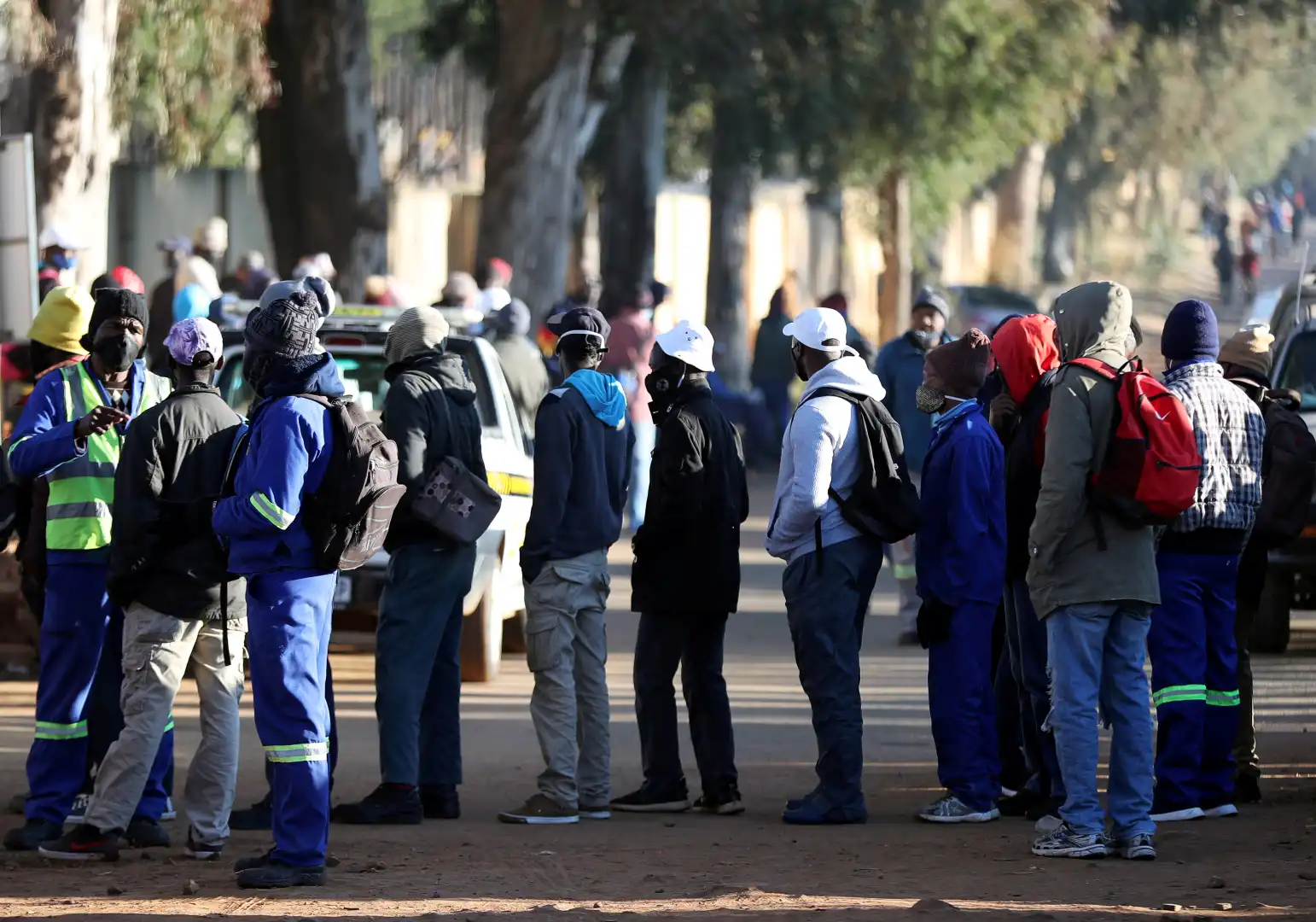
South Africa’s unemployment rate has retreated to its lowest level in over five years, offering a cautious reason for optimism in an economy that has long struggled to create enough jobs for its growing population. But behind the headline figure lies a more complex and sobering reality: nearly 8 million people remain out of work, youth joblessness continues to climb, and the number of discouraged work-seekers those who have given up looking entirely is rising.
According to the Quarterly Labour Force Survey (QLFS) for Q4 2025, released on Tuesday by Statistics South Africa (Stats SA), the official unemployment rate fell by 0.5 percentage points from 31.9% in the third quarter to 31.4% in the October-to-December period. That is the lowest reading since late 2020, when the economy was still reeling from the full impact of the COVID-19 pandemic and its lockdowns. Economists surveyed by Bloomberg had pencilled in a rate of 31.7%, making the outcome a modest upside surprise.
The data show that 44,000 people found employment between October and December, pushing the total number of employed South Africans to 17.1 million. The number of unemployed individuals simultaneously fell by 172,000 to 7.836 million. While a reduction in jobless numbers is unambiguously welcome, 7.8 million people still actively looking for work in a country of roughly 62 million underscores how far the economy remains from delivering broad-based employment.
Build the future you deserve. Get started with our top-tier Online courses: ACCA, HESI A2, ATI TEAS 7, HESI EXIT, NCLEX-RN, NCLEX-PN, and Financial Literacy. Let Serrari Ed guide your path to success. Enroll today.
Where the Jobs Were — and Were Not
The sectoral breakdown of job gains reveals a labour market driven by specific pockets of activity rather than a broad-based economic recovery. The largest employment increases were recorded in community and social services (+46,000), construction (+35,000), and finance (+32,000). These are sectors where government spending and seasonal building activity tend to spike toward year-end, raising questions about the durability of the gains.
That concern is reinforced by the concurrent losses in several key industries. The trade sector shed 98,000 jobs — the single largest decline during the quarter — while manufacturing lost 61,000 positions and mining dropped 5,000. Together, these three sectors represent significant pillars of South Africa’s formal economy and their contraction points to ongoing structural weaknesses in the country’s industrial base.
The regional picture is similarly uneven. The Western Cape led provincial job growth with 93,000 new positions, followed by Mpumalanga (+37,000) and North West (+36,000). In sharp contrast, Gauteng — the country’s economic heartland and home to Johannesburg — shed 54,000 jobs, while KwaZulu-Natal lost 41,000 and the Eastern Cape shed 32,000. The Western Cape’s consistent outperformance is increasingly attributed to relatively better-functioning local governance, a more diversified economy, and lower unemployment than the national average.
Stats SA noted that formal sector employment rose by 320,000 in Q4, while informal sector employment fell by 293,000. The shift away from the informal economy — which typically acts as a buffer for workers who cannot find formal jobs — suggests that seasonal formal hiring absorbed some workers during the festive quarter, but also that the informal safety net may be fraying.
The Hidden Crisis: Discouragement and Youth Unemployment
The headline unemployment figure, while the most widely cited, does not capture the full depth of South Africa’s labour market distress. Stats SA’s broader measures of labour underutilisation paint a much starker picture. The expanded unemployment rate — which includes discouraged work-seekers — stands at 42.1%, meaning that more than four in ten working-age South Africans are either jobless or have stopped looking for work. The composite measure that captures all dimensions of labour underutilisation (LU4) reaches 44.5%.
Perhaps most troubling is the rise in discouraged job-seekers. During Q4 2025, discouraged workers increased by 233,000 to reach 3.7 million. These are individuals who want to work but have stopped actively searching — often because they believe no jobs are available. Their exclusion from the official unemployment count creates an optical illusion of progress that masks the depth of despondency in communities across the country.
Youth unemployment remains arguably the most acute dimension of the crisis. The youth unemployment rate — covering those aged 15 to 34 — actually ticked upward by 0.14 percentage points to 43.8% in Q4 2025, even as the headline rate fell. In the narrow 15-to-24 age cohort, the rate has hovered above 58% for much of the past year. Stats SA’s Statistician-General Risenga Maluleke acknowledged that while the headline decline signals early signs of a gradual downward trend, the increase in discouraged workers and the persistently high youth unemployment rate “remain a concern.” Nearly half of South Africans between the ages of 15 and 34 are unemployed, a generation-defining crisis with implications for social cohesion and long-term economic potential.
Africa’s Largest Economy, Still Straining to Create Work
South Africa’s GDP is estimated at approximately $410 billion, making it the largest economy on the African continent, ahead of Egypt and Nigeria. Its position as Africa’s most industrialised economy has long made it a magnet for job-seekers from across the region, particularly from Zimbabwe, Mozambique, Lesotho, and Malawi. Yet the country’s status as a regional economic hub sits in uncomfortable tension with its role as one of the world’s most unequal societies and one of the few major economies where the unemployment rate has persistently exceeded 30%.
The current improvement marks a welcome change from earlier in 2025, when unemployment peaked at 33.2% in the second quarter the highest rate since Q2 2024. The subsequent declines across Q3 and Q4 have restored the rate to roughly where it stood before that mid-year deterioration. But the structural drivers of South Africa’s unemployment problem insufficient fixed investment, a poorly functioning freight and logistics system, skills mismatches, high input costs, and an energy grid still recovering from years of loadshedding remain largely unresolved.
One decision can change your entire career. Take that step with our Online courses in ACCA, HESI A2, ATI TEAS 7, HESI EXIT, NCLEX-RN, NCLEX-PN, and Financial Literacy. Join Serrari Ed and start building your brighter future today.
The Youth Fund and Small Business Strategy
Recognising that young people bear a disproportionate share of unemployment, the government has moved to deploy targeted financial intervention. In October 2025, the National Youth Development Agency launched a R2.5 billion ($135 million) Youth Fund to provide loans to small and medium-sized enterprises, with a particular focus on high-potential youth-owned businesses. The fund is designed to support enterprises that struggle to meet the collateral requirements of commercial banks.
In his State of the Nation Address delivered on February 12 at Cape Town City Hall, President Cyril Ramaphosa broadened the commitment, pledging R2.5 billion to support more than 180,000 SMEs alongside R1 billion in credit guarantees and proposed amendments to the National Credit Act to improve access to affordable financing. Ramaphosa argued that if every SME in South Africa hired just one additional worker, the country could generate three million new jobs — a formulation that places small business at the centre of the government’s employment strategy.
Separately, a Jobs Boost Outcomes Fund launched in mid-2024 has placed more than 3,070 young people into formal employment across 107 companies using an outcomes-based model — where implementation partners are only paid after a jobseeker is successfully placed in full-time work. The programme, backed by R300 million from the National Skills Fund, was on track to place 4,500 people in employment by end-2025, offering a scalable template for public-private employment interventions.
Migration, Deportations, and the Politics of Joblessness
South Africa’s unemployment crisis does not exist in a regional vacuum. The country draws hundreds of thousands of job-seekers from its neighbours each year, particularly from Zimbabwe and Mozambique — two countries where economic conditions and, in Zimbabwe’s case, long-running political instability, have pushed millions into migration. Estimates suggest between one and three million Zimbabweans live in South Africa, though precise figures are difficult to establish given the scale of irregular migration.
As economic frustration has mounted among South Africans, the government has responded with an intensified deportation drive. The Department of Home Affairs deported 46,898 undocumented migrants in the 2024/25 financial year ending March 2025 — an 18% increase over the previous year and the highest deportation figure in at least five years. Home Affairs Minister Leon Schreiber attributed the increase to improved collaboration between his department, the Border Management Authority, the South African Police Service, and local law enforcement under a joint initiative called Operation Vala Umgodi.
In the second quarter of the 2025/26 financial year, the Border Management Authority reported more than 8,000 arrests at border posts for attempted illegal entry, with Lesotho, Mozambique and Zimbabwe topping the list of origin countries. Across South Africa’s borders, more than 50,000 undocumented individuals were intercepted during the festive season, a record that has intensified debate between those who view robust enforcement as necessary to protect South African jobs and rights activists who argue that the treatment of migrants often falls short of constitutional and international humanitarian standards.
Critics, including researchers at the University of the Witwatersrand’s African Centre for Migration and Society, have questioned whether mass deportations address the root causes of migration or simply displace the problem, noting that many deportees attempt to re-enter within days.
Budget 2026: The Real Test
The economic backdrop against which Finance Minister Enoch Godongwana will present his national budget on February 25, 2026 is meaningfully better than a year ago. South Africa has been removed from the Financial Action Task Force (FATF) grey list. Inflation has fallen to its lowest level in two decades. The rand has strengthened. The electricity grid has stabilised, with more than 175 consecutive days without loadshedding recorded in the review period. S&P has upgraded South Africa’s sovereign credit rating.
These improvements have bought the finance minister some fiscal breathing room. But as Simone Cooper, head of business and commercial banking at Standard Bank South Africa, has noted, small businesses cannot grow on good intentions alone. They need funded programmes, streamlined regulations and faster government payment cycles.
Godongwana is expected to outline details of a R1 trillion public infrastructure investment commitment over the next three years — which Ramaphosa described at SONA as the largest such allocation in South Africa’s history — alongside a target of mobilising R2 trillion in new private and public investment over five years. Whether these commitments translate into employment at the scale required to reduce South Africa’s unemployment rate below 30% for the first time since before the pandemic will depend on Godongwana’s ability to pair fiscal credibility with tangible delivery. The budget speech is expected to include additional details on how the government plans to fund the R2.5 billion SME support commitment, the R156 billion water infrastructure programme, and other social and economic priorities announced in the SONA.
An Economy on the Mend, But Not Yet Healed
South Africa’s Q4 2025 unemployment data is, on balance, a modest positive. The headline rate has fallen to its lowest level since 2020, employment has grown, and the formal sector has absorbed more workers than it lost. Against the context of a country that has spent most of the past five years managing overlapping crises — the pandemic, loadshedding, logistics collapse, and fiscal stress — these numbers represent genuine, if fragile, progress.
But the caveats are significant. Discouraged workers are rising. Youth unemployment is not improving. The trade and manufacturing sectors, which typically offer the most scalable employment opportunities for lower-skilled workers, contracted during the quarter. And with South Africa’s broad unemployment measure standing at 41.2% when all categories of non-employment are included, the headline 31.4% figure tells only part of the story.
For the millions of South Africans who are still without work — and the millions more who have stopped looking — the question is not whether the trend is moving in the right direction, but whether it is moving fast enough to address a jobs crisis that has been decades in the making.
Ready to take your career to the next level? Join our Online courses: ACCA, HESI A2, ATI TEAS 7 , HESI EXIT , NCLEX – RN and NCLEX – PN, Financial Literacy!🌟 Dive into a world of opportunities and empower yourself for success. Explore more at Serrari Ed and start your exciting journey today! ✨
Track GDP, Inflation and Central Bank rates for top African markets with Serrari’s comparator tool.
See today’s Treasury bonds and Money market funds movement across financial service providers in Kenya, using Serrari’s comparator tools.
photo source: Google
By: Montel Kamau
Serrari Financial Analyst
18th February, 2026