India has emerged from a year of intense trade negotiations with a renewed strategic position, announcing breakthrough agreements with major global partners while successfully reducing punitive tariffs from the United States. The interim trade framework with Washington marks a significant de-escalation after months of escalating tariff tensions, but observers emphasize that India’s real bargaining power lies in its robust economic fundamentals and rapidly expanding market potential.
Under the deal announced on February 2, US tariffs on Indian exports will fall to 18 percent from a punishing 50 percent peak imposed in mid-2025, in exchange for India committing to eliminate or reduce tariffs on all US industrial goods and a wide range of food and agricultural products. The United States had initially imposed a 25 percent reciprocal tariff on Indian goods, which was later compounded by an additional 25 percent penalty related to India’s purchases of Russian crude oil, creating what trade analysts called an unprecedented tariff burden.
Commerce Minister Piyush Goyal described the agreement as a “golden letter” moment for India’s economic future, stating that “every sector is excited about the possibilities this opens up.” The framework came just days after India and the European Union wrapped up negotiations on what both sides have dubbed the “mother of all deals” – a comprehensive free trade pact that creates the world’s largest free trade zone encompassing two billion people and nearly 25 percent of global GDP.
Build the future you deserve. Get started with our top-tier Online courses: ACCA, HESI A2, ATI TEAS 7, HESI EXIT, NCLEX-RN, NCLEX-PN, and Financial Literacy. Let Serrari Ed guide your path to success. Enroll today.
EU Agreement Provides Strategic Leverage
Trade experts suggest the timing of the India-US framework announcement indicates that the EU deal concluded on January 27 may have acted as a powerful catalyst in bringing Washington to the negotiating table. The European agreement, which emerged after nearly two decades of on-and-off negotiations, signals India’s ability to secure alternative partnerships even as it navigates complex trade dynamics with the United States.
“I think it sent a message to the US that there are other partners. The Indian economy has been resilient,” said Harsh Pant, vice president of studies and foreign policy at think-tank Observer Research Foundation. “This kind of diplomatic signaling remains an important variable in how you want to project your confidence in your ability to navigate the relationship with the US.”
The India-EU free trade agreement represents a historic milestone, with the European Commission confirming that tariffs on 96.6 percent of EU goods exports to India would be eliminated or reduced, potentially saving up to €4 billion annually in duties on European products. For India, the deal provides duty-free access to the EU market for key export sectors including textiles, apparel, leather goods, marine products, gems and jewelry, and engineering goods – sectors that collectively employ millions of workers across the country.
European Commission President Ursula von der Leyen emphasized the strategic significance of the pact, stating it sends “a signal to the world that rules-based cooperation still delivers great outcomes” at a time when global multilateralism faces increasing strain. The agreement goes beyond traditional trade liberalization, incorporating commitments on sustainability, labor rights, climate action, and implementation of the Paris Climate Agreement.
Accelerated Trade Diversification Strategy
As trade talks with the United States dragged through 2025 – with Washington threatening additional tariffs throughout the year – India moved decisively to conclude agreements with Britain, New Zealand, and Oman, all within the past twelve months. This marks a notable strategic pivot for a country that has traditionally maintained a cautious approach toward opening its developing economy to advanced markets.
The India-UK Comprehensive Economic and Trade Agreement (CETA), announced in May 2025, provides the UK with duty-free access to 99 percent of Indian items covering nearly 100 percent of trade value. Under the agreement, India’s average tariffs on UK goods will fall sharply from 15 percent to merely 3 percent, potentially unlocking $23 billion in new trade opportunities for India. The agreement opens significant opportunities for Indian farmers to access the UK’s $37.5 billion agricultural market while providing preferential market access for textiles, engineering goods, and other key export sectors.
In December 2025, India announced the conclusion of negotiations with New Zealand for a free trade agreement that is expected to double bilateral trade to over $5 billion by 2030. The agreement, finalized after intense negotiations launched in March 2025, provides India with zero-duty access for all goods exports to New Zealand, while New Zealand receives duty concessions and market access for approximately 70 percent of India’s tariff lines covering roughly 95 percent of New Zealand’s exports to India on a phased basis. New Zealand has also committed to facilitate investments of $20 billion into India over the next fifteen years.
The India-Oman Comprehensive Economic Partnership Agreement (CEPA), signed during Prime Minister Modi’s visit to Muscat in December 2025, represents India’s second major trade deal in the West Asian region following the agreement with the UAE in 2022. The pact provides Indian exporters duty-free access to 96 percent of tariff lines, with a further 2 percent to be eliminated over time. A key strategic gain for India is the ability to import raw marble from Oman, diversifying away from Turkey which currently supplies approximately 55 percent of India’s marble imports valued at $339.81 million in the last financial year.
Economic Growth as Bargaining Power
Trade analysts emphasize that India’s strongest negotiating asset in these complex trade discussions remains its economic size and growth potential – a powerful draw even for a more protectionist America under President Donald Trump’s administration. India’s economy has demonstrated remarkable resilience, with the Reserve Bank of India revising the GDP growth forecast for fiscal year 2025-26 upwards to 7.3 percent from an earlier estimate of 6.8 percent.
According to the First Advance Estimates published by the National Statistics Office, India’s real GDP is estimated to grow by 7.4 percent in FY 2025-26, with nominal GDP growth at 8 percent. The economy grew at an impressive 8.2 percent in the second quarter of FY 2025-26, marking a six-quarter high and reflecting sustained momentum driven by robust domestic consumption and investment activity.
India became the world’s fourth-largest economy in mid-2025, surpassing Japan in terms of nominal GDP. The country is projected to reach a GDP of $5 trillion by 2027 and is on course to become the world’s third-largest economy with a projected GDP of $7.3 trillion by 2030. This growth trajectory positions India as an increasingly critical partner for global trade and investment, with its population of 1.4 billion people representing one of the world’s largest and fastest-growing consumer markets.
The Economic Survey 2025-26 highlights that India’s potential growth has strengthened to around 7 percent per annum, up from approximately 6.5 percent last year, supported by steady reforms, sustained public investment, a healthier financial system, and continued deregulation. The services sector, which is estimated to have grown by 9.1 percent in FY26, now accounts for 56.4 percent of gross value added, reflecting the rising importance of modern, tradable, and digitally delivered services in India’s economy.
Navigating the Russian Oil Question
While exporters have broadly welcomed the trade framework with the United States, significant ambiguities remain. The Indian government has neither confirmed nor denied Washington’s claim that New Delhi will stop buying Russian oil – a key sticking point in negotiations throughout 2025. President Trump announced that India had agreed to “stop buying Russian Oil, and to buy much more from the United States and, potentially, Venezuela,” but Indian officials have carefully avoided explicitly confirming this commitment.
Commerce Minister Piyush Goyal, addressing the Lok Sabha, emphasized that ensuring energy security for 1.4 billion Indians is a top priority, and that diversifying energy sources is part of this strategy in a changing global scenario. Notably, Goyal did not mention stopping oil purchases from any particular country.
According to trade data and energy analytics, India imported 1.38 million barrels per day of oil from Russia in December 2025, accounting for 27.4 percent of its total imports. While this represented the lowest volume of Russian oil imports since January 2023, it demonstrates continued energy engagement with Moscow despite Western pressure. India’s crude petroleum imports from Russia surged dramatically from approximately 2.5 percent of total oil imports in 2021, before Russia’s invasion of Ukraine, to around 35-40 percent of crude imports in the first half of 2025.
During Russian President Vladimir Putin’s visit to New Delhi in December 2025, both leaders reaffirmed their energy partnership, with Moscow promising uninterrupted fuel supplies and both nations planning major economic cooperation through 2030. Prime Minister Modi stated that “energy security has been a strong and important pillar of the India-Russia partnership,” while Putin criticized what he characterized as US hypocrisy in calling for India to halt crude imports from Russia while the United States itself continues to buy Russian nuclear fuel for its nuclear power plants.
One decision can change your entire career. Take that step with our Online courses in ACCA, HESI A2, ATI TEAS 7, HESI EXIT, NCLEX-RN, NCLEX-PN, and Financial Literacy. Join Serrari Ed and start building your brighter future today.
Terms of the US-India Framework
According to the joint statement issued by India and the United States, India will eliminate or reduce tariffs on all US industrial goods and a wide range of food and agricultural products, including dried distillers’ grains (DDGs), red sorghum for animal feed, tree nuts, fresh and processed fruit, soybean oil, wine and spirits, and additional products. India has also committed to address long-standing non-tariff barriers affecting bilateral trade in priority areas, including medical devices, information and communication technology goods, and agricultural products.
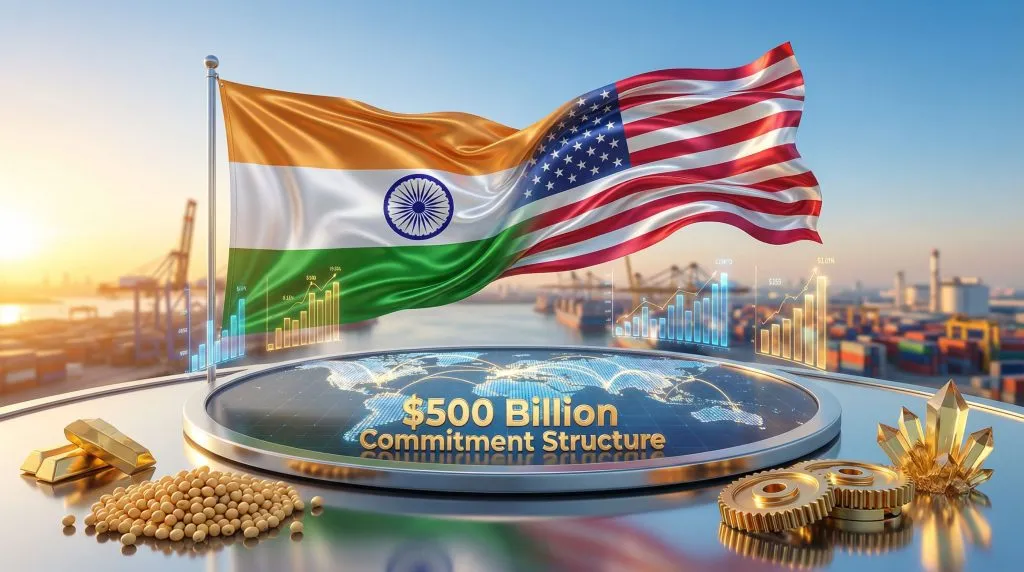
In a significant economic commitment, India intends to purchase $500 billion of US energy products, aircraft and aircraft parts, precious metals, technology products, and coking coal over the next five years. This includes potential aircraft purchases from Boeing valued at up to $80 billion, which would rank among the largest aviation procurement pipelines linked to a single country. However, market observers note that India has yet to clarify delivery schedules, funding structures, and the extent of firm commitments.
The executive order signed by President Trump on February 6 eliminates the additional 25 percent duty that had been imposed on products of India in 2025 as a penalty tied to India’s purchases of Russian oil. The order became effective for goods entered for consumption, or withdrawn from warehouse for consumption, on or after 12:01 a.m. Eastern on February 7, 2026. The 18 percent reciprocal tariff rate applies to Indian-origin goods, providing Indian exporters with a more competitive position compared to several Southeast Asian competitors.
However, critical details remain subject to finalization. The framework is non-binding and requires implementation through specific regulations and customs procedures. Trade experts have cautioned that the current arrangement remains subject to revision, pointing to past instances where tariff reductions announced by the US were later reversed, raising concerns about potential policy volatility.
Sectoral Implications and Market Access
For Indian exporters, the reduction from 50 percent to 18 percent tariffs represents significant relief, particularly for labor-intensive sectors. However, the 18 percent tariff will still apply to many key Indian exports, including textiles and leather goods – sectors that employ millions of workers and have been particularly vulnerable to tariff pressures. The total value of US-India bilateral trade reached $137.47 billion in 2025, with the United States remaining India’s largest trading partner for the fourth consecutive year.
Indian merchandise exports to the United States reached $86.5 billion in fiscal year 2025, with the US being India’s top export destination. The combination of tariff relief and macroeconomic confidence is expected to drive double-digit export growth rates in coming quarters, potentially offsetting the contraction experienced in late 2025 when exports dipped due to peak tariff pressures.
The India-EU agreement is expected to have even more transformative effects on Indian trade. The European Commission stated that the agreement will give EU companies privileged access to the world’s most populous country of 1.45 billion people and could potentially double EU goods exports to India by 2032. For India, gaining zero-duty or reduced-duty access across 96.6 percent of tariff lines in the EU market provides unprecedented opportunities for exporters in textiles, chemicals, pharmaceuticals, gems and jewelry, engineering goods, and agricultural products.
The EU and India already trade over €180 billion worth of goods and services annually, supporting approximately 800,000 jobs in the EU. Trade in services between the EU and India reached €59.7 billion in 2023, demonstrating robust growth from €30.4 billion in 2020. The agreement includes comprehensive provisions on services trade, with Indian service providers gaining privileged access to the EU market in key sectors such as financial services, maritime services, information technology, and professional services.
Strategic Realignment Amid Global Uncertainty
India’s accelerated pursuit of trade agreements reflects a broader strategic recalibration in response to global trade fragmentation and geopolitical tensions. The country has moved from its traditionally protectionist stance toward a more proactive engagement with global trade architecture, recognizing both the opportunities and vulnerabilities created by shifting economic power dynamics.
As India navigated intense US tariff pressure throughout 2025, New Delhi simultaneously strengthened ties with alternative partners. The timing of the EU agreement announcement – coming just days before the breakthrough with Washington – appeared calculated to demonstrate India’s expanding options. Prime Minister Modi even signaled warming relations with China during this period, further emphasizing India’s strategic flexibility.
The World Economic Forum’s Global Cooperation Barometer 2026 found that while global multilateralism has weakened, more “flexible and smaller arrangements of cooperation” continue to persist. Cooperation today is “more bespoke, more interest based and, most importantly, still present.” India’s diversified approach to trade partnerships embodies this evolution, as the country constructs a network of bilateral and regional agreements tailored to specific economic and strategic objectives.
For the United States, the India relationship represents a critical component of its Indo-Pacific strategy and serves as a counterweight to China’s growing influence in the region. India is an integral member of the Quad grouping (Australia, India, Japan, and the United States) that serves as a regional security framework. Multiple US administrations had strengthened the bilateral relationship, which experienced strain during Trump’s second term over tariffs and his stance on the India-Pakistan conflict.
Yet Trump’s tariff relief now leaves India’s effective rate lower than Vietnam’s 20 percent and other Southeast Asian countries’ 19 percent rates, providing Indian exporters with a competitive advantage in the American market. This shift aligns with Trump’s stated objective of closer US-India ties going forward, though the durability of this arrangement remains subject to political and economic dynamics in both countries.
Implementation Challenges and Future Outlook
While the announcement of multiple trade agreements marks significant diplomatic achievements, substantial implementation challenges lie ahead. The India-EU agreement requires approval by the Council of the European Union, consent of the European Parliament, and completion of domestic approval processes in India before entering into force. The agreement is subject to legal vetting and translation before formal signing, with trade liberalization measures expected to be phased in over several years. The earliest the agreement could come into force is early 2027.
Similarly, the India-New Zealand FTA is likely to be signed in the next three months after completion of domestic processes, but will take approximately a year to be operationalized as it requires approval from the New Zealand Parliament. The India-UK agreement also faces a parliamentary approval process before implementation.
The India-US framework explicitly notes that it represents an interim agreement, with both countries committed to negotiating a comprehensive Bilateral Trade Agreement (BTA) that will include additional market access commitments and more resilient supply chains. The framework agreement is conditional – if one side changes its tariffs, the other can respond in kind – meaning the relief, while real, is not unconditional.
Trade analysts emphasize that implementation will be key. “The disciplined approach is to treat this as live operational change,” noted legal experts at Clark Hill. “Companies should move early on analysis and contract posture but avoid hard commitments until the government publishes the remaining implementing details.”
For agriculture, a traditional sticking point in trade negotiations, India has maintained firm safeguards. Commerce Minister Goyal has underlined that India will never open up its dairy sector to any country as part of a free trade pact, protecting the interests of millions of farmers and livestock rearers. Prime Minister Modi stated during negotiations that India would “never compromise” on the interests of farmers, even if it meant paying a “heavy personal price.”
Looking Ahead: Balancing Opportunity and Risk
As India enters 2026, the country faces both unprecedented opportunities and complex challenges in managing its expanding web of trade relationships. The successful conclusion of multiple high-profile agreements positions India as an increasingly central player in global trade architecture, with enhanced market access to economies representing a substantial share of global GDP.
However, the path forward requires careful navigation of competing interests and geopolitical pressures. India must balance its energy security needs – including continued access to competitively priced Russian crude oil – with demands from Western partners to align more closely with their strategic objectives. The country must also manage domestic sensitivities around agricultural protection while pursuing deeper market integration with advanced economies.
The sustainability of India’s enhanced trade position will depend on several factors: the actual implementation of announced agreements, the evolution of US trade policy under the Trump administration, the trajectory of US-China relations and their spillover effects on India, and India’s ability to maintain its economic growth momentum amid global uncertainties.
For Indian businesses, the new trade landscape presents both opportunities and complexities. Exporters in textiles, pharmaceuticals, engineering goods, and services stand to benefit from improved market access and reduced tariff barriers. However, companies must navigate varying rules of origin requirements, phased tariff reductions, and evolving regulatory frameworks across different markets.
The broader message from India’s trade diplomacy in 2025 is clear: the country has successfully leveraged its economic scale and growth potential to secure better terms with major partners, even in a period of heightened protectionism and trade fragmentation. Whether this represents a sustainable strategic advantage or a temporary alignment of circumstances remains to be seen, but India has demonstrated its capacity to navigate complex trade negotiations while maintaining strategic autonomy.
As observers note, India’s bargaining power ultimately rests not in any single agreement but in the fundamentals of its economy – a large and growing domestic market, a young and increasingly skilled workforce, improving infrastructure, and a reform-oriented policy environment. These attributes ensure that India remains an attractive partner for both established and emerging economies, providing the country with options and leverage as it charts its course through an uncertain global trade landscape.
The coming months will reveal whether the ambitious commitments made in these agreements translate into tangible economic benefits for Indian exporters, workers, and consumers. For now, India has succeeded in reshaping its trade position through a combination of strategic diplomacy, economic leverage, and careful balancing of competing interests – positioning itself as a more assertive and pragmatic actor in global economic affairs.
Ready to take your career to the next level? Join our Online courses: ACCA, HESI A2, ATI TEAS 7 , HESI EXIT , NCLEX – RN and NCLEX – PN, Financial Literacy!🌟 Dive into a world of opportunities and empower yourself for success. Explore more at Serrari Ed and start your exciting journey today! ✨
Track GDP, Inflation and Central Bank rates for top African markets with Serrari’s comparator tool.
See today’s Treasury bonds and Money market funds movement across financial service providers in Kenya, using Serrari’s comparator tools.
photo source: Google
By: Montel Kamau
Serrari Financial Analyst
12th February, 2026