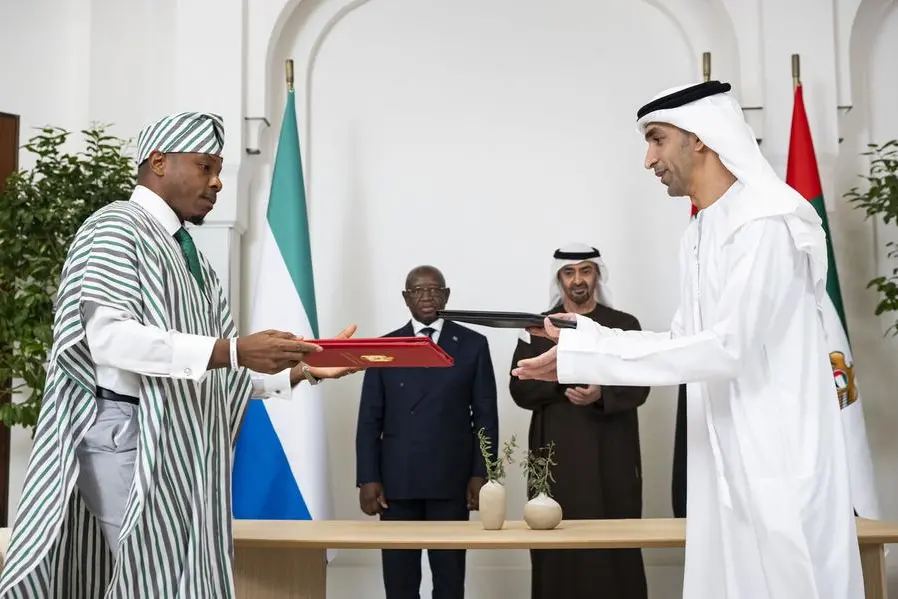
The United Arab Emirates and the Republic of Sierra Leone have formalized a comprehensive economic partnership that positions the Gulf state to expand its commercial footprint in West Africa while providing Sierra Leone with critical investment capital for infrastructure development and economic diversification. The signing of the Comprehensive Economic Partnership Agreement (CEPA) on February 2, 2026, marks a strategic milestone in bilateral relations and reflects the UAE’s broader commitment to strengthening economic ties across the African continent.
UAE President His Highness Sheikh Mohamed bin Zayed Al Nahyan and Sierra Leonean President Julius Maada Bio witnessed the signing ceremony at Qasr Al Shati in Abu Dhabi, where the agreement was formally executed by Dr. Thani bin Ahmed Al Zeyoudi, UAE Minister of Foreign Trade, and Ibrahim Alpha Sesay, Sierra Leone’s Minister of Trade and Industry. The event took place during President Bio’s working visit to the UAE, which included participation in the World Governments Summit in Dubai.
Build the future you deserve. Get started with our top-tier Online courses: ACCA, HESI A2, ATI TEAS 7, HESI EXIT, NCLEX-RN, NCLEX-PN, and Financial Literacy. Let Serrari Ed guide your path to success. Enroll today.
Strategic Objectives and Economic Framework
Sheikh Mohamed characterized the CEPA as representing a “significant step forward in deepening economic ties with Sierra Leone across a broad range of priority sectors,” emphasizing that the agreement reflects the UAE’s longstanding commitment to building partnerships aimed at driving sustainable development, fostering shared prosperity, and creating new opportunities for future generations. The partnership is structured to reduce trade barriers, enhance investment flows, and promote private sector collaboration in key sectors including agriculture, renewable energy, and infrastructure development.
Dr. Thani Al Zeyoudi, the UAE’s Minister of Foreign Trade, described the CEPA as “an important step that strengthens the UAE’s presence in West Africa and opens new horizons for trade and investment cooperation with one of the continent’s promising economies.” His statement underscores the strategic importance the UAE places on West African markets as part of its broader economic diversification strategy beyond traditional Gulf partnerships.
The agreement is expected to facilitate enhanced bilateral trade in multiple sectors. According to Al Zeyoudi, the CEPA will contribute to boosting bilateral trade especially in minerals, iron ore, bauxite, and agricultural products such as cocoa and fish. Sierra Leone’s rich natural resource base provides substantial opportunities for Emirati investors seeking to secure access to critical minerals and commodities that support UAE industries and global supply chain operations.
Current Trade Relationship and Growth Trajectory
Bilateral non-oil foreign trade between the UAE and Sierra Leone reached $153 million in 2025, demonstrating promising growth momentum that the CEPA is designed to accelerate substantially. This figure represents the baseline from which both nations aim to expand commercial exchange across diverse sectors, leveraging complementary economic strengths and geographic advantages.
The trade relationship has shown consistent growth in recent years, reflecting increasing engagement between Emirati companies and Sierra Leonean counterparts across multiple sectors. The CEPA provides a structured framework to institutionalize this growing relationship and remove impediments that have historically constrained bilateral commerce, including tariff barriers, regulatory complexities, and limited awareness of market opportunities.
President Bio expressed his satisfaction with the agreement, stating on social media that he had a “productive conversation” with Sheikh Mohamed regarding the partnership. The Sierra Leonean leader’s participation in the World Governments Summit provided an additional platform to showcase his country’s investment opportunities to an international audience and build relationships with potential investors beyond the UAE.
Sierra Leone’s Economic Profile and Natural Resource Wealth
Sierra Leone presents a compelling economic profile for UAE investors seeking exposure to African markets. According to Dr. Al Zeyoudi, Sierra Leone is considered one of the active economies in West Africa, with a gross domestic product of around $8.64 billion and economic growth forecasts of nearly 4 percent in 2025, which exceeds the global average. This growth trajectory, while modest in absolute terms, demonstrates economic resilience and potential for expansion with appropriate investment and policy support.
The West African nation’s strategic advantages extend beyond economic growth metrics to encompass significant natural resource endowments and geographic positioning. Al Zeyoudi highlighted the country’s strategic geographic location, which includes one of Africa’s deepest natural harbors in the capital city of Freetown. This deep-water port facility provides critical infrastructure for bulk commodity exports and positions Sierra Leone as a potential logistics hub for broader West African trade operations.
Sierra Leone’s mineral wealth constitutes its most significant economic asset and primary attraction for foreign investors. The country is recognized as one of the world’s leading producers of rutile, a titanium dioxide ore used extensively in paint, paper, and welding rod production. Sierra Leone accounts for approximately 14 percent of global rutile production, positioning it as a critical supplier in global titanium markets where demand continues to grow driven by aerospace, defense, and advanced manufacturing applications.
Beyond rutile, Sierra Leone possesses substantial reserves and active production of diamonds, iron ore, bauxite, and gold. The diamond industry has historically been central to the national economy, though it has also been associated with conflict financing during the country’s civil war from 1991 to 2002. Modern diamond production operates under the Kimberley Process Certification Scheme, which aims to ensure that diamonds are conflict-free and contribute to legitimate economic development rather than armed conflict.
Iron ore deposits at locations including Tonkolili and Marampa represent some of the largest concentrations in West Africa, with estimated reserves exceeding 12 billion tonnes. While global iron ore price volatility has created operational challenges for mining companies, the long-term fundamentals for iron ore demand remain strong driven by infrastructure development in emerging markets and ongoing industrialization in Asia.
Bauxite reserves at Port Loko and other locations provide another significant resource base. The Port Loko deposit contains an estimated 100 million tonnes of medium-grade bauxite with favorable logistics given its proximity to the capital and Port Pepel. Bauxite mining for aluminum production represents a growing sector as global demand for lightweight metals increases across automotive, aerospace, and construction industries.
UAE’s Expanding African Investment Portfolio
The UAE-Sierra Leone CEPA aligns with the Emirates’ long-term strategy of strengthening economic ties with African nations, reflecting its commitment to fostering sustainable economic growth and diversification across the continent. This partnership represents one component of a much broader UAE engagement with Africa that has accelerated significantly over the past decade as Emirati leadership has identified the continent as a priority destination for investment and trade expansion.
The UAE has emerged as Africa’s fourth-largest global investor, positioned behind only the United States, China, and the European Union. Between 2019 and 2023, Emirati companies invested or pledged more than $110 billion in new projects across Africa, establishing the UAE as the largest investor in new business projects on the continent during this period. This investment surge has transformed the UAE from a relatively minor player in African development finance to one of the continent’s most significant economic partners.
Of the total $110 billion investment portfolio, more than $70 billion has been strategically directed toward green energy, renewable energy, and sustainability sectors, underscoring the UAE’s leadership position among Arab and Gulf Cooperation Council investors on the continent. This substantial allocation to renewable energy projects reflects both the UAE’s commitment to global climate objectives and its strategic interest in securing access to critical minerals and metals necessary for the global energy transition.
The renewable energy investments span 23 African countries and encompass solar, wind, battery storage, and hydrogen projects. These initiatives address Africa’s substantial infrastructure gap, estimated at $150 billion annually, while positioning the UAE as a key partner in the continent’s sustainable development trajectory. African leaders have generally welcomed UAE investment as filling financing gaps that Western donors and development institutions have struggled to address adequately.
Major Emirati companies play central roles in executing this investment strategy. Dubai’s DP World operates six African ports and continues to expand its logistics network across the continent, while Abu Dhabi Ports has established operations in countries including Guinea, Egypt, and Angola. These port management operations support broader UAE trade objectives by facilitating efficient movement of goods between African markets and the Emirates while also serving as infrastructure that benefits African trade with global markets beyond the Gulf region.
In the mining sector, UAE-linked companies have made significant investments targeting strategic resources. International Resource Holdings, associated with Sheikh Tahnoon bin Zayed, secured a $1.1 billion deal for a 51 percent stake in Zambia’s Mopani Copper Mines, reflecting Emirati interest in securing copper supplies critical for electrical infrastructure and renewable energy systems. Similar strategic resource investments have occurred across the continent as the UAE positions itself to play a significant role in global supply chains for critical minerals.
One decision can change your entire career. Take that step with our Online courses in ACCA, HESI A2, ATI TEAS 7, HESI EXIT, NCLEX-RN, NCLEX-PN, and Financial Literacy. Join Serrari Ed and start building your brighter future today.
Service Sector Opportunities and Economic Integration
Beyond natural resources, the UAE-Sierra Leone CEPA creates opportunities for service sector collaboration that could deliver significant economic benefits for both nations. Dr. Al Zeyoudi noted that the agreement will provide promising opportunities for logistics, construction, engineering, healthcare, education, environment, financial services, telecommunications, tourism, and travel sectors, given the rapid growth of Sierra Leone’s services sector.
This service sector focus represents an important dimension of the partnership that extends beyond traditional extractive industry relationships. UAE companies possess substantial expertise in sectors including logistics management, financial services, telecommunications infrastructure, and healthcare delivery that could transfer to Sierra Leonean markets. The development of robust service sectors provides economic diversification benefits that reduce dependence on commodity price cycles and create higher-value employment opportunities.
The UAE’s role as a pivotal hub in global supply chains positions it to serve as a critical link connecting Sierra Leone and broader West African markets with the Arab world, Europe, Asia, and other regions. Emirates-based logistics companies can facilitate more efficient movement of Sierra Leonean exports to global markets while also providing access channels for imports of capital equipment, consumer goods, and intermediate inputs needed for economic development.
Financial services integration offers particular promise given the UAE’s position as a major international financial center. Emirati banks and financial institutions could provide capital for Sierra Leonean infrastructure projects, trade finance for bilateral commerce, and technical assistance for developing local financial sector capacity. Access to deeper pools of capital at competitive rates could accelerate infrastructure development and private sector growth in Sierra Leone.
Healthcare and education sectors present additional collaboration opportunities. UAE institutions have developed significant expertise in healthcare delivery, medical education, and hospital management that could be adapted to Sierra Leonean contexts. Similarly, educational partnerships could facilitate skills development, vocational training, and higher education access for Sierra Leonean students while also creating channels for knowledge transfer in technical and professional fields.
Complementary Agreements and Broader Cooperation
Beyond the CEPA itself, the partnership between the UAE and Sierra Leone encompasses several complementary agreements that address specific collaboration areas. Dr. Al Zeyoudi referred to the signing of a memorandum of understanding to regulate the contractual employment process for Sierra Leonean labor, addressing workforce mobility issues that can facilitate economic integration while protecting worker rights.
Labor mobility arrangements reflect the UAE’s significant expatriate workforce, which comprises more than 80 percent of the country’s population. Sierra Leonean workers could potentially find employment opportunities in UAE-based companies across various sectors, generating remittance flows that support economic development at home while also providing skills development and professional experience that workers can leverage upon return.
Sierra Leone also stands to benefit from the UAE’s Green Investment Initiative in Africa, which was launched during the COP28 climate summit held in Dubai. This initiative provides financing and technical support for renewable energy projects, sustainable agriculture, and climate adaptation measures across African countries. For Sierra Leone, which faces significant energy access challenges with less than 30 percent of the population connected to electrical grids, renewable energy investment could deliver transformative economic and social benefits.
The renewable energy focus aligns with Sierra Leone’s goal, established in partnership with the UK’s Department for International Development, to provide solar power access to all citizens. While progress toward this ambitious target has been limited by financing constraints and implementation challenges, UAE investment could accelerate deployment of distributed solar systems that provide clean, affordable electricity to unserved populations.
Strategic Context of UAE CEPA Program
The Sierra Leone agreement represents the latest addition to the UAE’s expanding portfolio of Comprehensive Economic Partnership Agreements designed to strengthen trade relationships and investment flows with key partner countries. The UAE has concluded more than 30 CEPA agreements globally, with several specifically targeting African nations as the Emirates seeks to deepen its economic engagement with the continent.
In recent weeks alone, the UAE has signed CEPAs with multiple African countries, demonstrating the accelerated pace of economic integration. A CEPA with Nigeria was concluded in January 2026, establishing a framework for expanded cooperation between the UAE and Africa’s largest economy. Similarly, a CEPA with the Democratic Republic of Congo was signed on February 3, 2026, just one day after the Sierra Leone agreement, focusing on mining sector cooperation given DRC’s substantial cobalt, copper, and other critical mineral reserves.
This rapid succession of CEPA signings reflects a coordinated UAE strategy to establish comprehensive economic partnerships across Africa that position the Emirates as a preferred investment and trade partner. The agreements follow a consistent template that reduces trade barriers, facilitates investment flows, promotes private sector collaboration, and identifies specific priority sectors for cooperation based on each country’s comparative advantages and development needs.
The UAE’s CEPA program extends beyond Africa to encompass partnerships across Asia, Latin America, and other regions as the Emirates pursues economic diversification and global trade expansion. However, African agreements have assumed particular prominence given the continent’s growth potential, resource wealth, and the relative scarcity of alternative investment sources that creates opportunities for UAE companies to establish first-mover advantages in emerging markets.
Implementation Challenges and Success Factors
While the UAE-Sierra Leone CEPA creates substantial opportunities for enhanced bilateral cooperation, realizing its full potential will depend on effective implementation and addressing various practical challenges. Trade agreements provide frameworks and commitments, but translating these into actual investment flows and expanded commerce requires sustained effort from both governments and private sector actors.
For Sierra Leone, governance and institutional capacity represent critical success factors. The country’s mining sector, while rich in resources, has historically been plagued by weak regulation, corruption, and smuggling that deprives the government of revenue and undermines legitimate business operations. Transparency International ranks Sierra Leone 110th out of 180 countries on its corruption perception index, indicating that corruption remains a significant challenge despite reform efforts.
Recent legislative and regulatory reforms have aimed to address these challenges. The Mines and Mineral Development Act of 2022 requires community consent for mining operations and strengthens environmental protections, while the Extractive Industries Revenue Act of 2018 aims to improve revenue collection and management from mining operations. The National Minerals Agency oversees licensing and compliance, operating a digital Mining Cadastre Administration System that provides public access to information on license holders and payments.
Infrastructure deficits pose another implementation challenge. Sierra Leone’s road network, port facilities outside of Freetown, and electrical grid all require substantial investment to support expanded commercial activity. The CEPA’s focus on infrastructure development cooperation could help address these gaps, but projects typically require long lead times from initial planning through construction completion before generating economic benefits.
For UAE investors, success will require adapting to Sierra Leone’s business environment, which differs substantially from Gulf markets in terms of regulatory frameworks, labor markets, infrastructure quality, and commercial practices. Companies that invest time in understanding local contexts, building relationships with Sierra Leonean partners, and engaging constructively with communities affected by their operations are most likely to achieve sustainable success.
Risk management represents another critical consideration for Emirati companies. Sierra Leone has demonstrated political stability since the end of its civil war in 2002, conducting multiple peaceful democratic elections and transfers of power. However, the country faces ongoing challenges including poverty, youth unemployment, and regional inequalities that create social tensions. Companies must conduct thorough due diligence and implement appropriate risk mitigation strategies when evaluating investment opportunities.
Regional and Global Implications
The UAE-Sierra Leone CEPA carries implications that extend beyond the bilateral relationship to affect regional dynamics in West Africa and global patterns of economic engagement with the continent. As the UAE deepens its economic presence across Africa through multiple CEPAs and investment initiatives, it is positioning itself as an alternative to traditional Western donors and development partners whose engagement with Africa has often been characterized by conditionality, slow disbursement of promised funds, and limited commercial orientation.
African leaders have increasingly expressed frustration with Western development assistance approaches, particularly regarding climate finance. At the COP29 summit in Azerbaijan, African negotiators sought $1.3 trillion annually in climate finance but wealthy nations committed only $300 billion, a gap that UAE and other Gulf investors have begun to fill. This dynamic creates opportunities for the Emirates to strengthen diplomatic relationships while also securing commercial advantages through preferred access to resources, markets, and investment opportunities.
However, UAE engagement also faces criticism from civil society organizations and labor rights advocates who raise concerns about environmental standards, worker protections, and transparency in some UAE-backed projects. Critics note that while UAE investment brings needed capital, the Emirates’ own record on issues including migrant worker rights and environmental regulation raises questions about the standards that will apply to African investments. Balancing rapid deployment of capital with adequate safeguards for workers, communities, and environments will be essential for ensuring that UAE engagement delivers sustainable development benefits.
From Sierra Leone’s perspective, the CEPA provides an opportunity to diversify its international economic partnerships beyond traditional relationships with former colonial power Britain, the United States, China, and European Union countries. Multiple partnership options create competition for investment that can improve terms and conditions for Sierra Leone while also reducing dependency on any single external partner. However, managing multiple partnerships with different priorities and approaches also creates coordination challenges for resource-constrained governments.
The Sierra Leone agreement also reflects broader global economic realignments as Gulf states leverage their accumulated financial resources to expand influence and secure access to resources and markets. The UAE’s transformation from a rentier state dependent on oil revenues to a diversified economy with global investment portfolios represents a significant shift in Gulf economic strategies. Africa’s resource wealth, growing population, and integration into global supply chains position it as a natural focus for this outward investment orientation.
Future Prospects and Next Steps
Following the CEPA signing, implementation will require both governments to take concrete actions to operationalize the agreement’s provisions. This includes establishing working groups to address sector-specific cooperation, creating mechanisms for dispute resolution, and developing processes to facilitate investment project approvals and regulatory compliance.
For the UAE, the Sierra Leone CEPA represents one component of a comprehensive Africa strategy that will likely continue to expand through additional partnership agreements, investment commitments, and development initiatives. The Emirates’ positioning as Africa’s largest source of new foreign direct investment creates momentum for further deepening of economic ties that could reshape patterns of trade and investment flows between Africa and the Gulf region.
Sierra Leone faces the challenge of translating the CEPA framework into tangible economic benefits for its population. This requires not only attracting UAE investment but ensuring that such investment creates quality employment, transfers technology and skills, generates government revenue through appropriate fiscal arrangements, and operates in environmentally and socially responsible ways. The government’s ability to negotiate favorable terms for specific investment projects while maintaining an overall attractive business climate will be critical for maximizing development outcomes.
The agreement’s emphasis on renewable energy cooperation offers particular promise given both countries’ interests in this sector. Sierra Leone needs massive expansion of electricity access to support economic development and improve living standards, while the UAE seeks to position itself as a leader in renewable energy deployment and financing. Joint projects could demonstrate models for sustainable development that balance economic, social, and environmental objectives.
As the partnership evolves, monitoring mechanisms will be essential for assessing progress, identifying challenges, and making necessary adjustments to implementation approaches. Both governments should establish clear benchmarks and metrics for evaluating the CEPA’s impact on bilateral trade flows, investment volumes, employment creation, and other key indicators. Regular consultations between officials, business representatives, and civil society can help ensure that the partnership remains responsive to stakeholder interests and priorities.
The UAE-Sierra Leone Comprehensive Economic Partnership Agreement marks the beginning of what both countries hope will be a long-term economic relationship characterized by mutual benefit, sustainable development, and shared prosperity. Whether the partnership fulfills this promise will depend on the quality of implementation, the commitment of both governments to addressing challenges as they arise, and the extent to which private sector actors seize the opportunities the agreement creates. Early indications suggest strong political will on both sides, but translating that commitment into concrete economic outcomes will be the true measure of the CEPA’s success.
Ready to take your career to the next level? Join our Online courses: ACCA, HESI A2, ATI TEAS 7 , HESI EXIT , NCLEX – RN and NCLEX – PN, Financial Literacy!🌟 Dive into a world of opportunities and empower yourself for success. Explore more at Serrari Ed and start your exciting journey today! ✨
Track GDP, Inflation and Central Bank rates for top African markets with Serrari’s comparator tool.
See today’s Treasury bonds and Money market funds movement across financial service providers in Kenya, using Serrari’s comparator tools.
photo source: Google
By: Montel Kamau
Serrari Financial Analyst
3rd February, 2026