After nearly two decades of intermittent negotiations marked by protectionist standoffs and political obstacles, India and the European Union have finalized what officials are calling the “mother of all deals”—a comprehensive free trade agreement that creates a market covering 2 billion people and representing approximately $27 trillion in combined economic output, or roughly 25% of global GDP.
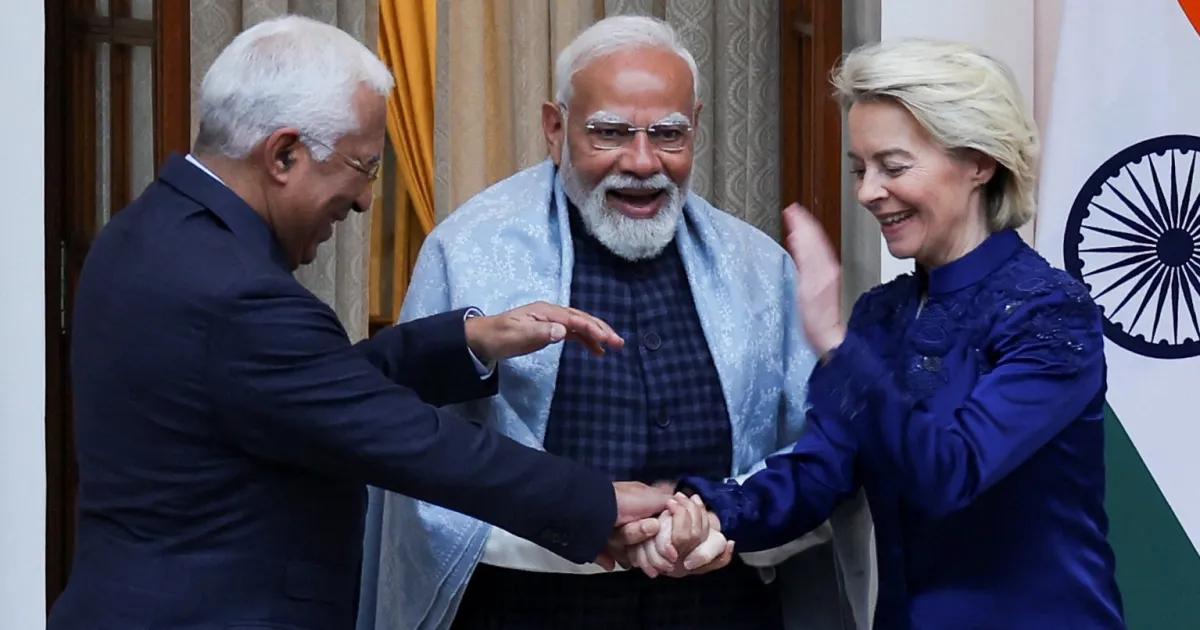
The agreement, announced Tuesday during a high-profile summit in New Delhi attended by Indian Prime Minister Narendra Modi, European Commission President Ursula von der Leyen, and European Council President António Costa, arrives at a pivotal moment for global trade architecture. Both economic powerhouses face steep tariffs imposed by United States President Donald Trump’s administration, which has slapped India with 50% combined tariffs—half of that specifically punishing New Delhi for its continued purchases of discounted Russian oil—while maintaining a 15% tariff regime on EU imports despite an existing trade framework.
“Europe and India are making history today,” von der Leyen declared in a post on X, adding that “We have concluded the mother of all deals. We have created a free trade zone of two billion people, with both sides set to benefit.” Modi, speaking at the India Energy Week conference and later at a joint press conference with EU leaders, described the partnership as strengthening “stability in the international system” at a time of “turmoil in the global order.”
The deal’s strategic significance extends well beyond tariff reductions. It marks a fundamental realignment of global trade relationships as traditional allies of the United States—both India and Europe—seek to reduce dependence on Washington’s volatile trade policies while positioning themselves for an era of intensifying economic multipolarity.
Build the future you deserve. Get started with our top-tier Online courses: ACCA, HESI A2, ATI TEAS 7, HESI EXIT, NCLEX-RN, NCLEX-PN, and Financial Literacy. Let Serrari Ed guide your path to success. Enroll today.
Trump’s Aggressive Trade Tactics Accelerate Deal Timeline
The India-EU negotiations, first launched in 2007, had languished for years over fundamental disagreements on agriculture, automotive tariffs, and market access. Trade talks collapsed in 2013 and were only relaunched in 2022 following Russia’s full-scale invasion of Ukraine, which disrupted European energy supplies and accelerated Brussels’ push for “strategic autonomy”—a catchphrase that in practice translates to reducing economic dependence on unreliable partners.
However, the final breakthrough came under direct pressure from Trump’s trade war tactics. The U.S. president’s threats of punitive tariffs against European allies over their objections to his demands to annex Greenland—a semi-autonomous territory of EU member Denmark—created what officials described as a widespread “sense of betrayal” across Europe. Trump’s embrace of far-right political parties and his onslaught of higher tariffs shattered long-held assumptions about transatlantic economic partnership.
For India, the calculus was equally stark. Trump imposed an initial 25% tariff on Indian goods last year, then added another 25% specifically as punishment for New Delhi’s oil imports from Russia, bringing total U.S. tariffs on Indian products to 50%—among the highest faced by any major economy. India’s petroleum minister, Hardeep Singh Puri, defended his country’s Russian oil purchases by citing the need for cheap energy to power a nation of 1.4 billion people.
The Trump administration’s response to the India-EU deal was swift and negative. Treasury Secretary Scott Bessent criticized Brussels, telling ABC News: “We have put 25% tariffs on India for buying Russian oil. Guess what happened last week? The Europeans signed a trade deal with India. They [the Europeans] are financing the war against themselves,” according to Al Jazeera.
Despite Washington’s disapproval, both India and the EU proceeded with finalization, signaling their determination to chart independent economic courses. “India has taken a policy of strategic patience [in dealing with Trump’s trade war],” former Indian diplomat Anil Trigunayat told Al Jazeera. “The deal with the EU is part of the same process to cushion the impact and find new partners.”
Comprehensive Tariff Reductions: What Changes and When
The India-EU free trade agreement represents the most ambitious trade pact either side has ever concluded, with India agreeing to eliminate or reduce tariffs on 96.6% of EU exports while Brussels will reciprocate by cutting duties on 99.5% of Indian shipments over seven years.
For European exporters, the deal promises dramatic market access improvements. Indian tariffs on 30% of EU goods will fall to zero immediately upon implementation, with phased reductions covering the remainder. The European Commission estimates the agreement will save up to 4 billion euros ($4.7 billion) annually in duties on European products.
Automobiles and Machinery
Perhaps the most dramatic changes affect the automotive sector. India currently imposes a 110% tariff on imported cars—effectively pricing European vehicles out of reach for all but the wealthiest consumers. Under the new agreement, these tariffs will gradually decline to as low as 10%, albeit subject to quota systems. Tariffs on car parts will be fully eliminated over five to ten years.
India has agreed to allow up to 250,000 European-made vehicles to enter annually at preferential duty rates—a quota more than six times larger than India has granted in other recent trade deals. This provision particularly benefits German, French, and Italian automakers who have long viewed India’s rapidly expanding middle class as a crucial growth market but faced prohibitive import barriers.
Machinery and electrical equipment—by far the EU’s largest export category to India, worth €16.3 billion in 2024—currently face tariffs up to 44%. These duties will be mostly eliminated over periods of five to ten years. For aircraft and spacecraft exports, valued at €6.4 billion last year, existing tariffs up to 11% will be phased out entirely.
Wine, Spirits, and Agricultural Products
European agricultural exporters secured some of the most striking concessions. Indian tariffs on wine imports—currently an eye-watering 150%—will plummet to between 20% and 30% for premium wines, with spirits seeing duties cut from 150% to a flat 40%, and beer tariffs reduced from 110% to 50%.
Olive oil will experience one of the most complete transformations, with tariffs up to 45% fully eliminated, opening doors for Mediterranean exporters to penetrate India’s growing middle-class consumer market beyond premium niches. “Under this agreement, European wines, spirits, beers, olive oil, confectionary, and other products will enjoy preferential access to the rapidly growing Indian market,” said Christophe Hansen, EU Commissioner for Agriculture and Food.
Chemical exports to India, currently valued at €3.2 billion and subject to tariffs up to 22%, will see most duties scrapped immediately upon the agreement’s entry into force. Pharmaceutical exports amounting to €1.1 billion and facing approximately 11% tariffs will be fully liberalized over staging periods of five to seven years.
Indian Export Gains
For India, the agreement delivers crucial relief to labor-intensive sectors devastated by Trump’s 50% tariffs. Textiles, apparel, marine products, leather goods, footwear, chemicals, plastics, sports goods, toys, gems, and jewelry will all incur zero duty once the agreement enters force. These sectors account for $33 billion in exports and were previously subject to EU tariffs ranging from 4% to 26%.
“This should boost India’s export competitiveness in these sectors, which are currently under strain due to higher US tariffs,” said Sonal Varma, chief economist for India and Asia ex-Japan at Nomura. India’s Commerce and Industry Minister Piyush Goyal predicted the textile sector alone could generate six to seven million jobs, noting it is India’s second-largest employer after agriculture.
Strategic Exclusions and Sensitive Sectors
Recognizing political realities, both sides agreed to exclude their most sensitive sectors from full liberalization. India kept dairy products—milk, cheese, and related items—entirely out of the agreement, citing “domestic sensitivities” about protecting smallholder farmers. New Delhi similarly excluded cereals from tariff concessions.
The EU, for its part, refused to allow preferential treatment for imports of Indian sugar, meat, poultry, and beef products to protect European farmers who have historically resisted agricultural trade liberalization. This approach reflects what EU Trade Commissioner Maroš Šefčovič described as a “new philosophy” in negotiations: “Being very clear in saying: if this is sensitive for you, let’s not touch it.”
This pragmatic strategy—sheltering politically explosive sectors while liberalizing the vast remainder of trade—proved crucial to overcoming the impasse that had stalled negotiations for years. Traditional EU-India talks foundered precisely because both sides insisted on comprehensive agreements that touched every sector, including agriculture and automobiles where domestic political pressures made concessions nearly impossible.
Beyond Tariffs: Services, Investment, and Mobility
The India-EU agreement extends well beyond goods trade to encompass services, investment frameworks, and labor mobility—areas where previous Indian trade deals have been notably limited.
India and the EU established a framework allowing temporary entry and stay for professionals, including business visitors, intra-corporate transferees, contractual service suppliers, and independent professionals. Brussels has offered binding commitments on student mobility and post-study work visas—addressing longstanding Indian complaints about European visa restrictions hampering professional services exports.
The services component covers 144 sectors, potentially opening European markets to India’s massive IT services industry while granting European financial services, telecommunications, and professional services firms improved access to India’s rapidly growing economy.
One decision can change your entire career. Take that step with our Online courses in ACCA, HESI A2, ATI TEAS 7, HESI EXIT, NCLEX-RN, NCLEX-PN, and Financial Literacy. Join Serrari Ed and start building your brighter future today.
Defense and Security Partnership: A Strategic Layer
Parallel to the trade agreement, India and the EU announced the launch of a security and defense partnership similar to frameworks Brussels maintains with Japan and South Korea. EU foreign policy chief Kaja Kallas and Indian External Affairs Minister Subrahmanyam Jaishankar signed the strategic pact, marking a significant deepening of cooperation beyond commercial ties.
This defense dimension reflects geopolitical realignments driven by both parties’ desire to reduce dependence on traditional partners. India, which has relied on Russia for key military hardware for decades, has been diversifying suppliers and pushing domestic defense manufacturing. Europe, traditionally reliant on U.S. security guarantees, is exploring alternative partnerships as Trump questions NATO commitments and pressures allies on defense spending.
The parallel announcement of trade and security agreements signals Modi and von der Leyen’s intention to build a comprehensive strategic partnership spanning economic, technological, and defense domains—creating an Indo-European axis independent of Washington’s increasingly unpredictable policies.
Market Reactions and Industry Impact
Financial markets offered an immediate verdict on the deal’s competitive implications. In India, shares of automotive and alcoholic beverage companies plunged on news of the agreement. Maruti Suzuki, the Japanese-owned market leader, saw its stock fall 1.5%, while Korean company Hyundai Motor India dropped 3.6%. Domestic manufacturers Tata Motors and Mahindra & Mahindra declined 1.3% and 4.2% respectively, as investors anticipated intensified competition from European imports at much lower prices.
Indian alcoholic beverage producers similarly faced sell-offs as traders priced in the threat from French wines, Italian spirits, and German beers entering the market at drastically reduced tariffs. The Indian government sought to soften concerns by emphasizing that reciprocal market access in the EU would create export opportunities for Indian-made automobiles and beverages, though these sectors remain far less developed than their European counterparts.
For European exporters, industry groups and business executives in Germany—the EU’s largest economy—responded positively, as did members of Chancellor Friedrich Merz’s ruling coalition in Berlin. The agreement promises to double EU goods exports to India by 2032, according to European Commission projections, with pharmaceutical, machinery, and automotive sectors positioned for substantial gains.
Implementation Timeline and Political Hurdles
Despite Tuesday’s announcement, the agreement will not take effect immediately. The final text must undergo legal vetting in both Brussels and New Delhi—a process expected to last five to six months, according to Indian officials familiar with the matter. Following legal review, the European Parliament must ratify the agreement before implementation.
India’s Commerce Minister Piyush Goyal said he expected the deal to come into force by the end of 2026, though trade analysts caution that unforeseen political complications or technical disputes over implementation details could extend the timeline.
The ratification process in the European Parliament may encounter resistance from agricultural constituencies concerned about potential future liberalization, despite current protections for sensitive sectors. Indian domestic politics could similarly complicate implementation if opposition parties characterize automotive tariff reductions as threatening domestic manufacturers.
Strategic Autonomy and the Fracturing of Global Trade
The India-EU agreement represents the latest and largest piece of Brussels’ aggressive push to reduce economic dependence on both the United States and China. Over the past year, von der Leyen has signed major trade deals with Japan, Indonesia, Mexico, and the Mercosur bloc comprising Argentina, Brazil, Paraguay, and Uruguay—all pursued under the banner of “strategic autonomy.”
For India, the EU pact is the fourth major trade agreement since Trump imposed punitive tariffs last August. Modi’s government has concluded deals with the United Kingdom, Oman, and New Zealand, while actively pursuing partnerships with Chile, Peru, and the Gulf Cooperation Council. This diplomatic offensive aims to diversify export destinations and reduce vulnerability to any single market’s trade policies.
“This is the most comprehensive trade deal India has ever signed, which gives European companies a first-mover advantage into this market and gives them a strategic upper hand that other players do not,” said Garima Mohan, a senior fellow at the German Marshall Fund.
Trade between India and the EU currently stands at $136.5 billion, making the bloc one of India’s largest trading partners alongside the United States and China. Both sides project the agreement will increase bilateral trade to approximately $200 billion by 2030—a nearly 50% expansion that would significantly rebalance India’s trade relationships away from U.S. dependence.
The Geopolitical Subtext: Russia, China, and Multipolar Trade
The timing and substance of the India-EU deal cannot be separated from broader geopolitical reconfiguration. India’s continued purchase of Russian oil—the stated justification for half of Trump’s 50% tariff—reflects New Delhi’s determination to maintain strategic autonomy in foreign policy, refusing to fully align with Western sanctions against Moscow despite pressure from Washington and Brussels.
The EU’s decision to proceed with a comprehensive trade deal despite India’s Russia ties represents a pragmatic acknowledgment that fragmenting global trade into rigid blocs serves neither European nor Indian interests. Brussels needs access to India’s vast and growing market; New Delhi requires European technology, investment, and market access. Both recognize that insisting on complete alignment on Russia policy would torpedo mutually beneficial economic integration.
Similarly, both parties view the agreement as a hedge against excessive dependence on China—though for different reasons. The EU seeks to reduce reliance on Chinese manufacturing and supply chains, particularly in strategic sectors like pharmaceuticals and electronics. India, which has tense border relations with China and competes directly with Chinese manufacturing in textiles and labor-intensive goods, sees European market access as a way to strengthen its position vis-à-vis Beijing.
“You have two big economic players coming together, which is a signal to the US that they are willing to move forward with their own agenda,” Harsh Pant, vice president of the New Delhi-based Observer Research Foundation, told Al Jazeera.
What the Deal Means for Workers and Consumers
Beyond geopolitical maneuvering and tariff schedules, the India-EU agreement will reshape daily economic life for workers and consumers across both regions.
For European consumers, reduced Indian tariffs on automobiles mean access to more affordable cars, including potential exports from European manufacturers’ Indian production facilities. Lower duties on Indian textiles, leather goods, and handicrafts should translate to reduced retail prices, though the magnitude depends on how much of the tariff savings suppliers pass through to end consumers versus capturing as improved margins.
European workers face a more complex picture. Increased exports to India—particularly in high-value sectors like machinery, chemicals, pharmaceuticals, and automobiles—should support employment in manufacturing and related supply chains. The European Commission estimates EU trade with India already supports around 800,000 jobs across the bloc, with the agreement expected to reinforce employment as trade volumes expand.
However, workers in sectors competing with Indian imports—particularly textiles and some manufactured goods—may face intensified pressure. Labor unions in southern European countries with significant textile industries will watch implementation closely, though EU exclusion of the most sensitive agricultural sectors should limit political backlash.
For Indian consumers, dramatically lower tariffs on European wines, spirits, automobiles, and luxury goods will make previously unaffordable products accessible to the expanding middle class. A bottle of French wine currently priced at multiples of its European retail cost due to 150% tariffs will see prices plummet, potentially creating mass markets where only niche premium segments existed before.
Indian workers, particularly in export-oriented sectors like textiles, gems and jewelry, leather goods, and footwear, stand to benefit substantially from duty-free access to European markets. Goyal’s projection of six to seven million textile jobs reflects the sector’s labor intensity and the potential scale of EU market penetration once tariff barriers fall.
Conversely, workers in protected sectors like automotive manufacturing may face adjustment pressures as European competition intensifies. The Indian government has sought to frame this as ultimately beneficial, arguing that exposure to global competition will drive domestic manufacturers to improve quality and efficiency while consumers gain access to superior products.
The U.S. Dimension: Can Washington Be Ignored?
Despite the historic significance of the India-EU pact, neither party can afford to ignore the United States entirely. The U.S. remains India’s largest export market and a crucial source of technology, investment, and strategic partnership. India’s total exports to six major EU markets—Netherlands, Germany, Italy, Spain, France, and Belgium—totaled $43.8 billion in the nine months ending December 2025, compared to $65.88 billion to the U.S. alone.
Trade analysts emphasize that while the EU deal provides India valuable diversification and leverage, it cannot substitute for resolution of the U.S. tariff dispute. Modi’s government continues seeking a bilateral trade agreement with Washington, though Trump’s unpredictable approach to negotiations has made progress difficult.
For Europe, the U.S. remains the largest trading partner, accounting for 17.3% of the bloc’s total trade in goods compared to India’s 2.4%. European officials view the India deal not as abandoning transatlantic economic ties but as creating alternatives and bargaining leverage should U.S. trade policy continue on its current erratic trajectory.
The fundamental question confronting both India and the EU is whether Trump’s trade wars represent a temporary aberration that will reverse with future U.S. administrations, or a structural shift requiring permanent reorientation of trade relationships. The comprehensive nature of the India-EU agreement—covering not just tariffs but services, investment, labor mobility, and strategic defense cooperation—suggests both parties are preparing for the latter scenario.
Conclusion: A New Chapter in Global Trade Architecture
The India-EU free trade agreement represents more than the sum of its tariff schedules and sector-by-sector market access commitments. It marks a fundamental reconfiguration of global economic architecture as major democracies seek stability and predictability in partnerships beyond Washington’s orbit.
“Ultimately, the agreement is about creating a stable commercial corridor between two major markets at a time the global trading system is fragmenting,” Indian trade analyst Ajay Srivastava told the Associated Press.
Von der Leyen framed the pact as proof that “rules-based cooperation still delivers great outcomes” and sends “a strong message that cooperation is the best answer to global challenges”—a pointed rebuke to Trump’s transactional, tariff-heavy approach to international economic relations.
Whether the “mother of all deals” delivers on its ambitious promises depends on implementation details, political will to overcome inevitable disputes, and the broader trajectory of global trade policy. But its conclusion after two decades of failed negotiations demonstrates that Trump’s aggressive tactics, intended to pressure trading partners into submission, may instead accelerate their pivot toward one another—reshaping global commerce in ways Washington neither intended nor can easily reverse.
For the 2 billion people living under the agreement’s eventual jurisdiction, the coming months and years will reveal whether this historic pact translates its impressive statistical scope into tangible improvements in prosperity, opportunity, and economic security. The stakes could hardly be higher—not just for India and Europe, but for the future architecture of global trade in an increasingly multipolar world.
Ready to take your career to the next level? Join our Online courses: ACCA, HESI A2, ATI TEAS 7 , HESI EXIT , NCLEX – RN and NCLEX – PN, Financial Literacy!🌟 Dive into a world of opportunities and empower yourself for success. Explore more at Serrari Ed and start your exciting journey today! ✨
Track GDP, Inflation and Central Bank rates for top African markets with Serrari’s comparator tool.
See today’s Treasury bonds and Money market funds movement across financial service providers in Kenya, using Serrari’s comparator tools.
photo source: Google
By: Montel Kamau
Serrari Financial Analyst
28th January, 2026