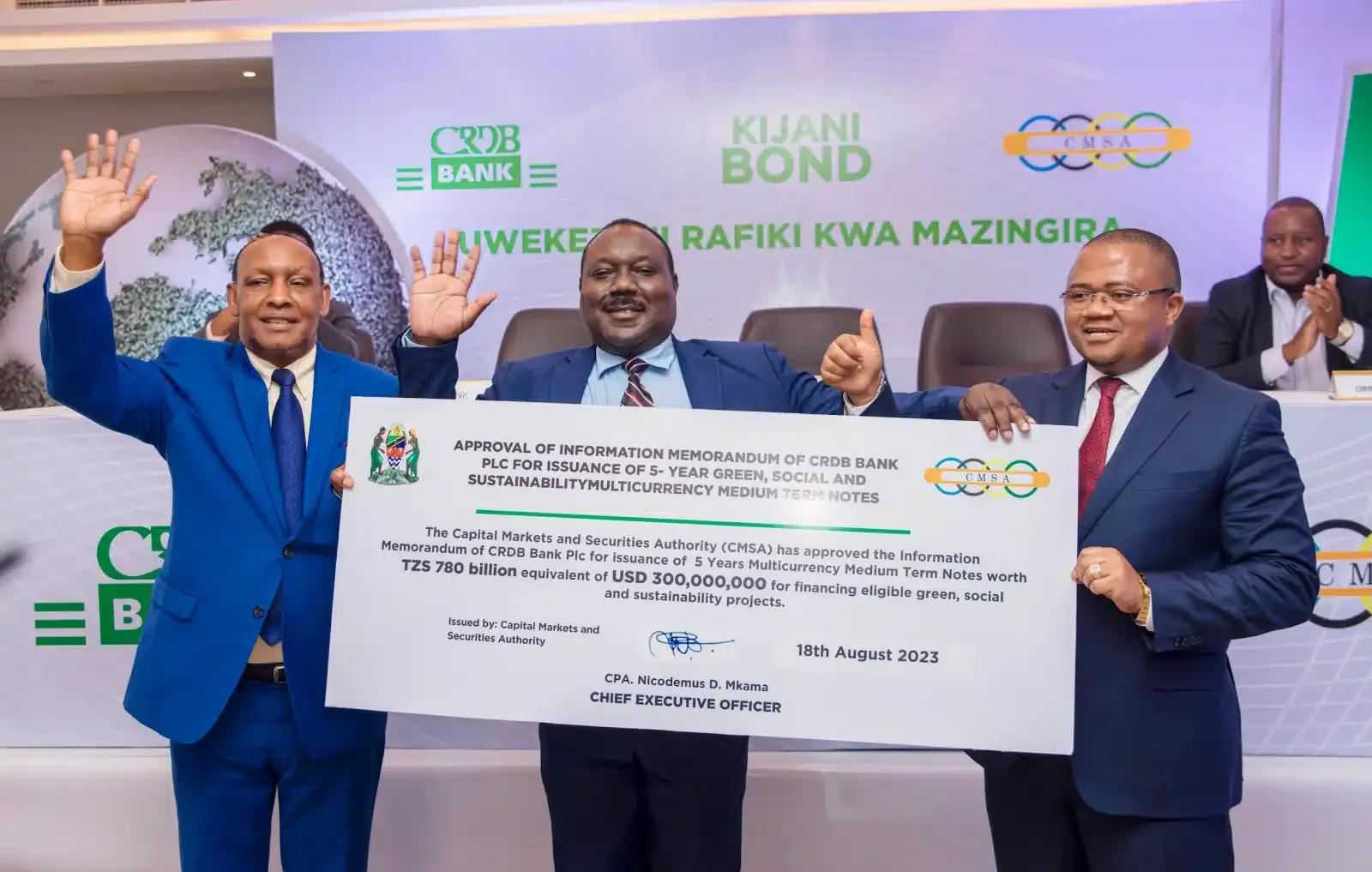
The landscape of sustainable finance in Tanzania entered a transformative new era when CRDB Bank successfully launched the Kijani Bond, marking a watershed moment not only for the East African nation but for the entire Sub-Saharan region. This groundbreaking financial instrument represents the largest green bond ever issued by a corporate entity listed on a stock exchange across Sub-Saharan Africa, signaling Tanzania’s emergence as a serious player in the global green finance arena.
At a prestigious launch event held at the Serena Hotel in Dar es Salaam, Hon. Prof. Kitila Mkumbo, Minister of State in the President’s Office for Investment and Planning, praised CRDB Bank for ushering in this new chapter of sustainable investment. The minister’s endorsement underscored the strategic importance of this initiative, acknowledging CRDB Bank’s pivotal role in providing local institutions with a viable pathway to harness the transformative potential of green bonds. His remarks highlighted the Tanzanian government’s unwavering commitment to fostering an enabling environment for investors through the continuous enhancement of existing policies, laws, and regulatory frameworks.
Build the future you deserve. Get started with our top-tier Online courses: ACCA, HESI A2, ATI TEAS 7, HESI EXIT, NCLEX-RN, NCLEX-PN, and Financial Literacy. Let Serrari Ed guide your path to success. Enroll today.
A Bold Step Toward Climate Finance
The issuance of the Kijani Bond carries profound significance within the context of Tanzania’s broader development aspirations. With its multi-currency Medium Term Note Programme valued at USD 300 million, this financial instrument represents a monumental stride toward realizing Tanzania’s National Financial Sector Development Master Plan 2020/21 – 2029/30. This strategic blueprint was designed to empower both public and private sectors, ultimately contributing to the greater welfare of the Tanzanian people through innovative financial solutions.
The bond’s architecture reflects careful consideration of accessibility and market dynamics. CRDB Bank’s Group CEO and Managing Director, Abdulmajid Nsekela, emphasized that the Kijani Bond shatters common misconceptions about green bonds being exclusively reserved for wealthy or institutional investors. With a minimum initial investment of just TZS 500,000 (approximately USD 200), the instrument democratizes access to sustainable investment opportunities, enabling even average Tanzanian citizens to participate in and benefit from climate-positive financial products.
What sets the Kijani Bond apart in an increasingly competitive financial landscape is its attractive yield structure. The bond offers an impressive 10.25% interest per annum, payable twice annually, providing investors with regular income streams while simultaneously contributing to environmental sustainability. This compelling return profile, coupled with the inherent stability that insulates investors from market fluctuations, positions the Kijani Bond as a particularly attractive proposition in an era of economic uncertainty.
Overwhelming Market Response and International Recognition
The market’s response to the Kijani Bond exceeded even the most optimistic projections. The offer period, spanning from August 31 to October 6, 2023, witnessed an extraordinary level of investor enthusiasm. The bond was oversubscribed by 429.55%, raising TZS 171.82 billion against an initial target of TZS 40 billion. This remarkable achievement attracted 1,754 investors, with an impressive 99% being Tanzanian citizens, demonstrating robust domestic confidence in both the financial instrument and the nation’s commitment to sustainable development.
Following the successful subscription period, the bond achieved another significant milestone by securing a listing on the Dar es Salaam Stock Exchange in November 2023. Mary Mnisawa, CEO of the DSE, projected that the listing would significantly amplify trading activities at the exchange, potentially doubling the average from TZS 150 billion to over TZS 300 billion. This dramatic increase in market capitalization would strengthen Tanzania’s capital markets infrastructure and enhance liquidity for investors.
The international financial community’s endorsement arrived in the form of substantial support from the International Finance Corporation, a member of the World Bank Group. IFC’s decision to invest 29.3% of the bond issuance, equivalent to USD 20 million in Tanzanian shillings, sent a powerful signal to global investors about the instrument’s credibility and potential impact. Amena Arif, IFC Country Manager for Tanzania, emphasized that mobilizing resources for climate mitigation and adaptation in the country requires strong private sector support, positioning CRDB Bank as a strategic partner in increasing access to local currency financing for businesses pursuing green and inclusive growth.
The bond’s international recognition reached new heights when it was listed on the Luxembourg Stock Exchange’s Green Exchange (LGX) platform in July 2024, marking its debut for an initial five-year period maturing in October 2028. The LGX, established in 2016 as the world’s first platform dedicated exclusively to sustainable securities, has become the international reference point for sustainable finance. Its eligibility requirements for green bond listing cover categories such as clean transportation, green buildings, energy efficiency, sustainable water management, pollution prevention, and renewable energy.
Addressing Tanzania’s Critical Climate Finance Needs
Tanzania’s participation in the global green bond market comes at a critical juncture for the nation. The country faces significant climate-related challenges, with the United Nations estimating that climate hazards could potentially wipe up to 2% off Tanzania’s GDP per year by 2030. These projections underscore the urgent need for robust climate adaptation and mitigation strategies backed by substantial financial resources.
The Tanzanian government has committed to reducing greenhouse gas emissions economy-wide between 30-35% relative to the Business-As-Usual scenario by 2030, an ambitious target that carries an estimated price tag of approximately USD 19.2 billion. This enormous funding requirement highlights the crucial role that innovative financial instruments like the Kijani Bond must play in mobilizing both domestic and international capital for climate action.
Tanzania’s vulnerability to climate change is compounded by the fact that over half of its population lives below the poverty line and depends heavily on weather-sensitive activities such as rain-fed agriculture, herding, and fishing for their livelihoods. Limited financial buffers and low levels of education and healthcare further impede communities’ ability to adapt to the adverse consequences of climate change, raising vulnerabilities to food insecurity and income losses.
Strategic Framework and Implementation
The Kijani Bond represents the first tranche of CRDB Bank’s comprehensive Green, Social, and Sustainability Bond Framework, designed to finance projects across multiple critical sectors. The proceeds from this pioneering instrument will be directed toward sponsoring environment-friendly projects aimed at mitigating climate change impacts in sectors including renewable energy, infrastructure development, water supply systems, sustainable manufacturing, and green construction initiatives.
According to projections shared during the launch, CRDB Bank aimed to raise upwards of USD 22 million in the first year of the bond’s operation. The bank anticipated that upon full operationalization, the bond would yield USD 37.34 million in the 2024/25 fiscal year, USD 78.84 million in 2025/26, and USD 83 million in both 2026/27 and 2027/28. These substantial capital flows are expected to catalyze significant environmental and social benefits across Tanzania’s development landscape.
Dr. Ally Laay, CRDB Bank’s Board Chairman, emphasized that both local and international investors would have opportunities to benefit from this innovative financial instrument, as it offers financing in both Tanzanian Shillings and US Dollars. This dual-currency structure provides flexibility for diverse investor profiles while also contributing to addressing the country’s foreign currency shortage challenges.
One decision can change your entire career. Take that step with our Online courses in ACCA, HESI A2, ATI TEAS 7, HESI EXIT, NCLEX-RN, NCLEX-PN, and Financial Literacy. Join Serrari Ed and start building your brighter future today.
Institutional Support and Expert Partnerships
The successful launch and implementation of the Kijani Bond required extensive collaboration among various specialized institutions, each bringing critical expertise to different aspects of the initiative. FSD Africa provided essential technical assistance throughout the bond issuance process, ensuring alignment with international best practices in sustainable finance.
Stanbic Bank assumed the pivotal role of lead underwriter and book runner for the green bond issue, leveraging its extensive experience in capital markets to ensure successful distribution and pricing. Denton Tanzania Law Chamber provided comprehensive legal advisory services, navigating the complex regulatory landscape governing securities issuance in Tanzania and ensuring full compliance with both national and international standards.
Orbit Securities Tanzania served as the sponsoring broker, facilitating market access and investor outreach. KPMG was entrusted with the responsibilities of the reporting accountant, ensuring transparent and accurate financial reporting throughout the bond’s lifecycle. Sustainalytics, an internationally recognized provider of environmental, social, and governance research and ratings, delivered a crucial second-party opinion, verifying the adequacy of CRDB Bank’s Green, Social, and Sustainability Bond Framework and its alignment with the principles and recommendations issued by the International Capital Market Association (ICMA).
Nicodemus Mkama, CEO of the Tanzania Capital Market and Securities Authority (CMSA), lauded CRDB Bank for achieving this historic milestone and reaffirmed the bond’s alignment with international standards. His endorsement emphasized the regulatory authority’s expectation that the Kijani Bond would prove instrumental in further developing green financing infrastructure throughout Tanzania, setting the stage for significant growth in climate finance across the nation.
Impact on Communities and Environmental Progress
The tangible impacts of the Kijani Bond have already begun to materialize across Tanzania’s diverse communities. According to statements from the Luxembourg Green Exchange, CRDB’s green bond has empowered thousands of women and youth-led businesses, supported climate-smart farming practices, and improved livelihoods across the country. These outcomes demonstrate that green bonds can deliver measurable social benefits alongside environmental improvements.
The bond’s focus on climate-smart agriculture has proven particularly significant given Tanzania’s heavy dependence on agricultural production. By financing projects that enhance agricultural resilience to climate variability, the Kijani Bond contributes directly to food security while reducing the sector’s environmental footprint. Investments in improved irrigation systems, drought-resistant crop varieties, and sustainable farming techniques are helping Tanzanian farmers maintain productivity despite increasingly erratic rainfall patterns.
Infrastructure projects financed through the bond are addressing critical development gaps while incorporating environmental sustainability principles. Renewable energy installations are expanding access to clean, reliable electricity in rural communities, reducing reliance on fossil fuels and lowering greenhouse gas emissions. Water supply projects are improving access to safe drinking water while incorporating sustainable management practices that protect vital water resources for future generations.
Broader Context: Africa’s Green Finance Challenge
The Kijani Bond’s success must be understood within the broader context of Africa’s chronic underrepresentation in global green finance markets. Despite bearing disproportionate climate change impacts while contributing minimally to global emissions, Africa accounted for less than 1% of the USD 2.2 trillion global green bond market as of 2023. This stark disparity highlights the enormous untapped potential for sustainable finance growth across the continent.
Several structural barriers have historically constrained Africa’s participation in green bond markets. Low liquidity and underdeveloped capital markets across many African nations have limited the potential for green bond proliferation. High perceived investment risks, often driven more by perception than reality, have deterred international investors despite the continent’s abundant natural capital and renewable energy potential. The lack of robust institutional and policy frameworks in some jurisdictions has further complicated efforts to scale green finance initiatives.
Tanzania’s success with the Kijani Bond offers a replicable model for other African nations seeking to tap into global sustainable finance flows. By establishing clear regulatory frameworks, building local technical capacity, and partnering with credible international institutions, countries can overcome traditional barriers to green bond issuance and access capital at competitive rates for climate-positive development projects.
Alignment with National Development Priorities
The Kijani Bond aligns seamlessly with Tanzania’s broader national development agenda as articulated in the Third National Development Plan (FYDPIII) and the Tanzania National Climate Change Response Strategy (NCCRS) 2021-26. These strategic frameworks prioritize the strengthening of environmental protection systems and sustainable use of natural resources as central pillars of the nation’s development trajectory.
The NCCRS 2021-26 entails a comprehensive set of adaptation and mitigation interventions across major economic sectors, designed to strengthen Tanzania’s climate change resilience while contributing to global efforts to reduce greenhouse gas emissions. The strategy takes into account Tanzania’s recent transition to lower-middle-income country status since 2020, with particular emphasis on sustainable industrialization pathways that balance economic growth with environmental stewardship.
CRDB Bank has demonstrated a long-standing commitment to environmental sustainability that predates the Kijani Bond launch. The bank has been dedicating 1% of its profits to facilitate local environmental activities, while also financing climate resilience and adaptation projects across its lending portfolio. This institutional commitment to sustainability positioned CRDB well to pioneer Tanzania’s green bond market.
Notably, CRDB Bank has achieved accreditation from the United Nations Green Climate Fund as a Direct Access Accredited entity, one of the few African financial institutions to receive this prestigious designation. This accreditation enables CRDB to access international climate finance directly, bypassing intermediaries and reducing transaction costs while expanding its capacity to finance large-scale climate adaptation and mitigation projects.
Investment Accessibility and Procedures
For prospective investors interested in participating in the Kijani Bond, CRDB Bank established multiple accessible channels to facilitate investment. Individuals can visit any of CRDB Bank’s extensive branch network throughout Tanzania or work through authorized brokers to complete their investment transactions. The bank made investment forms readily available through its official website at www.crdbbank.co.tz, ensuring that interested parties could easily access the necessary documentation.
For inquiries and assistance, CRDB Bank established a dedicated Customer Service Center accessible through a toll-free number, 0800008000, providing support in multiple languages to ensure that all Tanzanians could receive guidance regardless of their location or background. This commitment to accessibility reflects the bank’s broader mission of financial inclusion and democratization of investment opportunities.
Looking Toward the Future
The remarkable success of the Kijani Bond has established a strong foundation for continued innovation in Tanzania’s sustainable finance landscape. Building on this momentum, CRDB Bank launched the Samia Infrastructure Bond in early 2025, the second tranche under its five-year medium-term note programme. This subsequent infrastructure-focused bond, named in honor of President Samia Suluhu Hassan, raised TZS 323 billion and will finance urban and rural road infrastructure projects in partnership with the Tanzania Rural and Urban Roads Agency (TARURA).
The progression from the green-focused Kijani Bond to the infrastructure-centered Samia Bond demonstrates CRDB Bank’s evolving approach to sustainable finance, incorporating social sustainability alongside environmental objectives. This evolution reflects growing recognition that truly sustainable development must address interconnected social, environmental, and economic dimensions simultaneously.
Evans Osano, Director of Capital Markets at FSD Africa, aptly characterized the Kijani Bond as a trailblazing initiative that demonstrates Tanzania’s rapidly expanding green economy presents huge opportunities for both international and domestic investors. As the first green bond issued in Tanzania, it represents a major moment for the sustainable finance agenda across Africa, proving that African markets can successfully mobilize private capital for climate action at competitive rates.
The Kijani Bond’s journey from conception to successful implementation and international listing provides valuable lessons for policymakers, financial institutions, and development partners across Africa and beyond. It demonstrates that with proper regulatory frameworks, strong institutional partnerships, transparent governance, and genuine commitment to sustainability principles, developing nations can access global green finance markets and channel substantial capital toward climate-positive development.
As global attention increasingly focuses on the climate crisis and the urgent need for transformative action, Tanzania’s pioneering experience with the Kijani Bond offers hope and practical guidance for nations seeking to bridge the enormous climate finance gap. The bond’s success proves that green finance is not merely a theoretical concept confined to developed markets but a viable, scalable solution that can mobilize capital for sustainable development in emerging economies.
The environmental, social, and economic benefits already flowing from Kijani Bond-financed projects underscore the transformative potential of green bonds to deliver multiple dividends: climate resilience, improved livelihoods, economic growth, and environmental protection. As Tanzania continues to implement its ambitious climate commitments and other African nations observe its success, the Kijani Bond stands as a powerful testament to the possibilities that emerge when vision, partnership, and commitment to sustainability converge.
In an era defined by climate uncertainty and the imperative for urgent action, CRDB Bank’s Kijani Bond represents more than a financial instrument—it embodies a blueprint for climate-positive development that honors both present needs and future generations’ right to a livable planet. As the bond continues to finance renewable energy installations, sustainable agriculture, clean water systems, and climate-resilient infrastructure across Tanzania, it is writing a new chapter in Africa’s sustainable development story, one investment at a time.
Ready to take your career to the next level? Join our Online courses: ACCA, HESI A2, ATI TEAS 7 , HESI EXIT , NCLEX – RN and NCLEX – PN, Financial Literacy!🌟 Dive into a world of opportunities and empower yourself for success. Explore more at Serrari Ed and start your exciting journey today! ✨
Track GDP, Inflation and Central Bank rates for top African markets with Serrari’s comparator tool.
See today’s Treasury bonds and Money market funds movement across financial service providers in Kenya, using Serrari’s comparator tools.
photo source: Google
By: Montel Kamau
Serrari Financial Analyst
28th January, 2026