India’s infrastructure spending has surpassed three percent of gross domestic product, marking a significant milestone in the nation’s development trajectory, yet this ambitious expansion is increasingly colliding with the harsh realities of climate change as floods, cyclones, landslides, and extreme heat systematically damage highways, ports, urban assets, and hydropower projects across climatevulnerable regions. A comprehensive new analysis warns that mounting insurance premiums and deteriorating risk assessment capabilities are driving some parts of the country perilously close to the threshold of uninsurability, exposing governments, developers, and investors to escalating financial risks that could ultimately undermine India’s infrastructure-led growth strategy.
The report “Climate Risks and Insurance for India’s Infrastructure,” published by policy research organization Climate Trends, arrives at a critical juncture when Indian policymakers and business leaders gathered at the World Economic Forum in Davos to pitch India’s fast-growing economy and discuss whether the country can maintain its economic momentum while managing intensifying climate pressures. The findings present a sobering counterpoint to optimistic growth narratives, documenting how infrastructure expansion is accelerating fastest precisely in those regions most vulnerable to climate impacts, even as insurers struggle to accurately price rising and increasingly predictable climate risks.
Build the future you deserve. Get started with our top-tier Online courses: ACCA, HESI A2, ATI TEAS 7, HESI EXIT, NCLEX-RN, NCLEX-PN, and Financial Literacy. Let Serrari Ed guide your path to success. Enroll today.
Infrastructure Spending Surge Meets Climate Vulnerability
India’s infrastructure investment has reached historic levels, with the Union Budget 2025-26 allocating INR 11.21 lakh crore (USD 128.64 billion) for capital investment, representing 3.1 percent of GDP. This represents more than a fivefold increase over the past decade, reflecting the government’s commitment to infrastructure as the primary engine of economic growth. The country is constructing highways at a blistering pace of 33.8 kilometers per day, creating one of the world’s largest road networks, while simultaneously expanding ports, airports, energy grids, and urban infrastructure.
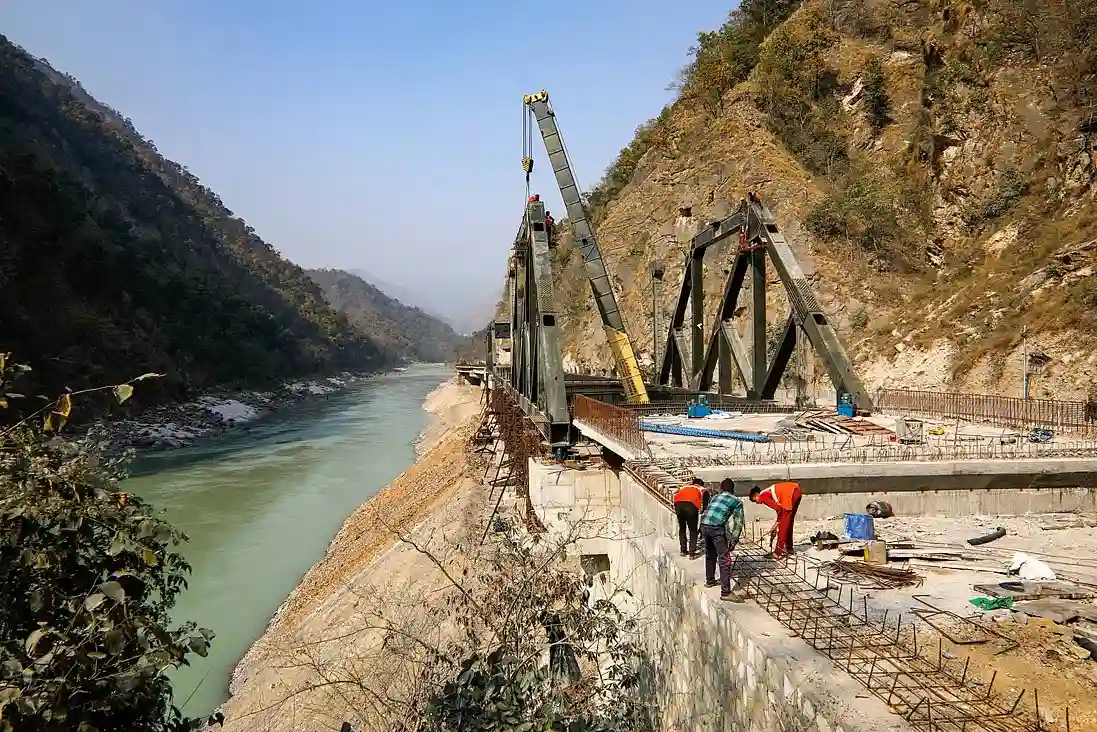
However, this unprecedented buildout is occurring against a backdrop of sharply deteriorating climate conditions. The Climate Trends analysis reveals that infrastructure expansion is concentrating in precisely those regions facing the highest climate vulnerability. States including Assam, Andhra Pradesh, Odisha, Uttarakhand, Himachal Pradesh, Sikkim, Ladakh, and parts of the Northeast represent both the most climate-vulnerable territories and the locations of massive infrastructure investments. Total investment exposure in these high-risk regions is estimated at approximately Rs 2.95 trillion, spanning ports, tunnels, highways, and major hydropower projects.
The report finds that climate impacts in India are no longer sporadic events but are rising steadily in both frequency and severity, with sharp acceleration since the mid-2010s as hydro-meteorological disasters, particularly floods, come to dominate the risk landscape. An analysis of Delhi demonstrates the widening gap between urban development and flood exposure, showing that while urban areas expanded at approximately 1.3 percent annually between 1986 and 2016, flood exposure grew much faster at around 2.46 percent—a divergence expected to widen further. This pattern repeats across India’s fastest-growing metropolitan regions, where infrastructure development proceeds with insufficient accounting for climate risk.
Hydro-Meteorological Events Define New Risk Reality
Hydro-meteorological disasters dominated India’s climate impact calendar in 2025, with flooding, extreme rainfall, cyclones, and landslides repeatedly hitting capital-intensive infrastructure. These risks were consistently ranked as high to very high—scores of four to five on a five-point scale—for urban assets, highways, ports, and hydropower projects. The recurring nature of these events is driving repeated losses, increasing insurance claims, and raising fundamental questions about long-term insurability in certain regions.
The past year provided stark illustrations of these intensifying risks. India experienced one of its hottest summers on record, with prolonged heat waves across northern and central regions disrupting construction schedules, factory output, logistics operations, and agricultural productivity. Government and industry assessments indicate that heat stress alone is already eroding between four and six percent of India’s GDP annually through lost working hours, rising health costs, and yield volatility. Urban flooding disrupted transport and municipal services across multiple tier-one and tier-two cities, while coastal regions faced increasingly intense cyclones.
What distinguishes the current moment from past climate patterns is the shift from episodic to structural impact. Climate risk has evolved from an occasional disruption into a persistent variable shaping credit assessments, project timelines, asset valuation, and public expenditure planning across India. Insurance coverage tightened sharply in high-risk zones during 2025, with higher premiums and exclusions for commercial assets becoming the norm rather than the exception.
Insurance Sector Under Mounting Stress
Interviews with insurers and reinsurers conducted for the Climate Trends report—including SBI General Insurance, Munich Re India, Swiss Re India, and the General Insurance Corporation of India—reveal mounting stress in climate risk pricing and assessment. Two-thirds of insurers reported rising premiums for infrastructure projects since 2015, while all respondents flagged affordability challenges, particularly for hydropower assets located in flood and landslide-prone terrain.
Most significantly, 100 percent of insurers surveyed indicated that existing risk models are struggling to capture evolving climate realities. Insurers cited data gaps, modeling uncertainty, and the rapidly changing frequency and severity of extreme weather events as primary obstacles to accurate risk assessment. This modeling inadequacy has profound implications—when insurers cannot accurately price risk, they face two equally problematic options: either charge premiums that may prove inadequate when claims materialize, threatening insurer solvency, or charge premiums so high that insurance becomes unaffordable, leaving infrastructure assets unprotected.
Insurers repeatedly flagged hydropower projects, national highways, and urban infrastructure in flood and landslide-prone areas as specific points of concern, with premium affordability already under severe strain. The uncertainty around future climate impacts makes underwriting increasingly complex, potentially discouraging coverage altogether or pushing risks back onto project developers and the state. This dynamic creates a protection gap where economic losses from climate events substantially exceed insured coverage—a gap that ultimately translates into fiscal liabilities for governments.
The Uninsurability Threshold Looms
The report’s most alarming finding centers on the concept of uninsurability—the point at which climate risks become so frequent, severe, or unpredictable that insurance companies cannot viably provide coverage at any premium level that policyholders can afford. The analysis concludes that as asset concentration increases and climate risks become more predictable in frequency and severity, certain parts of India could be pushed toward this threshold, with potentially devastating consequences for infrastructure development and economic stability.
Aarti Khosla, founder and director of Climate Trends, emphasized the urgency of this challenge during India’s infrastructure investment push. “As India seeks big investments at the World Economic Forum and plans double-digit nominal growth over the next five years, it would be remiss to not point out the risks to India’s infrastructure posed by climate impacts and extreme weather events,” Khosla stated. “The country’s rising exposure for its essential assets could thus lead to mounting climate-induced losses, which would be a fiscal and financial burden.”
The protection gap in India’s insurance sector is already substantial. Globally, 70 percent of economic losses caused by natural catastrophes over the past decade were uninsured, with 90 percent of these uninsured losses occurring in Asia alone. In India specifically, major cyclonic events like Cyclone Amphan in May 2020 caused economic losses exceeding Rs 950 billion, yet insured losses represented only a small fraction due to low insurance penetration. More recently, Cyclone Michaung hit Chennai and India’s east coast in early December 2023, with Tamil Nadu state government estimating losses from road and infrastructure damage alone at over Rs 50 billion.
Coverage Gaps for Critical Perils
While insurers have begun experimenting with parametric and climate-responsive products for floods, cyclones, heatwaves, and extreme rainfall, the Climate Trends report highlights a critical gap: no insurance products currently exist for cloudbursts and landslides—two of the most damaging and unpredictable hazards affecting Himalayan and northeastern regions where significant infrastructure investment is concentrated. This absence of coverage for high-impact perils creates acute vulnerability for projects in these regions.
Parametric insurance represents one innovative approach to addressing climate risks. Unlike traditional indemnity insurance that pays based on actual losses after lengthy claims assessment, parametric insurance pays predetermined amounts when weather indicators such as rainfall, temperature, or wind speed reach specified trigger levels. This approach accelerates compensation after events like floods and heatwaves, potentially making insurance more viable in high-risk environments. India’s central government is in initial discussions with domestic insurers to establish a nationwide parametric insurance program for climate-related disasters, though implementation timelines remain uncertain.
However, parametric products face their own challenges. They require robust weather monitoring infrastructure, sophisticated trigger design to minimize basis risk (the mismatch between actual losses and payouts), and actuarial expertise to price products accurately. For infrastructure assets with long operational lifespans measured in decades, designing parametric triggers that remain appropriate as climate conditions evolve presents particular difficulty.
Regulatory Challenges for IRDAI
The findings sharpen the challenge facing the Insurance Regulatory and Development Authority of India, which is simultaneously pushing insurers to deepen penetration, expand coverage, and innovate around emerging risks such as climate change while maintaining financial stability. India’s non-life insurance penetration remains around one percent of GDP, far below global levels, even as climate-linked losses rise. Recent IRDAI annual reports show insurance penetration actually declining to 3.7 percent in fiscal year 2023-24 from four percent the previous year, marking the second consecutive decline despite a six percent increase in premium collections.
This low penetration creates a vicious cycle: insufficient insurance coverage leaves individuals, businesses, and governments exposed to catastrophic losses from climate events, while simultaneously depriving insurers of the premium base and risk pooling necessary to offer affordable coverage. The climate challenge compounds this dynamic—as climate risks intensify, insurance becomes simultaneously more necessary and more difficult to provide on commercially viable terms.
The report argues that without standardized frameworks for climate risk disclosure, modeling, underwriting, premium pricing, and loss assessment, insurers may struggle to maintain solvency while keeping infrastructure insurance affordable. The Insurance Regulatory and Development Authority has identified steps to increase penetration so that by 2047 most citizens and enterprises have appropriate insurance solutions and coverage, but achieving “Insurance for All by 2047” requires addressing fundamental climate risk assessment and pricing challenges.
Recent regulatory initiatives aim to support this goal. IRDAI has introduced “use and file” procedures allowing insurance companies to launch products with increased speed to market without prior regulatory approval, encouraging innovation in areas like climate risk insurance, cyber insurance, and electric vehicle insurance. The regulator has also standardized certain protection products like Saral Jeevan Bima for life cover and Arogya Sanjeevani for health insurance to simplify purchase experiences and increase penetration.
However, these measures have yet to fully address the climate risk pricing and assessment challenges identified in the Climate Trends report. Developing robust actuarial frameworks for climate risks requires confronting fundamental uncertainty about how climate change will manifest in specific locations over coming decades—uncertainty that complicates traditional insurance pricing models based on historical loss experience.
One decision can change your entire career. Take that step with our Online courses in ACCA, HESI A2, ATI TEAS 7, HESI EXIT, NCLEX-RN, NCLEX-PN, and Financial Literacy. Join Serrari Ed and start building your brighter future today.
Fiscal Implications and Contingent Liabilities
For India’s finance ministry, the report raises concerns about rising contingent liabilities as climate risks become more frequent and predictable. When infrastructure assets remain uninsured or under-insured, losses from climate events are more likely to be absorbed through disaster relief, asset reconstruction, viability gap funding, and public guarantees. This dynamic elevates fiscal exposure, particularly given the substantial involvement of public sector banks and state-owned insurers in large infrastructure projects.
Globally, insured property losses exceeded USD 140 billion in fiscal year 2025, considerably higher than the ten-year average insured losses of approximately USD 94 billion. In India, natural catastrophe losses in 2023 reached USD 12 billion, well above the previous decade’s average, highlighting the scale of potential spillovers into public finances. Between 2019 and 2023, climate disasters caused damage worth approximately USD 56 billion in India according to the Centre for Research on the Epidemiology of Disasters.
The fiscal implications extend beyond direct disaster response and reconstruction costs. Uninsured climate losses affect tax revenues when businesses suffer setbacks, increase social welfare expenditures when households face income shocks, and potentially require government capital injections to recapitalize public sector banks and insurers facing large climate-related claims. Moreover, infrastructure projects that experience repeated climate-related losses may require ongoing government support through viability gap funding or other subsidies, creating long-term fiscal commitments.
India’s infrastructure financing gap already exceeds five percent of GDP despite substantial increases in public investment. Central government spending on infrastructure more than doubled from fiscal year 2021 to fiscal year 2024, yet private capital remains largely untapped, with institutional investors like insurance and pension funds allocating only six percent of their portfolios to infrastructure. Rising climate risk and insurance challenges could further discourage private infrastructure investment, placing even greater fiscal burden on government budgets.
Climate Resilience Integration Imperative
Khosla emphasized that climate resilience must be integrated into infrastructure planning from the outset rather than treated as a post-disaster fix. “Climate resilience must therefore be integrated into infrastructure planning from the very beginning to minimize the costs of post-disaster reconstruction,” she stated, adding that long-term insurance viability would also require “advanced actuarial models and standardized frameworks for risk disclosure, premium pricing and loss assessment.”
This resilience-first approach requires fundamental changes to infrastructure planning, design, procurement, and operation. Traditional infrastructure design standards typically rely on historical climate data to determine engineering specifications—for instance, designing drainage systems to handle historical maximum rainfall events or building coastal infrastructure to withstand historical maximum storm surge. However, as climate change renders historical conditions poor guides to future conditions, infrastructure designed to historical standards may prove inadequate.
Climate-resilient infrastructure design instead requires forward-looking climate projections to inform engineering specifications. This might involve designing drainage systems for rainfall intensities expected under future climate scenarios, elevating coastal infrastructure to account for projected sea level rise, or selecting different locations entirely for infrastructure vulnerable to emerging hazards. The Union Budget 2025-26 allocated INR 11.11 lakh crore for capital expenditure with stated aims of attracting private sector participation, yet analysts note these investments lack a climate-resilient focus despite nearly half of public infrastructure being vulnerable to climate risks.
Several specific policy mechanisms could support resilience integration. The Urban Challenge Fund announced in the budget with INR 1 lakh crore allocation seeks to transform cities into economic hubs, yet experts argue it needs explicit climate risk lens ensuring new infrastructure developments integrate heat mitigation, flood resilience, and nature-based solutions. The National Jal Jeevan Mission received INR 67,000 crore aiming for 100-percent rural tap water coverage by 2028, but lacks provisions on strengthening water security beyond basic infrastructure, such as groundwater depletion management, source sustainability, and climate resilience.
Modeling Challenges and Data Gaps
The universal acknowledgment among insurers that existing risk models inadequately capture evolving climate realities highlights fundamental challenges in climate risk assessment. Traditional actuarial approaches rely on historical loss data to predict future claim frequencies and severities. These approaches work well when underlying risk distributions remain stable over time—the fundamental assumption being that the future will resemble the past in statistically predictable ways.
Climate change violates this assumption. Historical loss distributions provide increasingly poor guides to future risk as climate conditions shift, extreme events intensify, and previously rare hazards become more frequent. This non-stationarity in climate risk distributions requires entirely different modeling approaches. Forward-looking climate risk models must incorporate climate science projections about how temperature, precipitation, sea level, and extreme event patterns will evolve under different greenhouse gas emission scenarios.
Developing such models requires integrating climate science, engineering assessments of infrastructure vulnerability, economic analysis of loss magnitudes, and actuarial expertise in translating these inputs into insurance pricing. It also requires addressing deep uncertainty—fundamental limits on predictability that arise from incomplete scientific understanding, internal climate variability, and uncertainty about future emission trajectories. This deep uncertainty complicates insurance pricing, as insurers cannot confidently predict loss distributions over policy periods, much less over the multi-decade lifespans of infrastructure assets.
Data gaps compound these modeling challenges. Comprehensive historical records of infrastructure losses from climate events remain incomplete in many Indian states. Weather monitoring networks, while improving, still have gaps in spatial coverage and variable quality. Property-level exposure data—details about infrastructure location, construction type, elevation, and other vulnerability factors—often exists in fragmented form across different government agencies and private entities rather than in integrated databases accessible for risk modeling.
International Context and Comparative Experience
India’s climate insurance challenges exist within a global context of rising climate-related insurance costs and contracting coverage in high-risk areas. In the United States, major insurers have retreated from providing coverage in California and Florida due to wildfire and hurricane risks, respectively. The recent Los Angeles wildfires, attributed by experts to climate change, occurred against a backdrop of California’s top insurer canceling hundreds of policies due to rising wildfire risk.
Globally, insured losses in 2024 amounted to USD 140 billion, considerably higher than the ten-year average. Verisk’s Global Modelled Catastrophe Losses Report estimates average annual insured property loss from natural disasters at USD 152 billion, attributing increases to inflation, urban expansion, more frequent severe weather, and climate change. In Asia specifically, the protection gap remains wide, with insurance covering only a small portion of total economic losses.
Some jurisdictions have developed alternative risk transfer mechanisms in response to insurance market stress. The UK introduced an infrastructure guarantees scheme in 2012, backing over £1.8 billion worth of projects through government guarantees to lenders and bond investors. The World Bank’s Multilateral Investment Guarantee Agency provides political risk insurance and credit enhancement in developing economies, helping unlock private capital for infrastructure.
India’s consideration of a Rs 20,000 crore risk guarantee fund managed by the National Credit Guarantee Trustee Company would underwrite project risks, providing comfort to both developers and lenders. Such mechanisms could partially address insurance gaps, though they also raise questions about moral hazard if they reduce incentives for climate-resilient project design and siting.
Fiscal and Financial Stability Dimensions
The intersection of climate risk, infrastructure investment, and insurance challenges has implications for India’s broader financial stability and fiscal sustainability. Financial institutions hold substantial exposures to infrastructure assets through direct loans, bond holdings, and equity investments. When climate events damage or destroy these assets, or when rising insurance costs and reduced coverage make infrastructure projects less viable, financial institutions face potential losses on their exposures.
The Reserve Bank of India’s Climate Risk Information System, launched in May 2025, represents a two-pronged data platform intended to bridge gaps in climate-related financial information. The platform aims to help financial institutions assess climate physical and transition risks in their lending and investment portfolios. However, the effectiveness of such tools depends on underlying data quality and climate risk modeling capabilities—the very areas where the Climate Trends report identifies significant gaps in the insurance sector.
Climate risk must be embedded into lending, underwriting, and portfolio strategy as a matter of asset quality and long-term return protection. Banks and insurers that build robust climate analytics, support credible transition finance, and price risk accurately will strengthen resilience as volatility increases. This is fundamentally about financial prudence rather than environmental ethics—climate risk that materializes in the form of asset losses, defaulted loans, or insurance claims directly impacts financial institution solvency and profitability.
Public sector banks and insurers face particular challenges. Their infrastructure portfolios include substantial exposures in climate-vulnerable regions, reflecting both development mandates to support infrastructure in underserved areas and legacy portfolios accumulated over decades. State-owned insurers have limited flexibility to withdraw from high-risk markets or dramatically raise premiums, as they face political pressure to maintain coverage availability and affordability. This dynamic can lead to underpricing of climate risk, with losses ultimately borne by government budgets when insurers require recapitalization.
Path Forward Requires Coordinated Action
The Climate Trends report concludes that with India’s infrastructure spending exceeding three percent of GDP and expanding rapidly into climate-sensitive regions, the window for integrating climate resilience and insurance reform is narrowing fast. Without coordinated action between policymakers, infrastructure developers, insurers, and financial institutions, the gap between economic ambition and climate reality could widen, posing systemic risks to India’s infrastructure-led growth model.
Several specific recommendations emerge from the analysis. First, infrastructure planning must incorporate forward-looking climate risk assessment from the earliest stages, using climate projections rather than historical data to inform siting, design, and engineering decisions. This requires building technical capacity within infrastructure agencies to work with climate science outputs and translate them into actionable planning parameters.
Second, standardized frameworks for climate risk disclosure, modeling, underwriting, and loss assessment need development and implementation across the insurance sector. This could include mandatory climate risk reporting for large infrastructure projects, development of industry-standard climate risk models by consortia of insurers and reinsurers, and regulatory guidance on appropriate approaches to climate risk underwriting. The Insurance Regulatory and Development Authority plays a critical coordinating role in developing such frameworks.
Third, innovative risk transfer mechanisms deserve exploration. These might include expanded parametric insurance products with refined trigger designs, catastrophe bonds that transfer extreme tail risks to capital markets, risk pooling arrangements allowing insurers to share exposures across geographic regions, and public-private partnerships where government provides partial risk guarantees for climate-vulnerable but strategically important infrastructure.
Fourth, investments in climate adaptation and resilience should be recognized as economically rational risk management rather than discretionary environmental spending. Climate-resilient infrastructure may cost more upfront but delivers lower lifetime costs when accounting for avoided climate damages and reduced insurance premiums. Green budgeting frameworks that track climate-related public expenditure and prioritize resilience investments can help embed this perspective in fiscal planning.
Fifth, improved data collection and sharing across government agencies, insurers, and infrastructure developers can support better climate risk modeling. This includes expanding weather monitoring networks, creating comprehensive infrastructure asset databases with vulnerability attributes, systematically documenting losses from climate events, and making relevant datasets available to modelers and researchers.
Climate as Economic Variable
As India enters 2026, climate change has crossed a decisive threshold—it is no longer an environmental externality or distant risk but a measurable economic variable shaping productivity, inflation, infrastructure resilience, financial stability, and national competitiveness. Heat stress alone erodes between four and six percent of GDP annually. Urban flooding disrupts transport and municipal services. Insurance coverage contracts in high-risk zones. Food price volatility responds to erratic rainfall. Climate risk now shapes credit assessments, project timelines, asset valuation, and public expenditure planning across the economy.
India requires approximately USD 300 billion annually in climate-related investment through 2030 to remain on a credible transition pathway toward its climate commitments. Actual flows remain well below this threshold. Global capital is available, but India’s ability to absorb it efficiently faces constraints from short-term debt, currency risk, insufficient credit enhancement, and uneven project readiness particularly at state and municipal levels. This gap is most acute in adaptation—despite being among the world’s most climate-vulnerable economies, less than one-quarter of India’s climate finance currently supports adaptation investments.
The infrastructure insurance crisis documented in the Climate Trends report represents a manifestation of this broader climate-economy integration. When insurers cannot viably cover infrastructure against climate risks, it signals that those risks are outpacing the economy’s adaptive capacity. This mismatch between economic ambition and climate reality creates systemic vulnerabilities that compound over time.
Conclusion: Urgency of Integration
The Climate Trends analysis arrives at a moment when India’s economic trajectory depends critically on sustained infrastructure investment to support growth, urbanization, and development objectives. The nation’s ambitions to become a USD 30 trillion economy by 2047 and build 100 smart cities require infrastructure expansion on an unprecedented scale. Yet the report’s findings about deteriorating insurance conditions and approaching uninsurability thresholds suggest these ambitions face fundamental constraints from climate reality.
The insurance stress signals that current infrastructure development approaches are unsustainable in a rapidly changing climate. Continuing business-as-usual buildout in high-risk regions without embedding climate resilience from the design stage will elevate both fiscal exposure and insurance costs, potentially making entire categories of infrastructure economically unviable. The challenge is compounded by India’s already-low insurance penetration—even before climate stress, most Indian infrastructure and assets remain uninsured, leaving governments as de facto insurers of last resort.
Addressing this challenge requires treating climate resilience not as an add-on or afterthought but as foundational to infrastructure planning, comparable in importance to technical feasibility and financial viability. It requires regulatory frameworks that properly account for climate risk in infrastructure finance and insurance. It requires data systems and modeling capabilities that accurately capture evolving climate hazards. Most fundamentally, it requires acknowledging that economic growth and climate adaptation are not separate agendas but intrinsically linked dimensions of sustainable development.
The window for integrating these perspectives is narrowing as climate impacts accelerate and regions approach uninsurability thresholds. Without decisive action to align infrastructure strategy with climate reality, India risks building a development path that proves financially unsustainable and economically fragile in the face of intensifying climate pressures. The stakes extend beyond individual projects or sectors to encompass the viability of India’s broader economic model and development trajectory.
Ready to take your career to the next level? Join our Online courses: ACCA, HESI A2, ATI TEAS 7 , HESI EXIT , NCLEX – RN and NCLEX – PN, Financial Literacy!🌟 Dive into a world of opportunities and empower yourself for success. Explore more at Serrari Ed and start your exciting journey today! ✨
Track GDP, Inflation and Central Bank rates for top African markets with Serrari’s comparator tool.
See today’s Treasury bonds and Money market funds movement across financial service providers in Kenya, using Serrari’s comparator tools.
photo source: Google
By: Montel Kamau
Serrari Financial Analyst
27th January, 2026