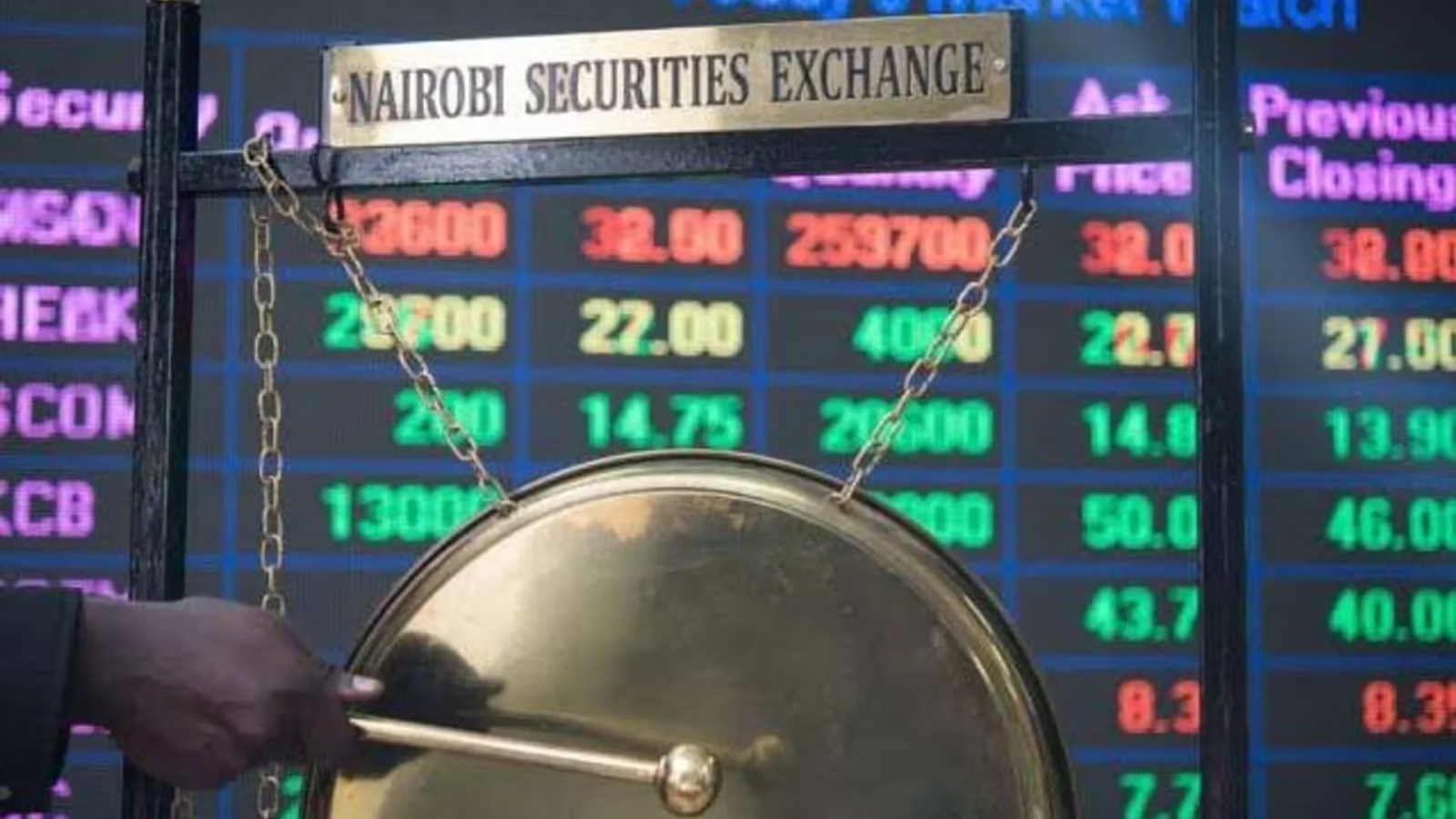
The performance of Kenya’s equity market in recent years presents a paradox that has increasingly puzzled analysts and policymakers alike. On one hand, the Nairobi Securities Exchange (NSE) has delivered its strongest back-to-back performance in more than a decade, with benchmark indices posting historic gains and market capitalization expanding rapidly. On the other hand, foreign investors—once the dominant force on the bourse—have continued to exit the market, extending a net selling streak that has now run uninterrupted for six consecutive years.
LIVENSE market summarySee NSE data →In 2025, offshore investors recorded net equity outflows of KSh 11.6 billion, prioritizing liquidity, risk reduction, and capital preservation over local market returns. This occurred despite Kenyan equities enjoying one of their most powerful rallies since the exchange’s modern benchmarks were introduced. The divergence between price performance and foreign investor behavior highlights a deeper structural shift underway at the NSE—one that is reshaping market dynamics, ownership patterns, and the role of local capital.
Build the future you deserve. Get started with our top-tier Online courses: ACCA, HESI A2, ATI TEAS 7, HESI EXIT, NCLEX-RN, NCLEX-PN, and Financial Literacy. Let Serrari Ed guide your path to success. Enroll today.
A Sixth Straight Year of Foreign Net Selling
Foreign investors have now been net sellers at the Nairobi Securities Exchange every year since 2020. While the magnitude of outflows has fluctuated, the direction has remained consistently negative. The KSh 11.6 billion net outflow recorded in 2025 followed several years of heavy drawdowns, particularly during the 2022–2024 period when global tightening cycles, geopolitical risks, and emerging market repricing accelerated capital flight.
What stands out in 2025 is not the scale of the exit—indeed, it was more moderate than in earlier years—but its persistence. Foreign investors continued to sell even as the NSE delivered its strongest two-year performance since the launch of its broad market index. This suggests that offshore capital is responding less to local equity fundamentals and more to global portfolio considerations.
Liquidity constraints, currency risk, and the opportunity cost of allocating capital to frontier markets in a high-interest-rate global environment have all weighed heavily on foreign decision-making. For many global funds, Kenya remains part of a broader emerging and frontier market basket, where allocations are adjusted based on macro risk rather than individual market performance.
Strong Returns, Weak Foreign Conviction
The contrast between market returns and foreign flows could hardly be starker. In 2025, the NSE All Share Index surged by 51.1 percent, marking its best annual performance since its inception in 2008. The rally followed another strong year in 2024, giving Kenyan equities their most impressive two-year run on record.
Other indices echoed this strength. The NSE 20 Share Index gained 56.13 percent in 2025, its best performance since 2003. Market capitalization expanded dramatically, rising from KSh 1.94 trillion at the start of the year to KSh 2.82 trillion by year-end. By January 5, 2026, total market capitalization had reached approximately KSh 2.94 trillion.
Such numbers would typically attract foreign inflows, especially in markets where valuation re-rating stories gain traction. Yet for Kenya, the opposite occurred. Offshore investors largely remained on the sidelines—or actively reduced exposure—underscoring a growing disconnect between domestic market momentum and international investor sentiment.
The Quarterly Pattern: Brief Inflows, Swift Reversals
A closer look at 2025 trading data reveals that foreign selling was not uniform throughout the year. The first quarter saw consistent net outflows as global investors maintained a defensive stance. Selling pressure eased somewhat in the second quarter, creating brief windows of optimism that foreign participation might be stabilizing.
June and August offered the most notable exceptions. In June, foreign investors posted net inflows of KSh 820 million, followed by a more substantial KSh 1.65 billion inflow in August—the strongest monthly foreign buying recorded in four years. However, these inflows proved fleeting.
September marked a sharp reversal. Nearly KSh 5.0 billion exited the market in that month alone, wiping out all gains recorded during the mid-year rebound. The selling pressure did not abate thereafter. November saw a further KSh 2.9 billion in net foreign outflows, cementing the year’s overall negative balance.
By the end of December, cumulative foreign selling had reached KSh 11.6 billion, confirming that short-term tactical inflows were insufficient to alter the broader exit trend.
One decision can change your entire career. Take that step with our Online courses in ACCA, HESI A2, ATI TEAS 7, HESI EXIT, NCLEX-RN, NCLEX-PN, and Financial Literacy. Join Serrari Ed and start building your brighter future today.
A Structural Decline in Foreign Market Participation
Beyond net flow figures, participation data reveals an even more telling story. Prior to 2019, foreign investors routinely accounted for more than 60 percent of monthly trading turnover at the NSE. In several periods, offshore participation exceeded 75 percent, giving foreign funds outsized influence over price discovery and liquidity conditions.
That dominance has steadily eroded. Since 2022, foreign participation has trended lower and become more volatile, frequently falling below 45 percent of monthly turnover. In September 2025, foreign participation dropped to just 28.0 percent—one of the lowest readings since 2010.
This decline reflects more than cyclical caution. It points to a structural realignment in which domestic investors—pension funds, insurance companies, asset managers, and retail participants—are increasingly driving market activity. The NSE is no longer a foreign-led exchange reacting primarily to offshore sentiment; it is becoming a locally anchored market with different behavioral dynamics.
Why Foreign Investors Are Staying Away
Several factors help explain why foreign investors have continued to reduce exposure despite strong equity performance.
Global Liquidity and Interest Rates
High global interest rates have reshaped capital allocation strategies. With risk-free yields elevated in developed markets, frontier equities must offer exceptional risk-adjusted returns to remain competitive. Even strong headline gains may not compensate for currency volatility and liquidity constraints.
Currency Considerations
For foreign investors, returns are measured not only in local equity performance but also in currency terms. Concerns about exchange rate stability and repatriation risk can significantly dilute the appeal of local market gains.
Portfolio Rebalancing
Kenya represents a relatively small allocation within global frontier and emerging market portfolios. When risk appetite shifts, such markets are often the first to see outflows as funds rebalance toward larger, more liquid markets.
Liquidity Constraints
While the NSE has improved in depth, liquidity remains concentrated in a handful of large-cap stocks. For sizable foreign funds, entering and exiting positions without moving prices remains a challenge.
Concentration in Blue-Chip Stocks
Foreign trading activity in 2025 remained heavily concentrated in a small group of high-value, liquid counters. Safaricom PLC continued to dominate foreign trading flows, accounting for the largest share of offshore buying and selling. The stock closed 2025 at KSh 28.35 and remained the primary liquidity anchor for foreign investors.
LIVENSE market summarySee NSE data →Major banking stocks also featured prominently. Equity Group, KCB Group, and Diamond Trust Bank all experienced significant foreign selloffs during the year.
This concentration underscores a key limitation of foreign participation: offshore investors tend to focus on a narrow universe of stocks that meet size, liquidity, and governance thresholds. As a result, their exit disproportionately affects index heavyweights even as broader market segments thrive.
Local Investors Drive the Rally
While foreign investors were selling, local capital stepped in decisively. Pension funds, insurance companies, and retail investors absorbed much of the supply, fueling a broad-based rally that lifted even previously dormant counters.
By the end of 2025, a record 13 NSE-listed stocks had more than doubled in value. Some of the standout performers included:
- Uchumi Supermarket Plc, which surged by 505.88 percent
- Sameer Africa Plc, up 486.42 percent
- Home Africa Ltd, which gained 262.16 percent
- Olympia Capital, rising by 193.53 percent
These gains highlight a shift in market leadership away from traditional blue chips toward smaller and mid-cap stocks, where local investors are often more active and patient.
Changing Market Psychology
The divergence between foreign exits and local buying has also altered market psychology. In earlier cycles, heavy foreign selling often triggered sharp corrections as domestic investors followed offshore cues. In 2024 and 2025, that pattern broke down.
Local investors increasingly viewed foreign selling as a liquidity opportunity rather than a signal of deteriorating fundamentals. This behavioral shift helped stabilize prices and, in many cases, accelerate rallies once selling pressure eased.
The result is a market that is less reactive to offshore sentiment and more influenced by domestic economic expectations, corporate earnings prospects, and dividend yields.
Implications for Market Structure
The prolonged withdrawal of foreign capital carries both risks and opportunities for the NSE.
On the positive side, greater local ownership reduces vulnerability to sudden global risk-off episodes. Markets driven by domestic savings tend to be more stable over the long term, particularly when institutional investors adopt strategic rather than speculative horizons.
However, reduced foreign participation can also limit liquidity, slow price discovery, and constrain access to international capital. It may also affect how global index providers view Kenya’s market classification, with potential implications for benchmark inclusion.
Balancing these dynamics will be a key challenge for regulators and market stakeholders in the years ahead.
What Could Bring Foreign Investors Back?
For foreign investors to return meaningfully, several conditions may need to align:
- Stabilization in global interest rate cycles
- Improved currency stability and hedging mechanisms
- Deeper market liquidity beyond a handful of blue-chip stocks
- Continued improvement in corporate governance and disclosures
While strong equity performance is necessary, it is not sufficient on its own. Foreign capital is increasingly selective and risk-sensitive, particularly when allocating to frontier markets.
A Market at an Inflection Point
The events of 2025 confirm that the Nairobi Securities Exchange is at a pivotal moment in its evolution. The market has demonstrated an ability to deliver exceptional returns even in the absence of foreign inflows, driven largely by domestic capital and renewed investor confidence.
At the same time, the sustained exit of offshore investors highlights unresolved structural challenges that continue to shape perceptions of risk and return.
Whether the next phase of growth will be fueled by a resurgence of foreign interest or a deepening of local participation remains an open question. What is clear, however, is that the NSE is no longer defined solely by foreign behavior. Its trajectory is increasingly being written at home.
Conclusion: Performance Without Participation
Foreign investors remained net sellers at the Nairobi Securities Exchange for the sixth consecutive year in 2025, even as Kenyan equities delivered record-breaking gains. The KSh 11.6 billion net outflow underscored a growing disconnect between local market performance and offshore investor behavior.
While global capital prioritized liquidity and capital preservation, domestic investors stepped in, driving one of the strongest rallies in the exchange’s history. The result is a market that is simultaneously stronger and more independent—but also more exposed to the limits of domestic liquidity.
As Kenya’s capital markets continue to mature, the challenge will be to harness the strength of local participation while rebuilding the conditions that make the market attractive to global investors. The experience of 2025 suggests that the balance of power has already begun to shift.
photo source: Google
By: Elsie Njenga
20th January, 2026