Space Exploration Technologies Corp., commonly known as SpaceX, has officially begun engaging with Wall Street’s premier investment banks in what could culminate in the largest initial public offering in history. The Elon Musk-founded aerospace manufacturer and satellite internet provider is conducting a comprehensive “bake-off” process, whereby financial institutions compete to secure advisory and underwriting roles for a potential public listing that market analysts anticipate could materialize in mid-to-late 2026.
Initial proposals from competing banks are expected to arrive in the coming weeks, setting the stage for what industry observers are calling a transformational moment for both the space industry and capital markets. While SpaceX has not officially confirmed a timeline, discussions suggest the company could pursue an IPO during a window around June or July 2026, depending on market conditions and the successful demonstration of critical technical capabilities.
Build the future you deserve. Get started with our top-tier Online courses: ACCA, HESI A2, ATI TEAS 7, HESI EXIT, NCLEX-RN, NCLEX-PN, and Financial Literacy. Let Serrari Ed guide your path to success. Enroll today.
Astronomical Valuation Projections Challenge Historical Records
Market speculation has placed SpaceX’s potential valuation in a range that would redefine the boundaries of corporate worth. The company is targeting a valuation of approximately $1.5 trillion for the entire enterprise, with the IPO seeking to raise significantly more than $30 billion in a transaction that would eclipse all previous records. These figures, while not officially confirmed by SpaceX, represent market expectations based on the company’s recent private valuations and revenue projections.
The prospective valuation would position SpaceX near the market capitalization that Saudi Aramco established during its record-breaking 2019 listing, when the state-owned petroleum giant raised $25.6 billion and achieved a market valuation of $1.7 trillion. Saudi Aramco’s debut, which overtook Apple as the world’s most valuable listed firm at the time, remains the benchmark against which all subsequent mega-IPOs are measured. On its first day of trading, Aramco’s shares surged 10 percent, pushing its valuation to $1.88 trillion and demonstrating the market’s appetite for transformational public offerings.
If SpaceX proceeds with the listing at the reported valuation levels, it would need to sell approximately five percent of the company to raise $40 billion, making it the biggest IPO of all time by a substantial margin. This surpasses not only Saudi Aramco’s $29 billion offering but also eclipses major technology listings including Alibaba’s $25 billion IPO in 2014.
Private Valuation Surge Reflects Starlink’s Explosive Growth
SpaceX’s path toward a public listing has been marked by dramatic increases in private market valuations. In December 2024, the company initiated a secondary share sale that valued SpaceX at $800 billion, according to Chief Financial Officer Bret Johnsen’s memo to shareholders. This valuation represented a doubling from the $400 billion mark established just months earlier in July 2024, demonstrating the extraordinary investor appetite for exposure to the company’s growth trajectory.
The per-share price in the latest secondary offering was set at approximately $421, nearly double the $212 per share established in the July valuation round. SpaceX structured the offering to allow employees to sell about $2 billion worth of stock while the company itself participated in buying back some shares, a strategy designed to establish fair market valuation in preparation for the IPO.
Elon Musk publicly disputed certain characterizations of these transactions, stating on social media that claims SpaceX was “raising money at $800 billion” were not accurate. He clarified that the company has been cash-flow positive for years and conducts regular stock buybacks twice annually to provide liquidity for employees and early investors. These valuation increments, Musk emphasized, are driven by concrete progress on Starlink expansion, Starship development, and global direct-to-cell spectrum acquisitions.
The secondary offering nonetheless positioned SpaceX as one of the world’s most valuable private companies, competing directly with OpenAI, which recently achieved a $500 billion valuation following a major stock transaction in October 2025. According to data from Crunchbase, SpaceX ranks as the world’s second most valuable private startup after OpenAI, though some reports place SpaceX’s $800 billion private valuation ahead of OpenAI’s earlier assessments.
Starlink: The Financial Engine Powering IPO Ambitions
Central to SpaceX’s IPO strategy is the extraordinary growth of Starlink, its satellite internet service that has evolved from an experimental venture into a multi-billion-dollar revenue generator. According to market research firm Quilty Space, Starlink is projected to reach $11.8 billion in revenue in 2025, driven by strong consumer demand and expanding U.S. military contracts. This represents a substantial increase from the estimated $7.7 billion in revenue for 2024.
The 2025 revenue projection breaks down into $7.5 billion from consumer services, $1.3 billion from hardware sales, and approximately $3 billion from U.S. government contracts, according to analysts tracking the company. Starlink’s government sector momentum has accelerated dramatically, with the service now considered an indispensable asset throughout the entire government sector, from U.S. embassies to battlefield communications.
Most notably, Quilty Space revealed a previously undisclosed $537 million Pentagon contract to provide Starlink services for Ukraine’s military forces through 2027, awarded under the U.S. Space Force’s Proliferated Low Earth Orbit program. SpaceX has secured 97 percent of awarded task orders under this program, which recently saw its ceiling raised from $900 million to $13 billion, reflecting exponential demand for satellite communications capabilities.
SpaceX’s overall revenue projections underscore Starlink’s dominant contribution to the company’s financial performance. According to people familiar with the matter, SpaceX expects to produce about $15 billion in revenue in 2025, increasing to between $22 billion and $24 billion in 2026, with the majority of sales coming from Starlink operations. This revenue trajectory positions Starlink as the company’s primary cash cow, far exceeding the contribution from traditional launch services.
Musk himself confirmed this dynamic in recent social media posts, stating that Starlink is by far the company’s greatest revenue driver and that NASA will contribute less than five percent of SpaceX’s revenue in the coming year. This statement directly countered narratives suggesting SpaceX receives substantial government subsidies, with Musk emphasizing that the company won its NASA contracts based on merit and affordability while maintaining cash-flow positive operations.
Satellite Constellation Dominance Creates Competitive Moat
Starlink’s market position stems from both its technological advantages and unprecedented scale of deployment. As of late 2025, SpaceX has launched more than 7,000 Starlink satellites into low-Earth orbit, representing approximately 60 percent of all active LEO satellites globally. This massive constellation enables the service to deliver high-speed, low-latency internet connectivity to underserved regions where traditional satellite and terrestrial providers have struggled to compete.
The service’s subscriber base has grown exponentially, from just 10,000 users in 2021 to 4.6 million by 2024, with projections suggesting the total could reach 8 million subscribers by the end of 2025. Residential subscribers generate an average revenue per user of approximately $2,000 annually, while specialized maritime services command an ARPU of roughly $34,000, and aviation services reach approximately $300,000 per user.
Key technological innovations have created what analysts describe as a “competitive moat” that rivals will find difficult to breach. These include laser inter-satellite links that reduce reliance on ground stations while enabling 5 terabits of new capacity weekly, phased array antennas delivering connectivity to both fixed and mobile users, and direct-to-device capabilities that integrate satellite connectivity into 5G networks through partnerships with major telecommunications providers.
Strategic partnerships are accelerating Starlink’s market consolidation. The collaboration with T-Mobile’s “T-Satellite” service, extended to Verizon and AT&T customers, has integrated satellite connectivity into existing cellular networks, creating hybrid infrastructure that addresses both urban and rural dead zones. These partnerships position Starlink to capture an estimated 70 percent of the LEO broadband market by 2030.
Government Contracts and National Security Integration
SpaceX’s position as a critical contractor for the U.S. government adds both substantial revenue and strategic complexity to any potential public offering. Beyond the Starlink military contracts, SpaceX serves as NASA’s primary launch provider for crew and cargo missions to the International Space Station. The company’s Falcon 9 rocket has achieved over 450 successful landings and relaunches by mid-2025, drastically reducing launch costs through reusability and attracting consistent government contracts.
NASA awarded SpaceX $2.89 billion in 2021 to develop the Artemis Human Landing System, which will transport astronauts from lunar orbit to the Moon’s surface using a modified Starship vehicle. While development has experienced delays relative to the mid-2027 target for the Artemis 3 mission, the contract represents a foundational element of America’s return to lunar exploration.
The U.S. Space Force has also invested $48 million in SpaceX for research into making Starship capable of delivering up to 90 tons of supplies anywhere on Earth within one hour, demonstrating the military’s interest in leveraging the company’s rapid launch capabilities for strategic logistics. These government relationships provide revenue stability and validate SpaceX’s technology for high-stakes applications, though they also introduce regulatory considerations that will feature prominently in IPO documentation.
Starship Development: Gateway to Mars and Deep Space Revenue
Underpinning SpaceX’s long-term valuation thesis is the Starship program, a fully reusable super heavy-lift launch vehicle designed to revolutionize space transportation economics. According to a memo from Chief Financial Officer Bret Johnsen, SpaceX is preparing for a possible 2026 public offering aimed at funding an “insane flight rate” for Starship, artificial intelligence data centers in space, and infrastructure for a lunar base.
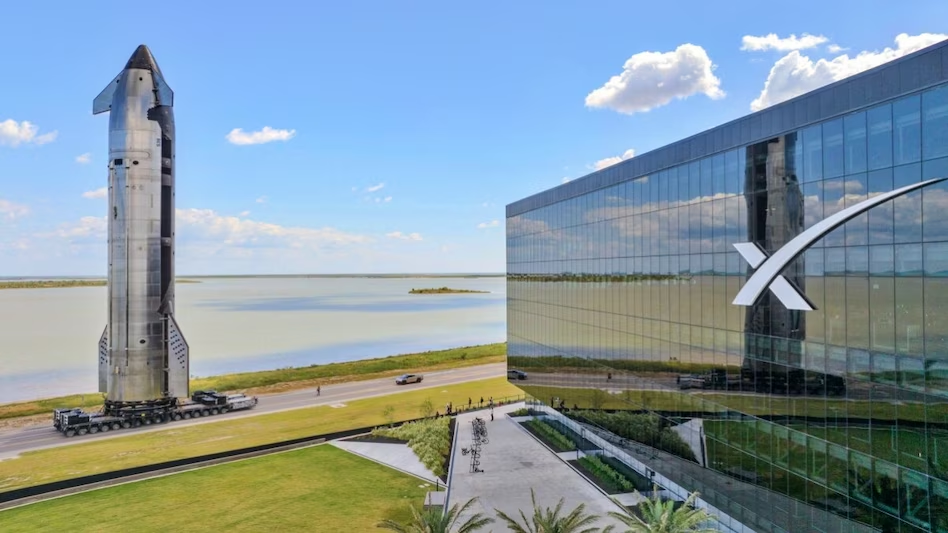
Starship consists of two key components: the Super Heavy booster and the 165-foot-tall Starship upper stage spacecraft, both designed for full reusability. The vehicle stands at an impressive 397 feet total height, making it the largest and most powerful rocket ever constructed. SpaceX has conducted multiple test flights throughout 2024 and 2025, with each successive mission demonstrating improved performance and achieving additional technical objectives.
The Mars colonization timeline remains ambitious despite historical delays. In September 2024, SpaceX announced plans to launch the first uncrewed Starship missions to Mars by 2026 during the next Earth-Mars transfer window, which occurs approximately every 26 months when the planets align favorably. These initial missions would focus on testing whether Starships can reliably land intact on Mars, with successful demonstrations potentially leading to crewed flights within approximately four years.
During a May 2025 presentation at SpaceX’s Starbase facility in Texas, Musk provided updated timelines indicating a 50 percent chance of achieving the 2026 Mars launch window, with the caveat that missing this opportunity would necessitate waiting an additional two years for the subsequent transfer window. The founder emphasized that all ingredients necessary to make life multiplanetary will be achieved with the third version of Starship, which the company aims to launch for the first time at the end of 2025.
SpaceX’s long-term vision involves establishing a self-sustaining city on Mars by approximately 2050, requiring the transportation of upwards of one million people and millions of tons of cargo to the Red Planet. The company projects that achieving this goal would necessitate launching more than 10 times per day during optimal transfer windows, with several thousand Starships ultimately transferring crew and equipment to build a lasting presence on another world.
Space-Based Data Centers: The Next Frontier for Revenue
Among the more intriguing elements of SpaceX’s IPO preparation is the strategic plan to develop space-based data centers. SpaceX expects to use some of the funds raised in an IPO to develop these orbital computing facilities, including purchasing the specialized chips required to run them. This concept, which Musk expressed interest in during a recent event with Baron Capital, represents a potential convergence of SpaceX’s launch capabilities with the explosive demand for AI computing infrastructure.
The rationale for space-based data centers centers on several potential advantages: access to abundant solar energy, elimination of terrestrial cooling costs through radiation to space, reduced latency for global communications through Starlink’s satellite network, and the possibility of deploying computing power in jurisdictions free from terrestrial regulatory constraints. While the technical and economic viability of this concept remains subject to substantial development, it illustrates the company’s strategy of leveraging its unique launch cost advantages to explore entirely new market opportunities.
If successful, space-based data centers could provide SpaceX with exposure to the rapidly growing artificial intelligence infrastructure market, where companies including Microsoft, Google, and Amazon are investing hundreds of billions of dollars in terrestrial facilities. The integration with Starlink would enable SpaceX to offer end-to-end solutions for global connectivity and computing, potentially creating synergies that enhance the value proposition for both business lines.
One decision can change your entire career. Take that step with our Online courses in ACCA, HESI A2, ATI TEAS 7, HESI EXIT, NCLEX-RN, NCLEX-PN, and Financial Literacy. Join Serrari Ed and start building your brighter future today.
Competitive Landscape and Market Positioning
SpaceX’s potential IPO occurs against a backdrop of intensifying competition in the satellite internet market and broader space industry. Amazon’s Project Kuiper represents the most substantial near-term competitive threat, with the e-commerce giant planning to deploy thousands of satellites beginning in 2026. However, Starlink’s first-mover advantage and established operational infrastructure provide significant competitive insulation.
Traditional geostationary satellite providers including Viasat and HughesNet have struggled to compete with Starlink’s superior performance and pricing. Viasat’s U.S. subscriber base has reportedly declined by 50 percent since 2020, while HughesNet has lost approximately 200,000 users over three years, according to industry analysis. These legacy providers operate satellites in much higher orbits, resulting in higher latency and inferior user experience compared to Starlink’s low-Earth orbit constellation.
In the launch services market, SpaceX maintains dominant market share, commanding approximately 75 percent of the commercial launch market according to industry estimates. The company’s Falcon 9 reusability has reduced launch costs to approximately $2,000-3,000 per kilogram, down from $10,000-20,000 per kilogram before SpaceX’s innovations. This cost advantage enables the company to both maximize profitability on commercial contracts and maintain competitive pricing that deters market entry by potential rivals.
IPO Market Context and Precedents
The timing of SpaceX’s potential IPO coincides with a resurgence in the public offerings market following a three-year drought. Wall Street executives have expressed optimism that momentum from 2025 will carry into 2026, potentially creating favorable conditions for large-scale listings. According to analysts quoted in Business Standard reporting, if multiple major technology companies including SpaceX, OpenAI, and Anthropic successfully complete IPOs, the U.S. market will experience a genuine revival.
OpenAI and rival Anthropic are reportedly in discussions for potential IPOs in the coming year, adding to the pipeline of transformational technology listings. OpenAI’s journey from a $14 billion valuation in 2021 to $500 billion in October 2025 demonstrates the market’s appetite for companies positioned at the forefront of technological disruption. The ChatGPT creator generated $4.3 billion in revenue during the first half of 2025, reflecting extraordinary growth rates similar to those SpaceX is experiencing with Starlink.
The comparison between SpaceX and historical mega-IPOs extends beyond valuation to market impact. Saudi Aramco’s 2019 listing raised $25.6 billion by selling just 1.5 percent of the company, whereas SpaceX would need to offer a larger percentage to achieve its fundraising goals. The Saudi offering attracted total bids of $119 billion, representing 456 percent of the total offer shares, demonstrating the potential for overwhelming demand when marquee assets become available to public investors.
Valuation Methodology and Investment Considerations
SpaceX’s prospective valuation multiples appear extraordinarily rich by conventional metrics but reflect the unique characteristics of the company’s market position and growth trajectory. At a $1.5 trillion valuation and projected 2026 revenue of $22-24 billion, SpaceX would trade at approximately 60-70 times forward revenue, a multiple that exceeds most public technology companies. However, proponents argue these multiples are justified by several factors: near-monopoly position in commercial space launch, first-mover advantage in LEO satellite internet with substantial competitive moats, exposure to multiple high-growth markets including satellite communications, space transportation, and potentially space-based computing, and demonstrated ability to disrupt established industries through technological innovation and cost reduction.
For perspective, even at the $800 billion private valuation established in late 2024, SpaceX trades at approximately 40-50 times projected 2025 revenue. Comparable high-growth technology companies including Tesla, Amazon in earlier years, and various software-as-a-service businesses have commanded similar revenue multiples during periods of rapid expansion, though sustaining such valuations requires delivering consistent growth and eventually achieving strong profitability.
The bull case for SpaceX’s valuation rests heavily on Starlink’s trajectory. If the service maintains its current 30-40 percent annual revenue growth rate and expands its total addressable market through direct-to-cell services, maritime and aviation connectivity, and emerging market penetration, the satellite internet business alone could generate $30-40 billion in annual revenue by 2030, according to optimistic analyst projections. At that scale, with improving margins as the satellite constellation amortizes, Starlink might justify a substantial portion of SpaceX’s current valuation.
Risks and Challenges Facing the IPO
Despite the compelling growth narrative, SpaceX faces substantial risks that will feature prominently in IPO prospectus disclosures. The capital intensity of the business remains extraordinary, with Johnsen’s December 2024 memo indicating the company has made approximately $1.4 trillion in long-term commitments to data center infrastructure over the next eight years. This level of capital commitment creates execution risk and requires sustained access to funding, making the IPO proceeds critical to the company’s strategic roadmap.
Starship development continues to face technical hurdles, with recent test flights experiencing anomalies including uncontrolled spinning and disintegration during reentry. While SpaceX has demonstrated a pattern of learning from failures and achieving progressive improvement, the ambitious timeline for Mars missions and orbital refueling demonstrations may slip, potentially disappointing investors expecting rapid progress toward interplanetary transportation.
Regulatory challenges loom across multiple dimensions. Environmental reviews of Starship launch operations at the Boca Chica, Texas facility have generated controversy, with concerns about impacts on wildlife preserves and coastal ecosystems. Internationally, Starlink faces regulatory hurdles in major markets including China, India, and various Middle Eastern countries where governments maintain tight control over telecommunications infrastructure or harbor concerns about data sovereignty and surveillance.
Competition from well-funded rivals could erode Starlink’s market position over time. Amazon’s Project Kuiper, backed by the e-commerce giant’s substantial resources, plans to deploy a constellation that could offer comparable performance. China’s Guowang constellation represents a geopolitical dimension to the competitive landscape, with the Chinese government supporting development of indigenous satellite internet capabilities that could dominate markets where Western companies face restrictions.
The company’s profitability timeline remains uncertain despite strong revenue growth. While Musk has stated SpaceX is cash-flow positive and has been for years, the heavy investments in Starship, satellite deployments, and ground infrastructure consume substantial capital. Public market investors typically demand clearer pathways to sustained profitability and free cash flow generation, metrics that may pressure SpaceX to moderate growth investments or demonstrate improving unit economics.
Musk’s Leadership and Governance Considerations
Elon Musk’s role as founder, CEO, and largest shareholder introduces both value and complexity to a potential SpaceX IPO. On one hand, Musk’s track record of building transformational companies including Tesla and SpaceX itself provides credibility to ambitious long-term visions. His ability to attract engineering talent, drive innovation, and maintain focus on seemingly impossible goals has proven repeatedly that conventional wisdom underestimates his execution capabilities.
However, Musk’s concurrent leadership of multiple companies including Tesla, X (formerly Twitter), xAI, Neuralink, and The Boring Company creates legitimate questions about attention allocation and potential conflicts of interest. His controversial public statements and political engagements have occasionally created reputational risks for his business ventures. Public market investors and regulators will scrutinize governance structures to ensure adequate board independence and management accountability.
The question of dual-class share structures or special voting rights for Musk will feature prominently in IPO negotiations. Many technology companies have gone public with structures that preserve founder control through super-voting shares, enabling long-term strategic focus without succumbing to quarterly earnings pressures. However, institutional investors have increasingly resisted such arrangements, viewing them as inconsistent with proper corporate governance. The resolution of this tension will significantly impact the IPO’s reception among different investor constituencies.
Market Reception and Investor Appetite
Early indications suggest strong institutional and retail investor interest in a potential SpaceX IPO. The company’s private share offerings have consistently attracted oversubscribed demand, with employees able to sell shares at progressively higher valuations in twice-yearly tender offers. Major institutional investors including Fidelity, Google Ventures, Founders Fund, and Valor Equity Partners have established substantial positions through private funding rounds, demonstrating sophisticated investors’ confidence in the company’s prospects.
The retail investor community has expressed particularly intense interest in SpaceX, viewing the company as a rare opportunity to invest directly in space exploration and humanity’s multiplanetary future. Online investment communities and forums dedicated to SpaceX discussion have proliferated, creating grassroots enthusiasm that could translate into strong demand during the IPO roadshow and book-building process.
International sovereign wealth funds have shown appetite for large-scale technology investments, with entities including Abu Dhabi’s MGX and other Gulf state investors participating in recent technology mega-deals. Given SpaceX’s strategic importance and growth trajectory, sovereign investors could provide substantial anchor investment that helps ensure successful IPO execution even in volatile market conditions.
The Road Ahead: Timeline and Execution
The path from current private operations to a successful public listing involves numerous steps that will unfold over the coming 12-18 months. Bank selection, currently underway through the bake-off process, represents the first critical milestone. Leading investment banks including Goldman Sachs, Morgan Stanley, JPMorgan Chase, and others are likely vying for leading underwriter positions that carry substantial fees and prestige.
Following bank selection, SpaceX will need to prepare comprehensive financial disclosures, undergo external audits, and draft detailed prospectus documents that satisfy Securities and Exchange Commission requirements. This process typically requires 6-12 months for companies of SpaceX’s complexity, particularly given the need to explain novel business models and address unique risk factors.
Roadshow presentations to institutional investors would occur in the weeks preceding the IPO pricing, providing management with opportunities to articulate the investment thesis and address investor questions directly. The reception during this roadshow phase will critically influence final pricing decisions and determine whether the offering can achieve the aspirational valuation targets.
Market conditions will ultimately dictate timing flexibility. If equity markets experience significant volatility or investor sentiment toward technology stocks sours, SpaceX may elect to delay the offering until more favorable conditions emerge. Conversely, strong market momentum and successful comparable IPOs could create windows of opportunity for maximizing valuation and ensuring robust aftermarket performance.
Conclusion: A Defining Moment for Space Commerce
SpaceX’s potential IPO represents far more than a corporate finance transaction; it marks a pivotal moment in the commercialization of space and the maturation of private space industry from government-funded exploration to profit-seeking enterprise. The ability to command a valuation approaching or exceeding $1 trillion would validate the business model of vertically integrated space companies that control both transportation and orbital infrastructure.
For investors, the offering presents a unique opportunity to gain exposure to multiple high-growth markets simultaneously: satellite internet, space launch services, potential space tourism, lunar economy development, and ultimately Mars colonization efforts. While the risks remain substantial and the valuation multiples demand faith in long-term execution, few companies can claim comparable positions at the nexus of technological transformation and new market creation.
As SpaceX and its banking advisors refine plans over the coming months, the global investment community watches with intense interest. Whether the company can successfully navigate the transition from private to public markets while maintaining its culture of innovation and ambitious goal-setting will influence not only SpaceX’s trajectory but the broader future of commercial space endeavors. The countdown to what could be history’s largest IPO has begun, with implications extending far beyond Wall Street to humanity’s future among the stars.
Ready to take your career to the next level? Join our Online courses: ACCA, HESI A2, ATI TEAS 7 , HESI EXIT , NCLEX – RN and NCLEX – PN, Financial Literacy!🌟 Dive into a world of opportunities and empower yourself for success. Explore more at Serrari Ed and start your exciting journey today! ✨
Track GDP, Inflation and Central Bank rates for top African markets with Serrari’s comparator tool.
See today’s Treasury bonds and Money market funds movement across financial service providers in Kenya, using Serrari’s comparator tools.
photo source: Google
By: Montel Kamau
Serrari Financial Analyst
17th December, 2025