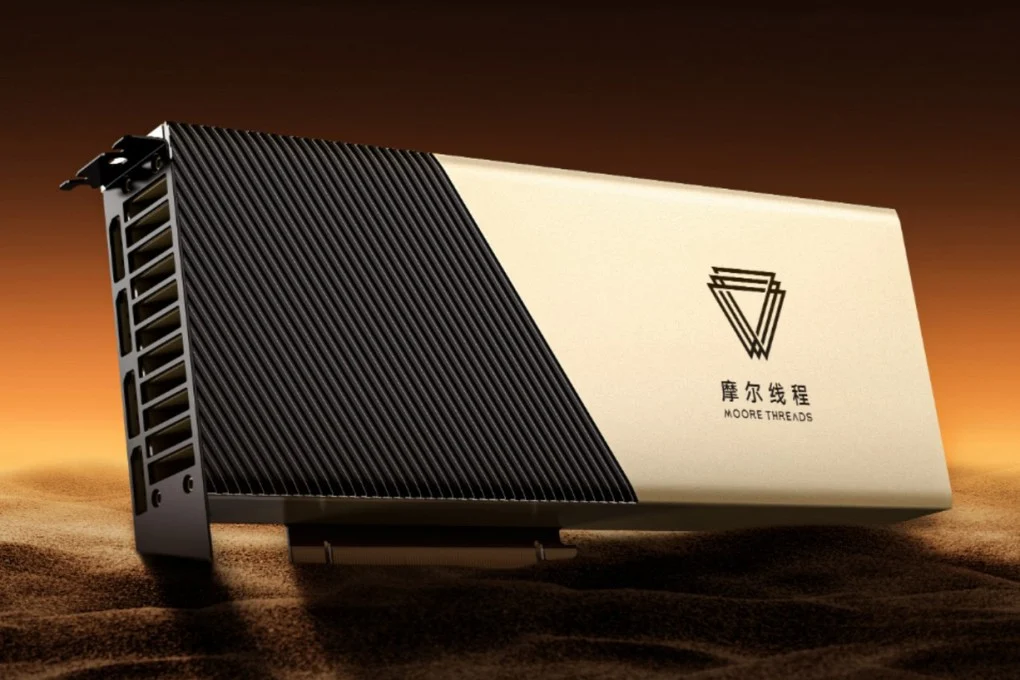
Moore Threads Technology Co., a leading Chinese artificial intelligence chipmaker, experienced a spectacular trading debut on the Shanghai Stock Exchange’s STAR Market on Friday, with shares soaring as much as 502% after raising 8 billion yuan ($1.13 billion) in what has become the year’s second-largest onshore initial public offering. The extraordinary first-day performance, if sustained, would represent the biggest opening pop for any IPO exceeding $1 billion since China’s 2019 IPO reforms, according to Bloomberg data.
The Beijing-based company’s shares opened at 650 yuan, more than five times its IPO price of 114.28 yuan, before settling around 600 yuan later in the day. This dramatic debut signals intensifying investor appetite for domestic semiconductor alternatives as Beijing accelerates its push for technological self-sufficiency amid escalating tensions with Washington over access to advanced computing technology.
The listing comes at a pivotal moment for China’s semiconductor industry. Nvidia CEO Jensen Huang recently acknowledged that his company’s share of China’s advanced AI chip market has plummeted from a dominant 95 percent to nearly zero due to U.S. export controls, creating an unprecedented opportunity for domestic players like Moore Threads to capture market share.
Build the future you deserve. Get started with our top-tier Online courses: ACCA, HESI A2, ATI TEAS 7, HESI EXIT, NCLEX-RN, NCLEX-PN, and Financial Literacy. Let Serrari Ed guide your path to success. Enroll today.
Investor enthusiasm for the offering was extraordinary even by Chinese standards. The retail portion of the IPO was oversubscribed by 4,000 times, resulting in a razor-thin final allotment rate of just 0.036 percent. This frenzy underscores the strategic importance Chinese investors place on semiconductor self-reliance as the U.S.-China tech war intensifies.
“A surge of this scale can be somewhat expected from the strong demand, and this is one of those flagship IPOs that will go on in history and be remembered,” said Shao Qifeng, chief investment officer at Ying An Asset Management Co. “However, from experience, such memorable IPOs don’t always bode well for their respective sectors as could be an indication of froth, at least in some corners.”
The success of Moore Threads’ debut triggered a rotation out of related stocks on Friday. Shenzhen H&T Intelligent Control Co., which holds a minor stake in Moore Threads, fell as much as 10% as investors took profits to participate in the new listing.
Founded by Former Nvidia Executive with Deep Industry Credentials
Moore Threads was founded in October 2020 by Zhang Jianzhong, who previously spent 14 years working for Nvidia as the company’s global vice president and general manager of its China operations. Zhang, a computer science graduate from Nanjing University of Science and Technology, joined Nvidia in 2005 and was credited with helping the American chip giant expand significantly in the Chinese market over the years.
Before his tenure at Nvidia, Zhang worked for prominent U.S. technology companies including Hewlett-Packard and Dell, accumulating nearly two decades of experience in the GPU industry. His pedigree gave Moore Threads immediate credibility in China’s competitive semiconductor landscape, attracting marquee investors including GGV Capital, Sequoia China, ByteDance, and Tencent Holdings.
The company’s name pays homage to Moore’s Law, reflecting Zhang’s stated mission to double the number of concurrent threads every two years. Since its founding, Moore Threads has received $800 million in funding from over two dozen active investors, including Big Tech firms and state-backed investment vehicles like Beijing Zhongguancun Science City Innovation Development.
Rapid Growth Amid Mounting Losses and Strategic Pivot
During the first three quarters of 2025, Moore Threads’ net loss reached 724 million yuan, according to a Sinolink Securities note, though this represented a 19% improvement from the year-ago period. Meanwhile, revenue surged by 182% to 780 million yuan, demonstrating the company’s ability to rapidly scale its operations despite ongoing profitability challenges.
The company initially earned revenue from graphics chips designed for gaming and visual rendering before pivoting to AI accelerators used in powering large language models. This strategic shift proved prescient as demand for AI computing infrastructure exploded across China following the global generative AI boom triggered by OpenAI’s ChatGPT.
Moore Threads’ valuations remain lofty by conventional metrics. The company’s price-to-sales ratio stands at 123 times based on the offer price of 114.28 yuan per share, exceeding the average of 111 times for its peers, according to a December 4 filing. Recognizing investor concerns, the company recently asked its lead sponsor to remind potential investors of risks related to its elevated valuations.
Despite these financial realities, industry analysts believe Moore Threads may turn profitable by around 2027, if demand for AI chips continues to grow and its technology matures. The company expects 2025 sales to jump as much as 242% to 1.5 billion yuan as it joins several other Chinese startups seeking to fill the void left by Nvidia’s forced exit from the advanced chip market.
US Sanctions and Strategic Resilience
A major setback came in October 2023 when the U.S. Commerce Department added Moore Threads to its Entity List, barring the company’s access to key technologies including advanced foundry services and U.S. electronic design automation software. The designation, which grouped Moore Threads with rival Biren Technology among 13 Chinese entities, was justified by Washington as necessary to prevent China’s military from obtaining advanced computing capabilities.
The sanctions had immediate consequences. Within weeks of being blacklisted, Zhang announced layoffs affecting a single-digit percentage of the company’s roughly 1,000 employees and initiated an internal restructuring to sharpen focus on GPU development. In an internal letter to staff, Zhang directly blamed U.S. sanctions for the personnel cuts but rallied employees with a defiant message.
“At this juncture of challenges and opportunities, what I want to say is that there is no ‘darkest moment’ for Chinese GPUs, only vast possibilities,” Zhang wrote, emphasizing the company’s determination to build China’s highest-quality full-function GPU despite external headwinds.
Despite the setback, investor optimism has only intensified as Beijing promoted the semiconductor sector as a key component of its push toward technological supremacy. Chinese regulators fast-tracked Moore Threads’ listing registration in a record 88 days, signaling strong governmental backing for strategic technologies vital to national security and AI ambitions.
Market Dynamics and Competitive Landscape
Moore Threads enters the public markets at a time when China’s domestic chip industry is experiencing unprecedented momentum. The Star 50 Index, which tracks the biggest companies on the STAR Board, has jumped more than 30% this year. Shares of rival chip designer Cambricon Technologies have surged 383% in 2024, making it China’s top-performing stock and briefly giving it a market capitalization approaching that of Intel.
The broader market sentiment has been transformed by U.S. export controls that have effectively barred Nvidia’s most advanced AI chips from the Chinese market. According to Bernstein Research, Nvidia still commanded 66 percent of China’s overall accelerator market in 2024, with Advanced Micro Devices at 5 percent, Huawei’s HiSilicon unit at 23 percent, and emerging player MetaX with about 1 percent. However, Bernstein forecasts that Nvidia’s market share will decline to 54% in 2025 as localization accelerates.
“U.S. export controls have created a unique opportunity for domestic AI processor vendors, as they are not competing with the most advanced global alternatives,” the Bernstein report noted, predicting that the localization ratio of China’s AI chip market will surge from 17% in 2023 to 55% by 2027.
Chinese tech giants including Huawei, Alibaba, and Baidu have stepped up investments in AI chip development as China has increasingly restricted Nvidia’s chip sales in the country. This creates a favorable ecosystem for Moore Threads and its peers to gain traction among domestic customers seeking reliable, locally-produced alternatives.
One decision can change your entire career. Take that step with our Online courses in ACCA, HESI A2, ATI TEAS 7, HESI EXIT, NCLEX-RN, NCLEX-PN, and Financial Literacy. Join Serrari Ed and start building your brighter future today.
Technical Capabilities and Strategic Positioning
Moore Threads has developed its own GPU architecture called MUSA (Moore Threads Unified System Architecture), a unified platform designed to compete with Nvidia’s dominant CUDA ecosystem. The company offers a complete software stack to serve developers and end users, with the MUSA architecture designed to be compatible with CUDA through an automatic code conversion tool called MUSIFY, enabling users to migrate existing CUDA code to the MUSA platform.
The firm’s latest products include the MTT S4000 GPU for enterprise applications and AI workloads. Moore Threads has also made inroads in the gaming market with its MTT S80, which became notable as the only Chinese-made GPU capable of supporting DirectX 12 and running the highly anticipated Chinese game title Black Myth: Wukong, though performance benchmarks suggest it remains several generations behind Nvidia’s flagship offerings.
One significant bottleneck that may constrain Moore Threads’ growth is manufacturing capacity. Chinese chip designers face limitations because they cannot use Taiwan Semiconductor Manufacturing Co. (TSMC) as a contract manufacturer due to U.S. restrictions, leaving them dependent on local foundries like Semiconductor Manufacturing International Corp. (SMIC), which has limited capacity for advanced nodes below seven nanometers compared to international competitors.
IPO Proceeds and Future Plans
Proceeds from the IPO will fund next-generation projects in AI and graphics chips as well as supplement working capital. The offering ranks behind only Huadian New Energy Group Co.’s $2.7 billion IPO in July as the largest onshore listing in China this year.
A successful listing by Moore Threads could pave the way for other Chinese semiconductor startups. MetaX Integrated Circuits Shanghai Co., a closely watched peer, opened subscriptions on the same day as Moore Threads’ debut, targeting 3.9 billion yuan in its own STAR Market listing. Meanwhile, memory chipmakers Yangtze Memory Technologies Co. and ChangXin Memory Technologies Inc. are weighing onshore IPOs that could value each company at up to 300 billion yuan.
The Shanghai Stock Exchange has accepted a slew of IPO applications this year from chipmakers including SJ Semiconductor and Xiamen UX IC, turning local capital markets into a funding engine for strategic technologies. Additionally, Kunlunxin, the AI chip unit of Chinese internet search giant Baidu, is planning an IPO in Hong Kong, according to Reuters, citing sources familiar with the matter.
Investor Caution Amid Valuation Concerns
Not all market participants share the enthusiasm driving Moore Threads’ spectacular debut. William Xin, chairman of Spring Mountain Pu Jiang Investment Management Co., who did not apply for shares in the IPO, expressed skepticism about the sustainability of such valuations.
“The price is beyond my understanding,” Xin said. “While domestic demand for AI chips will be huge, Moore Threads has yet to make a profit, and faces an uncertain future and tough competition in an expensive arms race. A stock cannot defy gravity and fly into the stratosphere.”
The concerns are rooted in broader market dynamics. China’s SSE STAR Chip Index currently trades at 118 times earnings, compared with a multiple of just 12 for the Shanghai Composite Index, highlighting the premium investors are paying for semiconductor growth in China’s race for tech self-sufficiency.
Chen Zunde, a fund manager at Guangdong Fund Investment Co., noted that recent listings have performed well partly because overall market sentiment has been muted. “So it makes sense for a sizable jump at its debut,” Chen said. However, he added that some worry the IPO could siphon funds from peers, adding pressure to the broader market.
Strategic Importance in US-China Tech Competition
Moore Threads’ successful IPO underscores the deepening bifurcation of the global semiconductor supply chain. Washington’s escalating export controls, which began in October 2022 and have been progressively tightened, aim to limit China’s progress in artificial intelligence and military capabilities by restricting access to advanced chips and the equipment needed to manufacture them.
These restrictions have had cascading effects throughout the industry. Nvidia has been forced to develop progressively downgraded chip variants for the Chinese market, starting with the A800 and H800, then the H20, each designed to comply with evolving U.S. performance thresholds. Even these compliant chips have faced obstacles, with Chinese regulators reportedly discouraging domestic tech companies from purchasing them in favor of local alternatives.
The result is a market environment where Chinese semiconductor firms, despite facing technological gaps compared to their American counterparts, benefit from policy support, guaranteed domestic demand, and reduced competition from global leaders. This dynamic has created a window of opportunity for companies like Moore Threads to establish themselves as viable alternatives, even if their products don’t yet match the performance of Nvidia’s cutting-edge offerings.
Outlook and Industry Implications
Moore Threads’ historic debut carries significant implications for China’s semiconductor ambitions and the global AI chip landscape. The company’s ability to attract such extraordinary investor interest despite mounting losses and technological gaps with industry leaders reflects confidence in China’s long-term commitment to semiconductor self-sufficiency.
Sinolink Securities analyst Fan Zhiyuan initiated coverage with a “buy” rating and set a target price of 182.25 yuan for the stock, nearly 60% higher than the IPO price, arguing that “the era of AI is driving rapid expansion in GPU demand” and that Moore Threads could become a “key force” in accelerating China’s efforts to replace foreign chips with local technology.
However, significant challenges remain. Moore Threads must continue investing heavily in research and development to close the performance gap with Nvidia while navigating manufacturing constraints imposed by limited access to advanced foundry services. The company must also prove it can achieve profitability in a capital-intensive industry where even established players face margin pressures.
As the U.S.-China tech competition intensifies, Moore Threads finds itself at the center of a strategic inflection point. Its success or failure will serve as a bellwether for China’s broader semiconductor ambitions and could influence policy decisions in both Beijing and Washington regarding the future of technology export controls and industrial policy.
For now, the company’s spectacular market debut has captured the attention of global investors and policymakers alike, marking a symbolic milestone in China’s determined push to reduce its dependence on foreign semiconductor technology and establish itself as a major player in the critical AI chip industry that will likely shape technological competition for decades to come.
Ready to take your career to the next level? Join our Online courses: ACCA, HESI A2, ATI TEAS 7 , HESI EXIT , NCLEX – RN and NCLEX – PN, Financial Literacy!🌟 Dive into a world of opportunities and empower yourself for success. Explore more at Serrari Ed and start your exciting journey today! ✨
Track GDP, Inflation and Central Bank rates for top African markets with Serrari’s comparator tool.
See today’s Treasury bonds and Money market funds movement across financial service providers in Kenya, using Serrari’s comparator tools.
photo source: Google
By: Montel Kamau
Serrari Financial Analyst
5th December, 2025