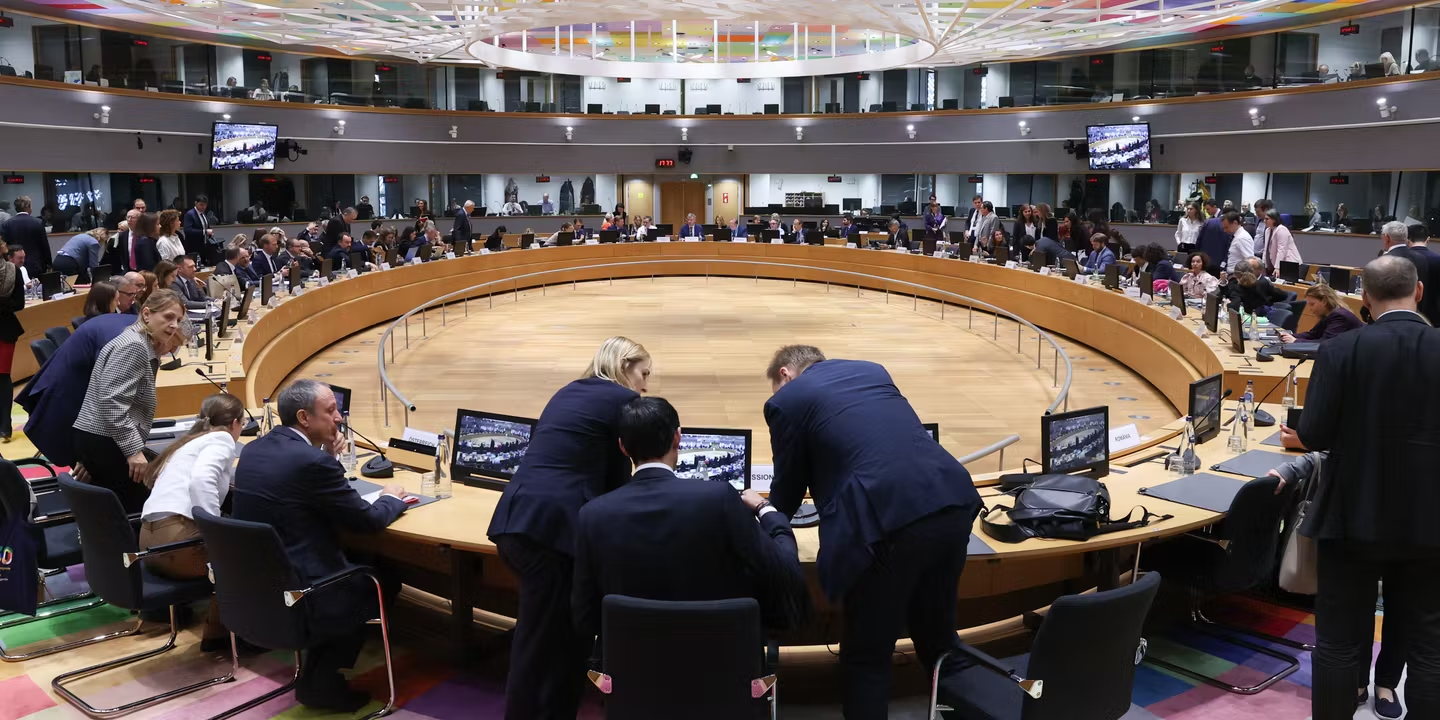
The European Union’s Reflection Group on Mobilising Climate Resilience Financing has presented a comprehensive roadmap to Commissioner Wopke Hoekstra, emphasizing the urgent need for collective action to strengthen the bloc’s resilience against mounting climate-related risks. The report comes at a critical juncture as weather- and climate-related extremes caused estimated losses of €208 billion between 2021 and 2024 across European Union member states, with annual costs rising sharply and showing no signs of abatement.
Commissioner Hoekstra, who leads the European Commission’s Climate, Net Zero and Clean Growth portfolio, welcomed the report’s recommendations, stressing that investing in climate resilience extends far beyond damage prevention. The commissioner emphasized that such investments serve as prerequisites for economic stability, business continuity, and sustainable long-term growth across the European Union’s diverse economic landscape.
Build the future you deserve. Get started with our top-tier Online courses: ACCA, HESI A2, ATI TEAS 7, HESI EXIT, NCLEX-RN, NCLEX-PN, and Financial Literacy. Let Serrari Ed guide your path to success. Enroll today.
The Growing Economic Toll of Climate Change
The financial burden of climate-related disasters continues to escalate across Europe at an alarming rate. Between 1980 and 2024, weather and climate-related extremes accumulated economic losses totaling €822 billion in European Union member states, with over a quarter of these losses occurring in just the past four years. This concentration of damages underscores the accelerating impact of climate change on European societies and economies.
Statistical analyses reveal a troubling trend: economic losses from climate extremes are increasing over time, with the last four years all ranking among the top five years of highest annual economic losses since 1980. The data demonstrates that annual costs have risen dramatically, with average annual losses jumping from €8.6 billion in the 1980s to €44.9 billion during the 2020-2024 period.
The composition of these losses reveals distinct patterns across hazard types. Hydrological hazards such as floods account for 47% of total losses, while meteorological hazards including storms, lightning, and hail represent 27% of the total. Climatological hazards, particularly heat waves, caused almost 18% of total losses, with the remaining 8% attributed to droughts, wildfires, cold spells, and frost.
The Context Behind the Reflection Group
Launched under the European Commission’s 2024 Communication on Managing Climate Risks, the Reflection Group brought together key industrial players and representatives from both public and private financial institutions. The initiative emerged from growing recognition that the European Union and its economy remain insufficiently protected against climate hazards, despite increasing awareness and policy interventions over the past decade.
The Group’s mandate focused on addressing the fundamental financing challenges that hamper effective climate resilience investments. In a context where extreme weather events are becoming more frequent and severe, the Group sought to identify practical pathways for mobilizing both public and private sector resources to build adequate protective infrastructure and systems.
Central Findings and Recommendations
A cornerstone message emerging from the report emphasizes that delaying action will only amplify the economic and societal burden of climate-related impacts. The Group’s analysis concluded that procrastination carries significant costs, affecting not only governments but also businesses and individual citizens across all European Union member states.
The report calls for collective action across all economic sectors, requiring the engagement of public authorities, private actors, and communities. This multi-stakeholder approach recognizes that climate resilience cannot be achieved through governmental action alone but demands coordinated efforts spanning the entire spectrum of society.
For the public sector, the report urges authorities to establish comprehensive resilience frameworks and provide forward-looking climate-risk information. A particular emphasis is placed on empowering local authorities through project aggregation and ensuring their access to blended finance mechanisms. These recommendations acknowledge that local governments often lack the technical capacity and financial resources to independently develop and implement large-scale resilience projects.
Private sector actors receive encouragement to invest substantially in resilient infrastructure and services. The Group agreed that scaling up climate resilience investment is not merely necessary but represents both a market creation opportunity and an innovation catalyst. Given the magnitude of investment needs, mobilizing private sector finance for climate resilience emerges as both an economic necessity and a strategic opportunity for European businesses.
The Climate Protection Gap Challenge
The report devotes significant attention to what experts term the “climate protection gap” – the substantial difference between economic losses from climate-related disasters and the portion of those losses covered by insurance. According to data from the European Insurance and Occupational Pensions Authority, only about 25% of climate-related losses in the European Union are currently insured, with coverage dropping below 5% in some member states.
This protection gap creates severe economic vulnerabilities. When disasters strike, uninsured losses typically fall on individual citizens and governments, straining public finances and household budgets. The growing effects of climate change mean that coverage is likely to shrink further as rising premiums reduce demand and insurers withdraw from particularly exposed areas.
Recent collaborative work between the European Central Bank and EIOPA has proposed a two-pillar approach to address this gap. The first pillar involves an EU public-private reinsurance scheme to increase insurance coverage for natural catastrophe risks by pooling private risks across the European Union. The second pillar proposes an EU fund for public disaster financing to reinforce disaster risk management in member states.
Key Initiatives and Tools Proposed
The Reflection Group’s report proposes several concrete initiatives designed to translate policy recommendations into actionable programs. Among the most significant is a Climate Resilience Project Pipeline intended to help local authorities access financing for adaptation projects. This pipeline would aggregate smaller projects into larger, more bankable investment opportunities that can attract institutional investors.
The report also suggests establishing an EU-wide digital platform for blended finance. Such a platform would connect public sector resources with private capital, creating structured opportunities for co-investment in climate resilience projects. Blended finance approaches have proven effective in other contexts by using public funds to reduce investment risks and improve returns for private sector participants.
Another proposed initiative involves creating an EU observatory on insurability to enhance risk awareness across member states. This observatory would collect and disseminate data on climate risks, insurance penetration rates, and protection gaps, enabling better-informed decision-making by policymakers, businesses, and citizens.
The report stresses the critical importance of reliable climate data and accessible risk information. Without accurate, granular data on climate hazards and vulnerabilities, neither public authorities nor private actors can make sound investment decisions. The Group recommends developing standardized resilience metrics that would allow consistent measurement and comparison of resilience levels across regions and sectors.
One decision can change your entire career. Take that step with our Online courses in ACCA, HESI A2, ATI TEAS 7, HESI EXIT, NCLEX-RN, NCLEX-PN, and Financial Literacy. Join Serrari Ed and start building your brighter future today.
Insurance Coverage and Residual Risk Management
Addressing insurance coverage for residual risks emerged as a priority concern. Even after implementing adaptation measures, some level of climate risk inevitably remains. Ensuring adequate insurance protection for these residual risks is essential for comprehensive resilience strategies.
The Climate Resilience Dialogue report, published in July 2024, identified the need to actively explore potential for new public-private collaboration schemes at both EU and national levels. These partnerships can promote risk prevention and adaptation while reducing the cost of risk transfer and incentivizing both the supply and demand for insurance coverage.
Current data shows significant variation in insurance penetration across European Union member states. Countries like France and Denmark maintain residential flood insurance penetration rates between 75-100%, while Greece’s coverage falls between 0-25%. This disparity creates uneven resilience across the European Union, with some populations far more vulnerable to climate shocks than others.
Integration with the European Integrated Framework
The Reflection Group’s work is designed to feed directly into the European Integrated Framework for Climate Resilience, scheduled for adoption in late 2026. This comprehensive framework aims to establish a more ambitious, coherent EU approach to climate resilience and preparedness, covering both individual member states and the European Union as a collective entity.
Commissioner Hoekstra has taken the lead in developing this framework, which represents one of the centerpiece initiatives of the European Commission’s climate adaptation strategy. The policy package will be presented during the second half of 2026 following a thorough impact assessment process.
The integrated framework responds to requests from both the European Parliament and the Council for bolder action on growing climate impacts and risks. It also supports recommendations from the European Court of Auditors published in 2024, which highlighted significant gaps in current European Union adaptation efforts.
In tandem with other EU policies, the framework aims to safeguard Europe’s security and prosperity while boosting competitiveness and protecting public health and wellbeing. The emphasis on economic competitiveness reflects recognition that climate resilience is not merely a defensive measure but a strategic investment in Europe’s long-term economic viability.
Public Consultation and Stakeholder Engagement
Climate resilience has remained prominently in the public spotlight with the launch on December 1 of the Commission’s open public consultation on climate resilience. This consultation invites stakeholders and citizens across the European Union to participate and share their views on how best to shape EU policies and investments for a more resilient Europe.
The consultation process recognizes that effective climate resilience strategies must incorporate diverse perspectives and expertise. Local authorities bring practical experience with on-the-ground implementation challenges, while businesses understand the operational and financial considerations that influence private sector investment decisions. Citizens and civil society organizations contribute insights about community needs and social equity concerns.
Through this participatory approach, the European Commission aims to ensure that the final integrated framework reflects real-world conditions and constraints while maintaining the ambition necessary to address the scale of the climate challenge effectively.
The Investment Case for Climate Resilience
Multiple studies demonstrate that climate resilience investments deliver substantial returns. Research indicates that every euro spent on prevention and preparedness results in benefits for all, making upfront investments in reducing vulnerability to climate risk far less costly than the sizable sums required to recover from climate impacts such as droughts, floods, forest fires, or heat waves.
A World Resources Institute analysis found that, on average, one dollar invested in adaptation and resilience has the potential to generate more than ten dollars in benefits over a ten-year period. These returns stem not only from avoided damages but also from broader economic, social, and environmental benefits that emerge from well-designed resilience investments.
The European Investment Bank has positioned itself at the forefront of climate finance mobilization. In 2024, the EIB Group invested a record €51 billion – approximately 60% of its total financing – to support the green transition. Since 2021, the bank has backed around €563 billion of investment in climate and environmental sustainability, keeping it firmly on track to reach its €1 trillion target by 2030.
Addressing Barriers to Climate Resilience Investment
Despite the strong economic case for climate resilience investments, significant barriers continue to impede progress. Governance-related challenges persist as obstacles to implementing adaptation actions in many countries, even where well-developed governance frameworks exist. These challenges include difficulties in coordination due to limitations in financial, technical, and human capacities.
The European Environment Agency reports that almost all European countries face substantial barriers, gaps, and challenges in institutional, financial, technical, and human capacities. More than half of all countries report gaps in coordination, cooperation, and policy coherence, often connected to unclear responsibilities, lack of awareness, and low political saliency.
Complex coordination mechanisms lacking adequate capacities represent a barrier in many countries, even in those with mature governance frameworks already in place. The European adaptation strategy refers to the local level as the bedrock of adaptation, making upscaling of regional and local adaptation crucial for successful climate resilience.
The Path Forward
The Reflection Group’s final report arrives at a moment when European policymakers increasingly recognize that climate resilience must become an integral part of all European investment decisions. As noted in recent EU climate progress reports, climate hazards are undermining Europe’s competitiveness, security, and prosperity, requiring urgent integration of climate resilience considerations across all sectors.
Meeting the European Union’s climate and energy targets demands a major scale-up in finance, with annual energy-system investment needing to more than double to around €565 billion in 2021-2030 compared with 2011-2020 levels. The EU is mainstreaming climate action across funding programs, with approximately €662 billion earmarked for climate objectives in the current long-term budget covering 2021-2027.
The Group’s work emphasizes that climate resilience financing is not a burden but an opportunity to drive innovation, create markets, and strengthen European competitiveness in a rapidly changing global environment. By mobilizing both public and private resources effectively, the European Union can build the resilience necessary to protect its citizens, preserve its prosperity, and maintain its position as a global leader in addressing climate change.
As extreme weather events continue to intensify and economic losses mount, the urgency of implementing the Reflection Group’s recommendations becomes increasingly apparent. The report provides a roadmap for systemic cooperation across sectors to protect communities, infrastructure, and economic activities throughout the European Union. Success will require sustained commitment from all stakeholders – governments, businesses, financial institutions, and citizens – working together toward the common goal of a climate-resilient Europe.
The European Commission’s planned integrated framework for 2026 will test whether the European Union can translate these recommendations into concrete action that matches the scale of the climate resilience challenge. With €208 billion in losses already recorded between 2021 and 2024, and projections showing continued increases in climate impacts, the window for effective action continues to narrow. The Reflection Group’s report provides the blueprint – now comes the critical task of implementation.
Catch Up With Our Other Headlines
3rd December, 2025
America Takes Command: U.S. Charts New Economic Path as G20 President Amid Diplomatic Tensions
New MoU Between Kenya and Somalia Exchanges Targets Stronger Regional Market Link
Ready to take your career to the next level? Join our Online courses: ACCA, HESI A2, ATI TEAS 7 , HESI EXIT , NCLEX – RN and NCLEX – PN, Financial Literacy!🌟 Dive into a world of opportunities and empower yourself for success. Explore more at Serrari Ed and start your exciting journey today! ✨
Track GDP, Inflation and Central Bank rates for top African markets with Serrari’s comparator tool.
See today’s Treasury bonds and Money market funds movement across financial service providers in Kenya, using Serrari’s comparator tools.
photo source: Google
By: Montel Kamau
Serrari Financial Analyst
3rd December, 2025