Kenya Power has launched a nationwide deployment of Optical Character Recognition (OCR) technology to revolutionize how the utility reads electricity meters and generates bills for its 1.8 million postpaid customers. The automated system, which allows meter readers to scan meter displays instead of manually keying in readings, represents a major milestone in the company’s ongoing digital transformation and directly addresses longstanding customer complaints about billing inaccuracies.
The rollout follows a successful six-month pilot program conducted in Nairobi between March and September 2025. Kenya Power’s Commercial Cycle Manager, Richard Wida, announced that the system is now being deployed across all eight of the company’s operating regions, marking one of the most significant upgrades to the utility’s billing infrastructure in recent years.
“Technology is a major driver of our business, and in terms of billing, specifically meter reading, we have been looking at how to make it better and more accurate,” Wida stated in an official announcement on November 24, 2025. “With the OCR system, the meter reader will just be required to scan the meter, and the system will pick the meter readings automatically. This will save time and eliminate human error that is likely to occur if the meter reader manually types the readings.”
Build the future you deserve. Get started with our top-tier Online courses: ACCA, HESI A2, ATI TEAS 7, HESI EXIT, NCLEX-RN, NCLEX-PN, and Financial Literacy. Let Serrari Ed guide your path to success. Enroll today.
Addressing a Long History of Billing Disputes
The introduction of OCR technology comes against the backdrop of years of customer complaints about billing errors that have strained the relationship between Kenya Power and its consumers. Billing anomalies have been a persistent source of dissatisfaction, with many disputes arising from misread meters, estimated bills, and data entry mistakes during the manual reading process.
The scale of these problems became particularly evident in 2017 and 2018 when Kenya Power faced a class action lawsuit filed by lawyer Apollo Mboya on behalf of consumers over inflated and backdated bills. The lawsuit revealed systemic issues with the company’s billing system, particularly after the utility migrated to a new Integrated Customer Management System in November 2017.
At the time, Kenya Power’s then-Managing Director Ken Tarus admitted that there had been errors in the conversion to the new system, stating that “some bills, which have been sent out reflect an amount due in excess of what should have been charged.” The controversy eventually led to a court settlement in December 2020 that gave customers one month to file complaints about billing errors incurred since the beginning of that year.
More recently, disputes continue to plague the utility. In October 2025, the Energy and Petroleum Regulatory Authority (EPRA) ordered Kenya Power to reconnect electricity supply to a Meru farmer who had been disconnected over a disputed bill of Sh212,054, which the company later revised down to Sh64,033. Such cases underscore the ongoing challenges with billing accuracy that OCR technology aims to resolve.
How the OCR System Works
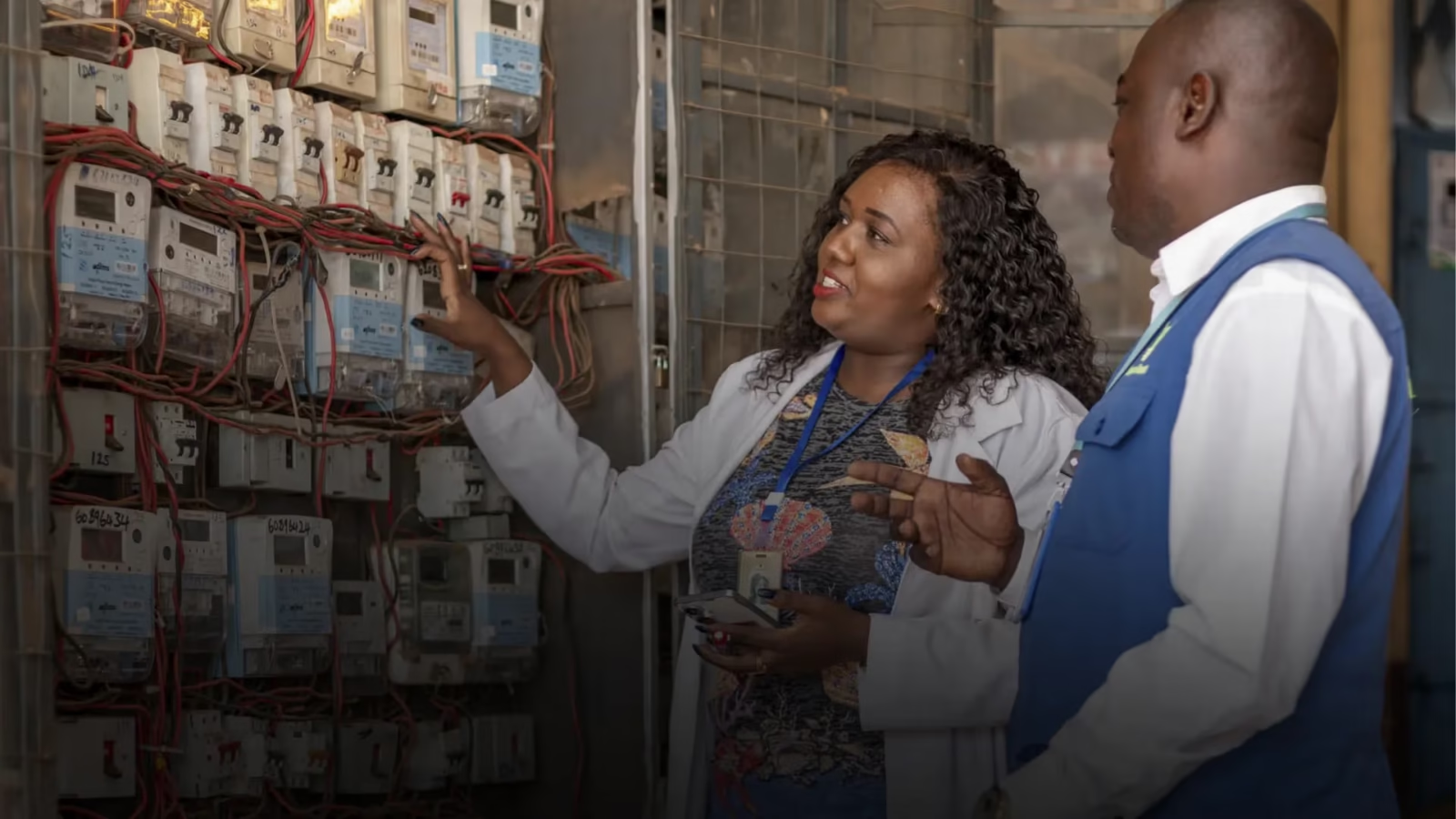
The OCR technology represents a fundamental shift from the traditional meter-reading process that has been prone to human error. Instead of meter readers manually typing meter numbers and consumption readings into handheld devices—a process that could result in transposed digits, missed readings, or incorrect entries—the new system uses advanced image recognition technology to automatically capture and process meter data.
When a meter reader arrives at a customer’s premises, they simply use a smart device equipped with OCR capabilities to scan the meter’s display. The system instantly recognizes the numbers shown on the meter, records the reading, and transmits it to Kenya Power’s central billing system. This automation eliminates the manual data entry step that has been the primary source of reading errors.
The technology works by analyzing the visual image of the meter display, identifying individual digits through pattern recognition algorithms, and converting them into digital data. This process happens in real-time, allowing meter readers to verify the captured reading immediately and ensure accuracy before moving to the next customer.
According to Kenya Power’s announcement, the OCR system will significantly reduce the time required to read each meter while simultaneously improving accuracy. The technology is designed to work with the existing postpaid meters currently installed across the country, requiring no hardware changes at customer premises—only upgrades to the equipment used by meter readers.
Scope and Scale of the Deployment
The nationwide rollout targets all 1.8 million postpaid meters that still require monthly manual readings for billing purposes. These meters form a substantial portion of Kenya Power’s customer base, distinct from the prepaid token-based system that many residential customers use and the smart meters being deployed for large commercial and industrial users.
The deployment across all eight of Kenya Power’s operating regions represents a massive logistical undertaking. The company must train hundreds of meter readers on the new technology, ensure they have access to the necessary scanning devices, and integrate the OCR data capture with existing backend billing systems.
The Nairobi pilot program that preceded the nationwide rollout provided valuable insights into the practical challenges of implementing OCR at scale. During the six-month trial period, Kenya Power tested the technology under various conditions, refined its processes, and addressed technical issues before committing to full deployment.
Wida emphasized that the OCR technology is a major milestone in Kenya Power’s digital transformation journey, through which the company aims to strengthen service delivery and enhance customer experience. “It will complement other technologies that the Company has deployed to improve service delivery and strengthen operations,” he added.
Integration with Digital Self-Service Platforms
The OCR rollout is part of a broader digital transformation strategy that Kenya Power has been pursuing to modernize its operations and improve customer service. The utility has already established multiple digital touchpoints that allow customers to interact with the company remotely, reducing the need for physical visits to Kenya Power offices.
The MyPower mobile application and the USSD code *977# have become central to this digital strategy. Through these platforms, customers can check their electricity bills, purchase prepaid tokens, report power outages, and—crucially for postpaid customers—submit their own meter readings monthly for accurate billing.
According to data released by Kenya Power in August 2025, the number of customers using these self-service platforms surged to 2.1 million, up from 1.7 million the previous year. The increased usage of digital platforms resulted in a 75% reduction in foot traffic to company banking halls, demonstrating the effectiveness of the digital-first approach.
The utility has announced plans to eventually integrate OCR capabilities directly into these self-service platforms. This would allow customers using the MyPower app or USSD code to scan their own meters using their smartphone cameras, automatically capturing the reading without manually typing numbers. Such integration would provide an additional layer of accuracy for customers who prefer to submit their own readings rather than wait for meter readers to visit their premises.
“In future, we want to enable the use of OCR in self-reading so that our customers can enjoy the convenience of reading their meters with minimal chance of error,” Wida explained, outlining the company’s vision for empowering customers with the same accurate technology used by professional meter readers.
One decision can change your entire career. Take that step with our Online courses in ACCA, HESI A2, ATI TEAS 7, HESI EXIT, NCLEX-RN, NCLEX-PN, and Financial Literacy. Join Serrari Ed and start building your brighter future today.
Complementing Smart Meter Deployment
While OCR addresses the needs of existing postpaid meters, Kenya Power has simultaneously been expanding its deployment of smart meters that represent an even more advanced approach to meter reading and customer service. Smart meters, part of Advanced Metering Infrastructure (AMI), enable two-way communication between the utility and customers, allowing for remote reading, remote disconnection and reconnection, and real-time monitoring of electricity consumption.
As of August 2025, Kenya Power reported having installed smart meters for more than 8,000 commercial and industrial customers and 100,000 Small and Medium Enterprise (SME) customers. The smart meter program, which began in 2021 with a $11.2 million World Bank-funded project targeting 55,000 SME customers, has demonstrated significant benefits for both the utility and consumers.
Smart meters provide real-time monitoring and remote reading capabilities that completely eliminate the need for physical meter reading visits. In case of power outages, the smart meters can communicate directly with Kenya Power’s National Contact Centre, facilitating immediate problem detection and resolution. Customers also receive SMS notifications about their power supply status, creating a more responsive and transparent service experience.
The financial impact of smart meter deployment has been substantial. In February 2024, Kenya Power reported that 67,000 installed smart meters had helped grow annual sales by Sh347 million, with an annual sales increase of 17.47 gigawatts per hour equivalent to Sh397 million. The smart meters reduce commercial losses by providing accurate, real-time data on electricity consumption and helping identify anomalies instantly.
However, the high cost of smart meters means that their deployment has been prioritized for large consumers and commercial customers who represent the majority of Kenya Power’s revenue. For the millions of smaller domestic customers with postpaid meters, OCR technology provides a cost-effective middle ground—significantly improving accuracy without requiring the infrastructure investment needed for full smart meter deployment.
Kenya Power Managing Director Joseph Siror has indicated that the company plans to scale up smart meter deployment to strengthen metering and billing operations further. By December 2024, the company aimed to have all large electricity users connected to smart meters, with plans to connect customers consuming more than 200 units within three years. This phased approach ensures that both OCR for existing meters and smart meters for high-value customers work together as part of a comprehensive metering strategy.
Customer Complaints Handling and Regulatory Oversight
Kenya Power operates under a structured Customer Complaint Policy designed to ensure that customers can report issues and receive timely feedback and resolution. The company defines a complaint as any expression of dissatisfaction about its services, billing, connections, outages, accidents, or employee conduct. Every formal complaint must be documented, issued a reference number, and tracked until it is resolved or formally closed.
Customers can lodge complaints through multiple channels, including Kenya Power’s 24/7 Contact Centre at 97771, the MyPower app, the USSD code *977#, email, social media platforms, or by visiting Kenya Power offices. Once submitted, complaints are recorded in the company’s Internal Complaint Management System (InCMS), which routes issues to the appropriate departments for investigation and resolution.
For billing-related complaints, Kenya Power acknowledges written complaints within two working days and provides feedback within three working days after logging the complaint. If customers remain dissatisfied with the outcome, they can escalate their concerns through multiple internal levels—from County Business Managers to Regional Managers, General Managers, and ultimately the Managing Director and CEO.
Beyond Kenya Power’s internal mechanisms, the Energy and Petroleum Regulatory Authority (EPRA) plays a critical oversight role. Pursuant to Section 160 of The Energy Act 2019, EPRA has the mandate to approve licensees’ complaint handling and dispute resolution procedures. The regulator is empowered to investigate consumer complaints, facilitate dispute resolution processes, and take appropriate actions against service providers who violate consumer rights.
When disputes cannot be resolved through Kenya Power’s internal processes or EPRA’s intervention, customers can appeal to the Energy and Petroleum Tribunal. This multi-tiered system ensures that consumers have recourse when facing billing disputes or service delivery issues.
The introduction of OCR technology is expected to significantly reduce the volume of billing-related complaints that flow through these channels. By eliminating the human error inherent in manual data entry, the system should reduce disputes over incorrect readings, estimated bills, and unexplained consumption spikes that have historically been among the most common complaints received by Kenya Power.
Broader Context of Kenya’s Energy Sector Digitalization
Kenya Power’s adoption of OCR technology reflects broader trends in the digitalization of Kenya’s energy sector and the country’s overall push toward digital governance and service delivery. The utility industry globally has been undergoing significant technological transformation, with utilities in developed economies having already deployed smart metering and automated reading systems on a large scale.
However, utilities in Africa have faced challenges in adopting these technologies due to funding constraints, infrastructure limitations, and the need to balance modernization with affordability for customers. Kenya Power’s phased approach—combining OCR for existing meters, smart meters for high-value customers, and digital self-service platforms—demonstrates how African utilities can pragmatically adopt technology while managing resource constraints.
The company’s digital transformation has been driven partly by the need to improve operational efficiency and reduce commercial losses. Electricity theft, non-payment, and errors in accounting and record-keeping contribute to significant revenue losses for the utility. Accurate automated metering helps address these challenges by providing reliable data on actual consumption and reducing opportunities for manipulation or fraud.
Kenya Power’s efforts also align with broader government initiatives to expand electricity access and improve service delivery. The company serves more than 8 million customers as of 2025, up from 7.9 million at the end of 2020, reflecting ongoing grid expansion and last-mile connectivity programs that aim to ensure every Kenyan household has access to electricity.
Expected Benefits and Impact
The OCR system deployment is expected to deliver multiple benefits across different dimensions of Kenya Power’s operations and customer experience. The most immediate and visible benefit will be improved billing accuracy, directly addressing the source of countless customer complaints and disputes that have plagued the utility for years.
By eliminating manual data entry errors, OCR should dramatically reduce instances of incorrect bills, which have led to customer frustration, payment delays, and costly dispute resolution processes. Customers who previously received bills that seemed inconsistent with their actual consumption patterns should see more predictable and accurate billing that reflects their true electricity usage.
For Kenya Power’s operations, the technology promises significant efficiency gains. Meter readers will be able to complete their routes more quickly since scanning a meter takes less time than manually recording and typing readings. The reduced time per meter reading means that meter readers can cover more customers in the same working day, potentially allowing Kenya Power to optimize its workforce deployment or redirect resources to other critical areas.
The automated data capture also improves data quality throughout Kenya Power’s billing system. With fewer errors entering the system at the point of data collection, downstream processes—from bill generation to payment reconciliation to customer service—all benefit from having reliable, accurate information. This cascading effect of improved data quality can enhance decision-making across the organization.
From a customer service perspective, OCR should reduce the volume of billing disputes and complaints that Kenya Power’s customer service teams must handle. This allows the company to focus its customer service resources on other important areas such as outage response, new connections, and service quality improvements rather than spending time investigating and correcting billing errors.
The technology also supports Kenya Power’s transparency and accountability objectives. With automated readings that are captured digitally and timestamped, there is a clear audit trail showing exactly when each meter was read and what reading was captured. This transparency can help rebuild customer trust in Kenya Power’s billing processes, which has been eroded by years of billing disputes.
Looking ahead, the integration of OCR into self-service platforms will empower customers with greater control over their billing process. By allowing customers to scan their own meters through mobile apps, Kenya Power can provide even more frequent reading opportunities—customers won’t need to wait for the monthly meter reader visit but can submit updated readings at any time, ensuring their bills reflect their most current consumption.
Challenges and Considerations
While OCR technology offers significant benefits, its successful implementation will depend on several factors. Meter readers must be properly trained not just in how to use the scanning devices but also in troubleshooting common issues—such as meters with damaged or unclear displays, meters in difficult-to-access locations, or technical problems with the scanning equipment.
The technology’s effectiveness also depends on the quality of the scanning devices and the robustness of the OCR software. The system must be able to accurately read meter displays under various lighting conditions, from different angles, and with meters of different ages and conditions. Kenya Power’s six-month pilot program in Nairobi likely helped identify and address these technical challenges before the nationwide rollout.
Connectivity and data transmission represent another consideration. The OCR devices used by meter readers must be able to reliably transmit captured readings to Kenya Power’s central billing system. In areas with poor mobile network coverage, ensuring real-time or near-real-time data synchronization may require careful planning and backup processes to prevent data loss.
Customer education will also be important, particularly when OCR is eventually integrated into self-service platforms. Customers will need clear guidance on how to properly scan their meters using the MyPower app to ensure accurate readings. Kenya Power will need to provide user-friendly instructions and support channels to help customers adopt this capability successfully.
The cost of the OCR implementation—while likely lower than full smart meter deployment—still represents a significant investment for Kenya Power. The company must procure scanning devices for all its meter readers, invest in the backend systems that process and integrate OCR data, and fund the training and change management required for successful adoption.
Conclusion and Future Outlook
Kenya Power’s rollout of OCR technology for its 1.8 million postpaid meters represents a pragmatic and significant step forward in the utility’s digital transformation journey. By addressing the persistent problem of billing errors through automated data capture, the company is taking concrete action to improve one of the most common sources of customer dissatisfaction.
The OCR deployment complements Kenya Power’s broader strategy of combining multiple technological solutions—from smart meters for large users to digital self-service platforms for all customers—to modernize its operations and enhance service delivery. This multi-pronged approach recognizes that different customer segments have different needs and that cost-effective solutions must be deployed strategically.
As the rollout progresses across all eight operating regions, Kenya Power will need to carefully monitor the system’s performance, gather feedback from both meter readers and customers, and make continuous improvements. The success of the OCR implementation will ultimately be measured not just by technical metrics like reading accuracy or operational efficiency, but by the impact on customer satisfaction and the reduction in billing disputes.
Looking further ahead, the company’s vision of integrating OCR into customer self-service platforms could represent an even more transformative change. By putting accurate reading technology directly in customers’ hands through their smartphones, Kenya Power would be empowering consumers to take greater control of their electricity consumption monitoring and billing—a shift that could fundamentally change the relationship between the utility and its customers.
For now, the nationwide OCR rollout stands as a concrete example of how African utilities can leverage appropriate technology to address longstanding operational challenges and improve service delivery, even with resource constraints. As Kenya Power continues its digital transformation, the OCR system will serve as a critical foundation for the more accurate, transparent, and customer-centric utility service that Kenyan electricity consumers have long demanded.
Catch up with our latest Headlines:
- African Development Bank Commits $15 Million to Adenia Fund Targeting SME Growth Across Africa
- Amazon’s $15 Billion Indiana Investment Signals Major AI Infrastructure Expansion in the Midwest
- NCBA Group Launches Offshore Investment Platform to Connect Kenyan Investors with Global Markets
- Ethiopia Emerges as Sub-Saharan Africa’s Fastest Growing Economy with 7.2% IMF Growth Projection for 2025
- US September Jobs Report Reveals Mixed Labor Market as Unemployment Reaches Four-Year High Despite Job Gains
- Kenya Secures Duty-Free Agricultural Export Access to Malaysia in Strategic Partnership Agreement
Ready to take your career to the next level? Join our Online courses: ACCA, HESI A2, ATI TEAS 7 , HESI EXIT , NCLEX – RN and NCLEX – PN, Financial Literacy!🌟 Dive into a world of opportunities and empower yourself for success. Explore more at Serrari Ed and start your exciting journey today! ✨
Track GDP, Inflation and Central Bank rates for top African markets with Serrari’s comparator tool.
See today’s Treasury bonds and Money market funds movement across financial service providers in Kenya, using Serrari’s comparator tools.
photo source: Google
By: Montel Kamau
Serrari Financial Analyst
26th November, 2025